-
Innovations for Women
Feb. 2
Fred wrote this email to Matt Morgan, our Viking Sky Cruise Director:
I have limited experience in advising on women’s health. My only previous venture was on the Covid World Cruise. We were required to get a temperature check before disembarking in a port. There was a long line and passengers were curious and a bit apprehensive. As I completed my test and walked past a long line, a woman asked, “How was it?’ I responded, “Not bad, but I wish they didn’t do it rectally.” The look on her face and others around her changed. I couldn’t tell for sure, but I think they were looks of appreciation. Building on this success, I’d like to offer 2 suggestions.
Our excursions frequently have lavatory stops, some of which are time consuming. Lines for women always seem to be longer. I don’t know if it’s because of their being chatty or a lack of athleticism. Whichever it is I’d like to help.
1) My first suggestion is to employ a method that Karla and I used with our kids. On a long car trip, we wanted to arrive at our destination and our kids, not infrequently, would say, “I have to go potty.” We learned to ask, “Gas station or side of the road?” Usually, side of the road would suffice and we avoided long stopovers. What about asking excursion drivers to periodically ask, “Side of the road?” Passengers could disembark, relieve themselves and rejoin the bus with no long lines. An additional cultural benefit is that it would allow Vikings to meet the locals as they descended on trees and bushes. It makes a good visual.
2) A second thought is a new innovation highlighted in the January 21 New York Times in the article, “The Pure Liberation of a Personal Urination Device.” https://www.nytimes.com/2024/12/17/magazine/personal-urination-device.html It facilitates woman peeing while standing up…..an uncommon skill without technical assistance. The article provides more detail and color commentary. Viking could distribute these funnel-like items in the welcome bag. Men may claim differential treatment since they have already mastered the skill. But, they would benefit from the time savings.
I’m looking for no credit for these changes; I’m OK with “Morgan Innovations.” And the stops could be called Mattinees. Most of this demographic remember fondly the old Saturday movie matinees.
I haven’t talked to Karla about helping with a pre-port demo. But she always likes to be helpful. Alternatively, if Heather (our former cruise director and now the boss to many cruise directors) is joining the ship sometime, I bet Karla would yield to her. If you implement these suggestions, I assure you that you will be remembered…perhaps even famous.
-
Wellington
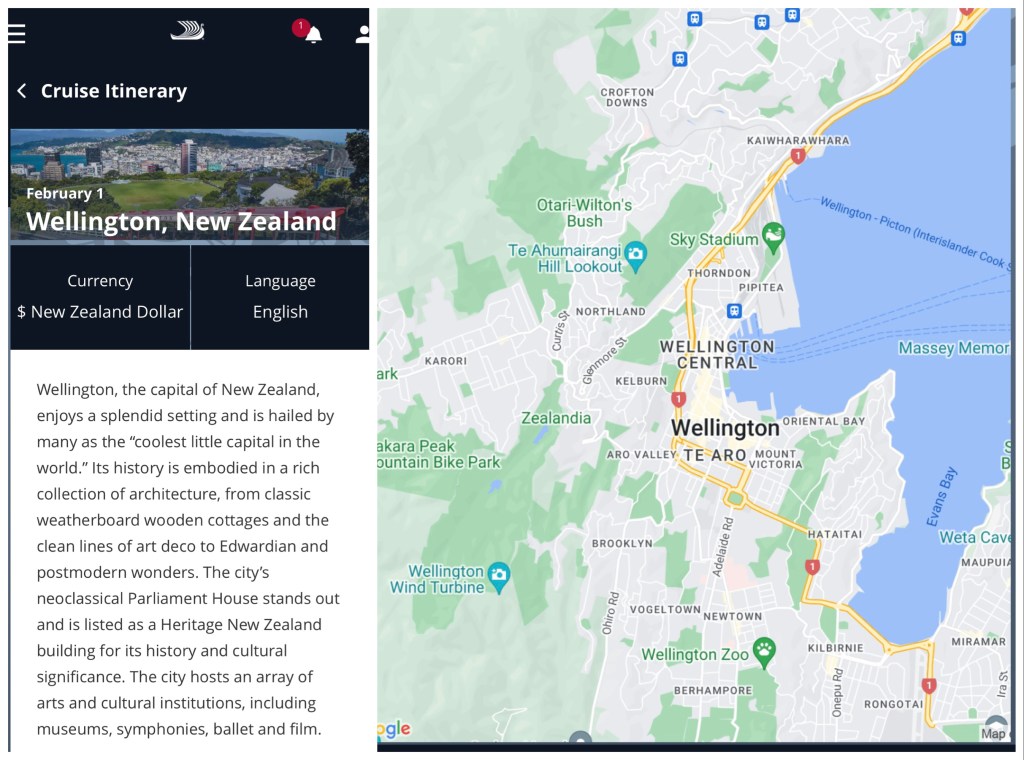
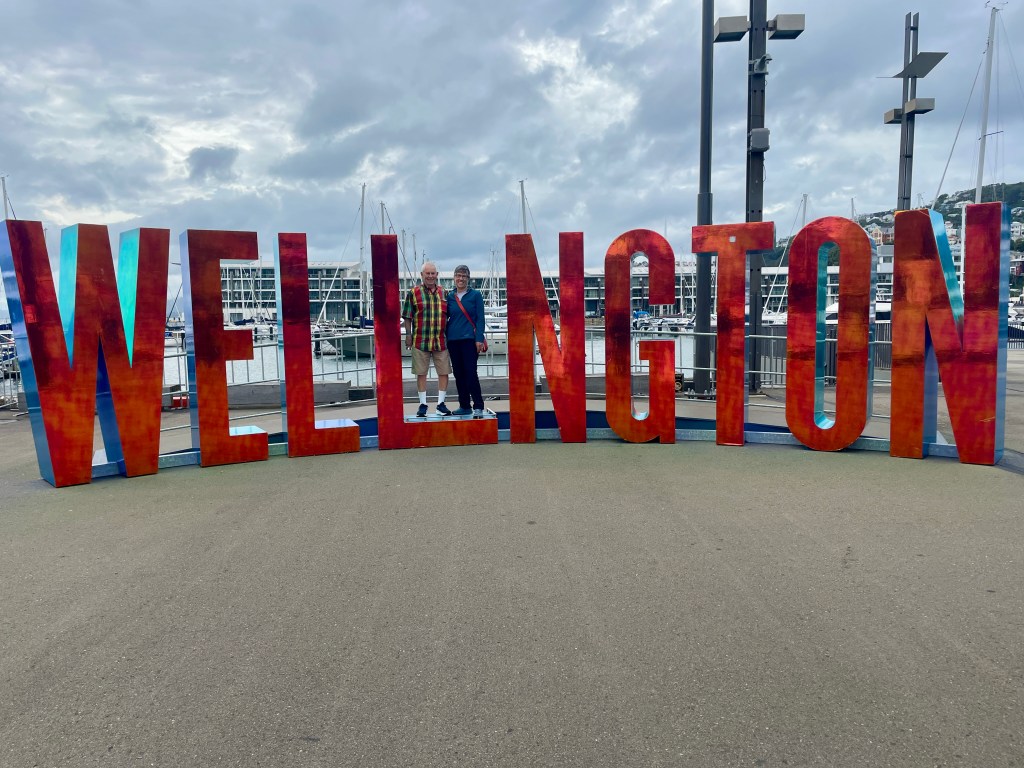
Feb. 1
In the afternoon of January 30 in Auckland, Karla walked for one of her many 20,000 plus step days. Her mission was to see if she could find a replacement for one of my hearing aids that stopped working and to change the color of her nails. She was successful with her nails. The “hearing people” couldn’t help her. but informed her that the New Zealand center for my hearing aids was in Wellington….our Saturday destination. When she contacted the Wellington center, she was told that they were closed on Saturday; it didn’t look like they could help us. We thought, maybe in Sydney.
Then, Karla received a surprise email from Devah Jackson, the lead person for Phillips hearing aids for Costco New Zealand. She said that she could help us on Saturday. She is a graduate of Purdue and settled in New Zealand 10-12 years ago and is married with kids. She found NZ after having tough experiences with the tiger mothers of children she served at a preschool audiology clinic in Las Vegas. Devah said that her husband agreed to handle the kids while she helped us out. We agreed to meet her at the “Blue Ferry Station” at noon. Around noon, a 35-40 year old woman drove up with her mother in the car. She opened the trunk of her car and revealed a bunch of hearing aids, testing devices etc. I ended up with a different brand of hearing aid that requires a battery. She needed to go by her office to get something. When she returned, she handed me a programmed hearing aid and 9 batteries. (The batteries last 7-10 days.) I asked her what we could do for her, thinking that we should pay something. (I thought the retail market would be about $1000.) She said, “this is New Zealand….just pay it forward.” Karla asked for contact information for her boss so we could write something nice. She said that she would send something….reluctantly. She was just trying to be helpful, not looking for credit. She mentioned if her parents were traveling and ran into issues, she hoped that someone would help them.
After sending a complimentary note to her boss, we received this email back.
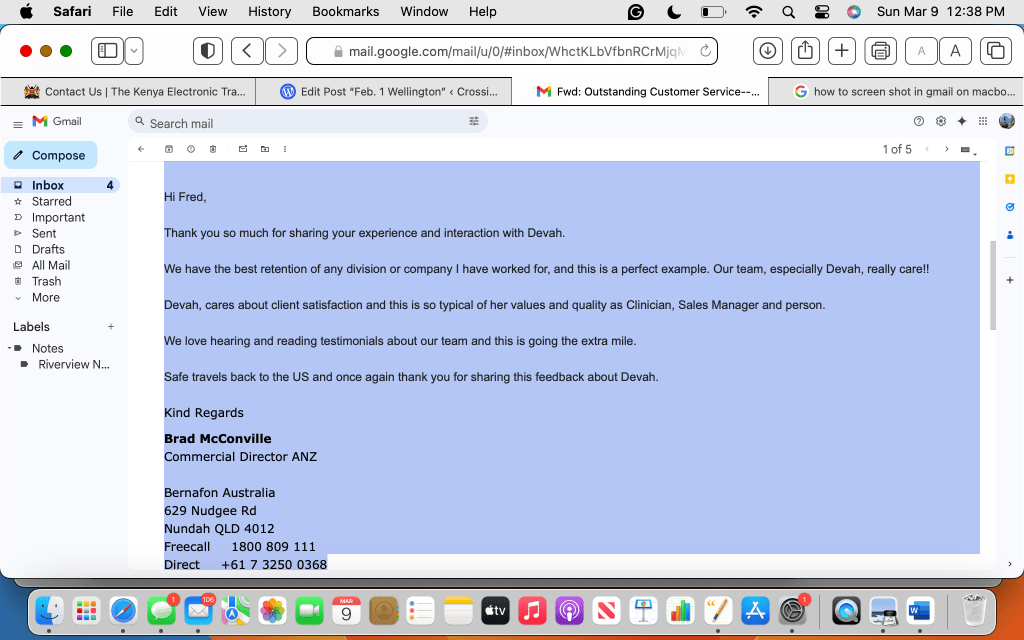
That may be the best customer service I’ve ever received, but it’s not surprising in New Zealand. When we visited New Zealand years ago, I said that it reminded me of growing up in Portland in the fifties. At a grocery store the owner asked us where we were headed. Upon hearing the destination, she suggested that we stay with her family. A simpler life. At 10-11 years old, I would hitchhike downtown or take the bus if I had a dime. There was not a fear of strangers. The US has changed; I hope that New Zealand doesn’t. I mentioned the early approval of women’s’ right to vote, pension programs etc. They approved same sex marriages in 2013. They are much more supportive of “Diversity, Equity, and Inclusion” than other counties I could name.
Karla and I walked the city in the morning and visited a couple thrift shops. I returned to the ship after my hearing aid appointment. I thought 12,000 steps was sufficient. Karla saw a hill, a cable car that hauled people up to the Botanic gardens, and thought it needed to be explored. She returned to the ship with her third consecutive 25,000 step day. Wellington was OK. The people were great.
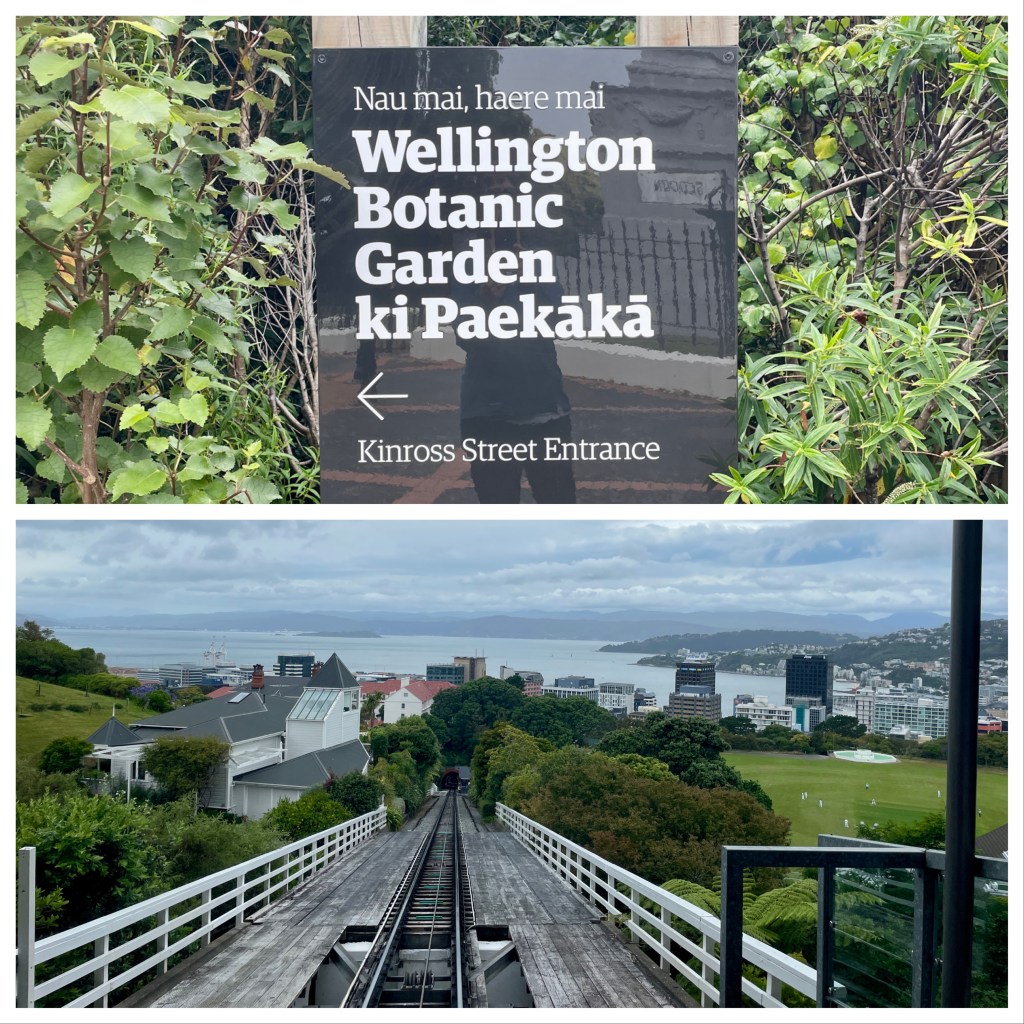
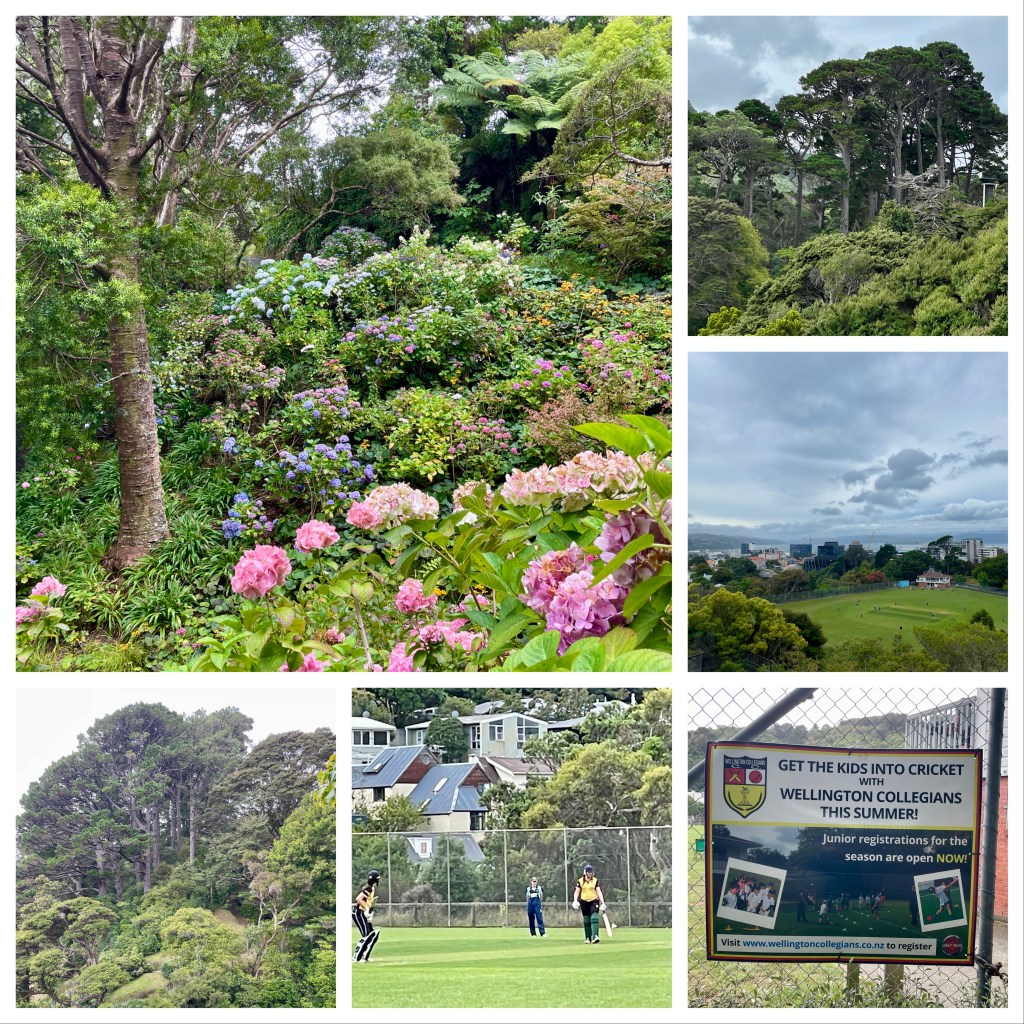
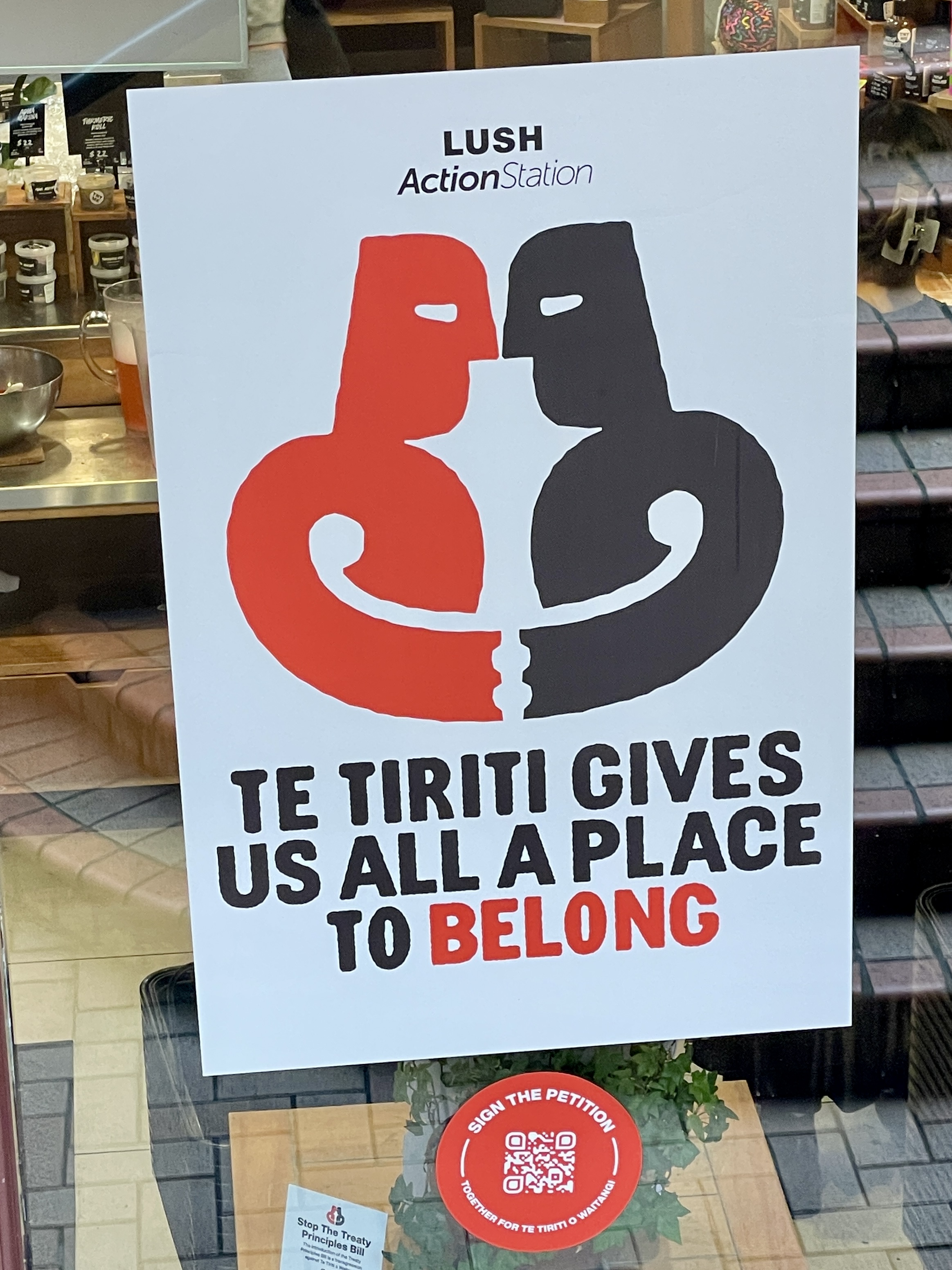
Cable car track, botanic garden hike, view, and cricket above. Below, seen walking about town: artist signs of encouragement, the legislative beehive building and support for the Maori Treaty. 

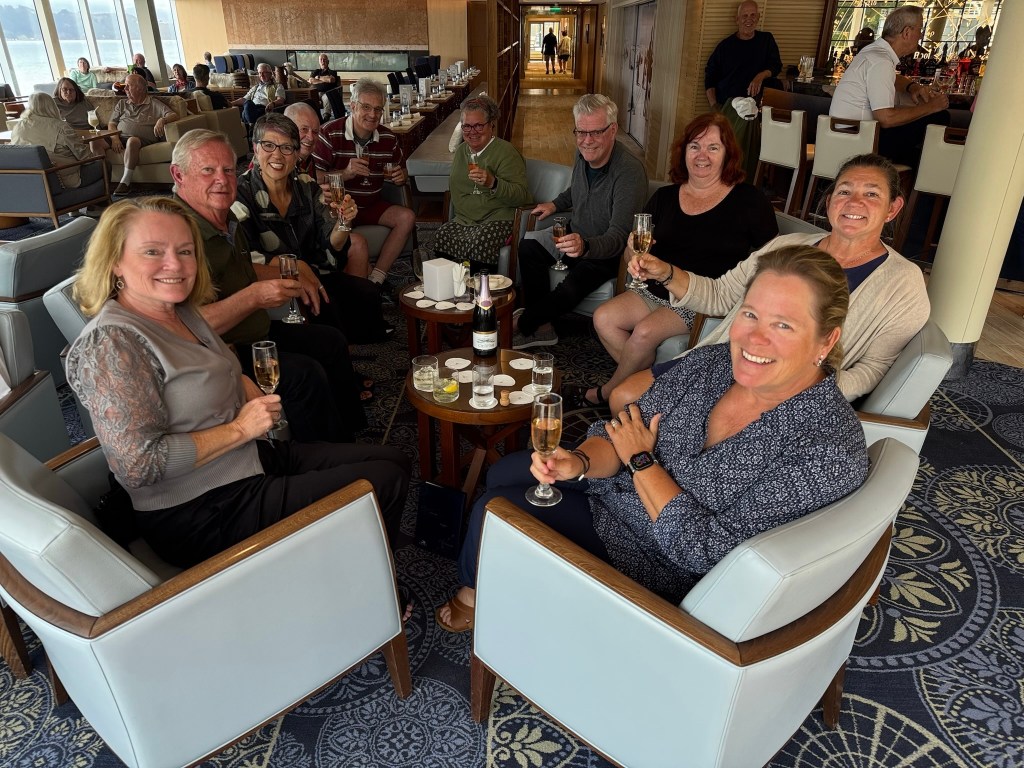
Upon returning to the ship, celebrated a “bubble Saturday” with friends. -
Napier
Jan. 31
Napier is a pleasant coastal city with around 70,000 people. It seems as though lots of our stops are at coastal cities. While Napier has a history beginning with Captain Cook, followed by whalers, traders, and missionaries, it is really defined by a 7.9 earthquake in 1931. The earthquake leveled the commercial center and lots of residential structures, A decision was made to reconstruct the city in Art Deco style. It retains that style today.
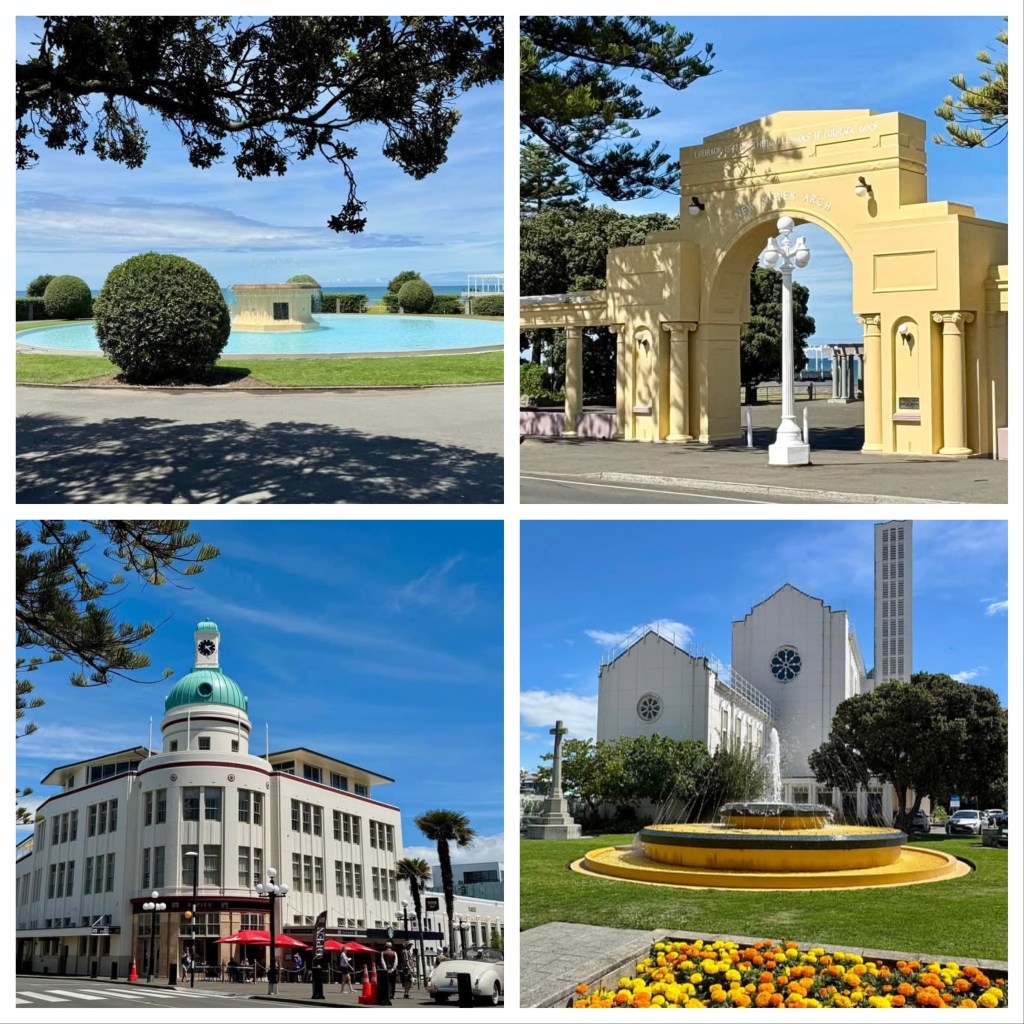
Examples of the art deco design. The surroundings are flat fertile lands surrounded by hills. Our driver described it as “one big farm” and a “fruit bowl.” The economy is defined by the production and export of natural resources. It is the largest wool center in the Southern hemisphere. It is the second largest wine region in New Zealand, after Marlborough. It is known for the export of wool, meat, timber and wood pulp as well as apples, pears and stone fruit. The area doesn’t get lots of rain, but 4 rivers feed underground aquifers. By tapping the aquifers to irrigate the fertile land, they have accelerated growing seasons for their crops. California pine, for example requires about 30 years to mature in California; 20 in the Napier area.
A few standout facts:
-Electricity is provided by solar, wind and hydro.
-There are no “critters” so the birds and animals thrive.
-Resource extraction is limited to preserve the natural environment .
-There are 100’s of earthquakes, most not especially strong. Our driver said there was a 3.1 that morning.
-We saw lots of cattle on the hills and some of the nation’s 38 million sheep. The flatlands are loaded with crops and the hills with grazing animals.
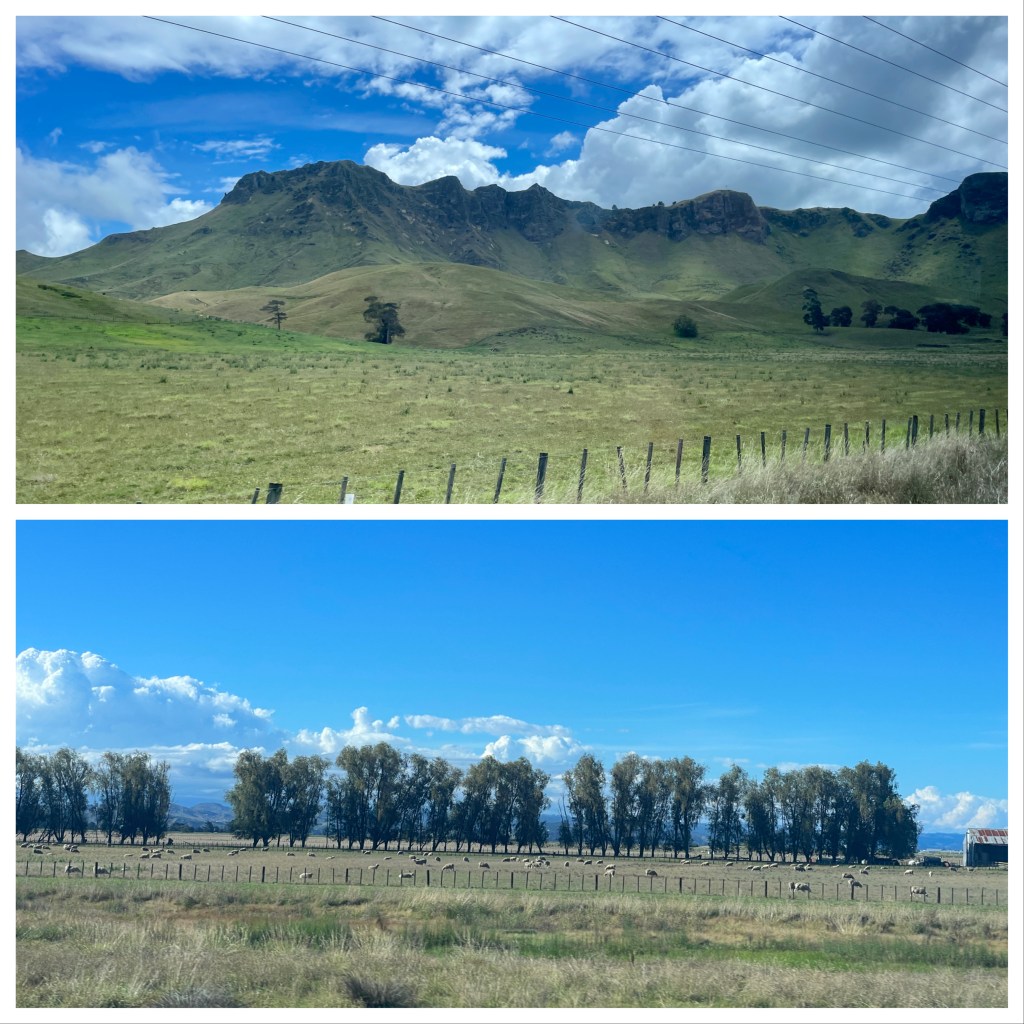
Our tour was billed as a tour of the Tukituki River and visit to a winery. Once we viewed the countryside, we visited a “honey center.” We walked through the shop and ate manuka honey ice cream while viewing all of the honey products. As you can imagine, there were soaps, lotions, and honey containers that seemed to be reasonably priced. A tasting station allowed sampling of about 20 different kinds of honey….clover, thyme, borage, etc. And, of course, they sold manuka honey with all of it’s beneficial health effects.
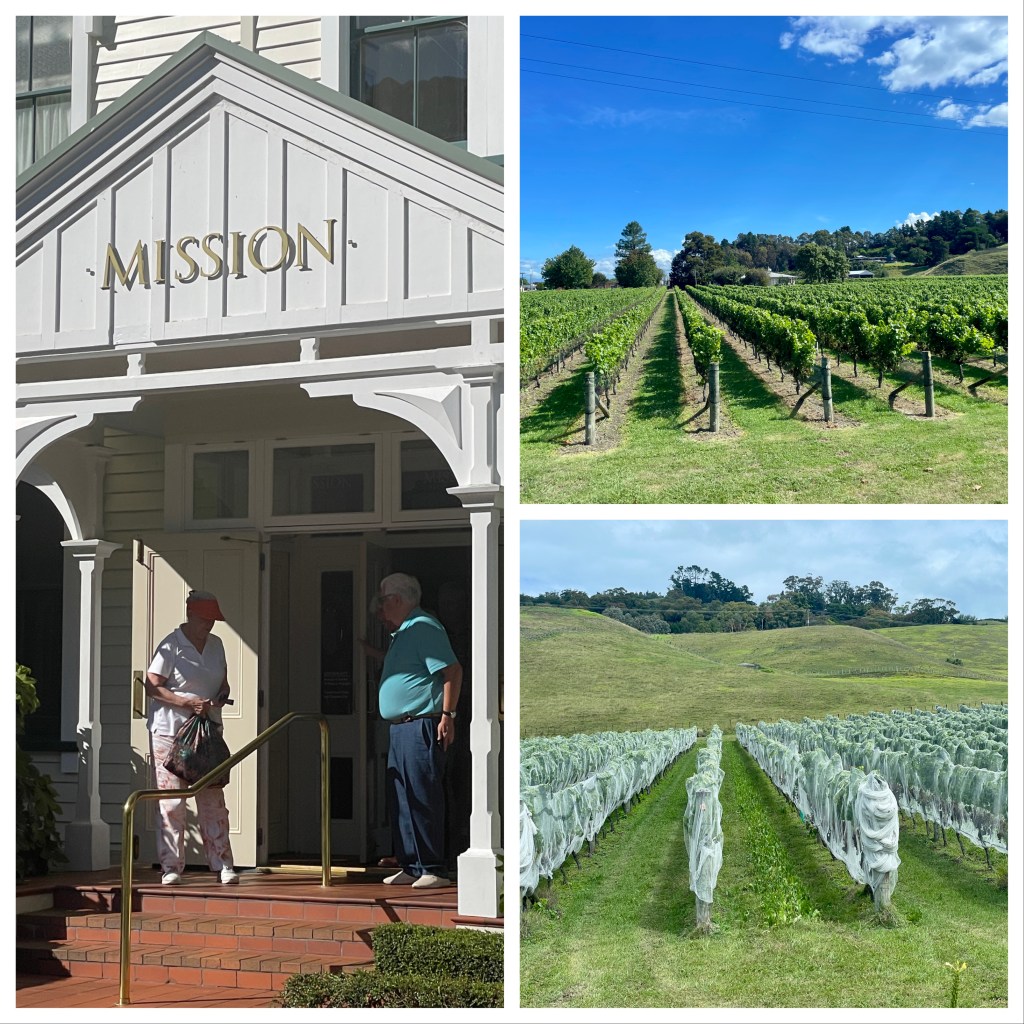
The final stop was at the Mission Winery. It’s the oldest winery in New Zealand, having been founded in 1851 by Catholic priests. It is still owned by the Catholics. The wine was decent and the grounds nicely preserved. Following our tasting of 5 wines, we were returned to the ship around sailing time. The ship leaves on time whether all passengers are on board or not. The exception is that if you’re on a Viking sponsored excursion, they will wait for your arrival. Usually, we can find excursions provided by independent operators, but we’re hesitant to sign up for them if there is any doubt about arriving back at the ship on time.
-
Tauranga
Jan. 30
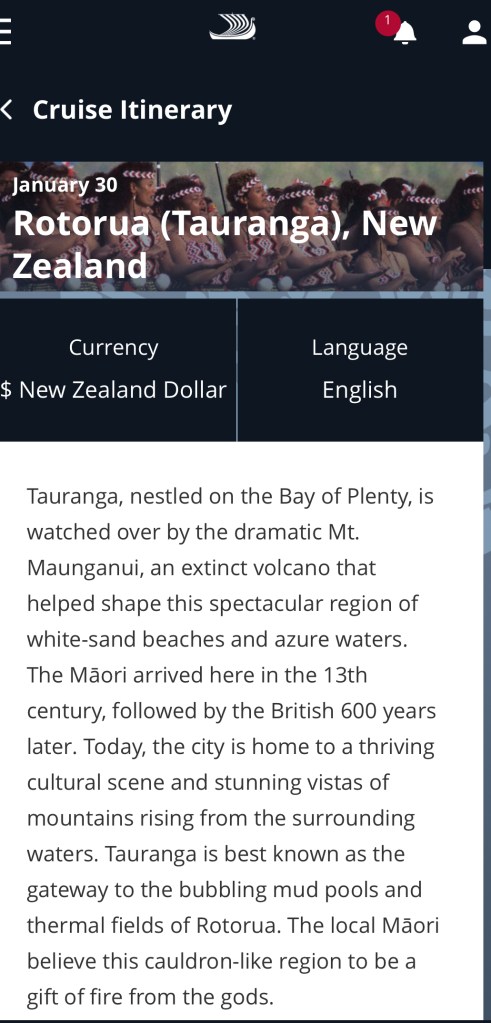
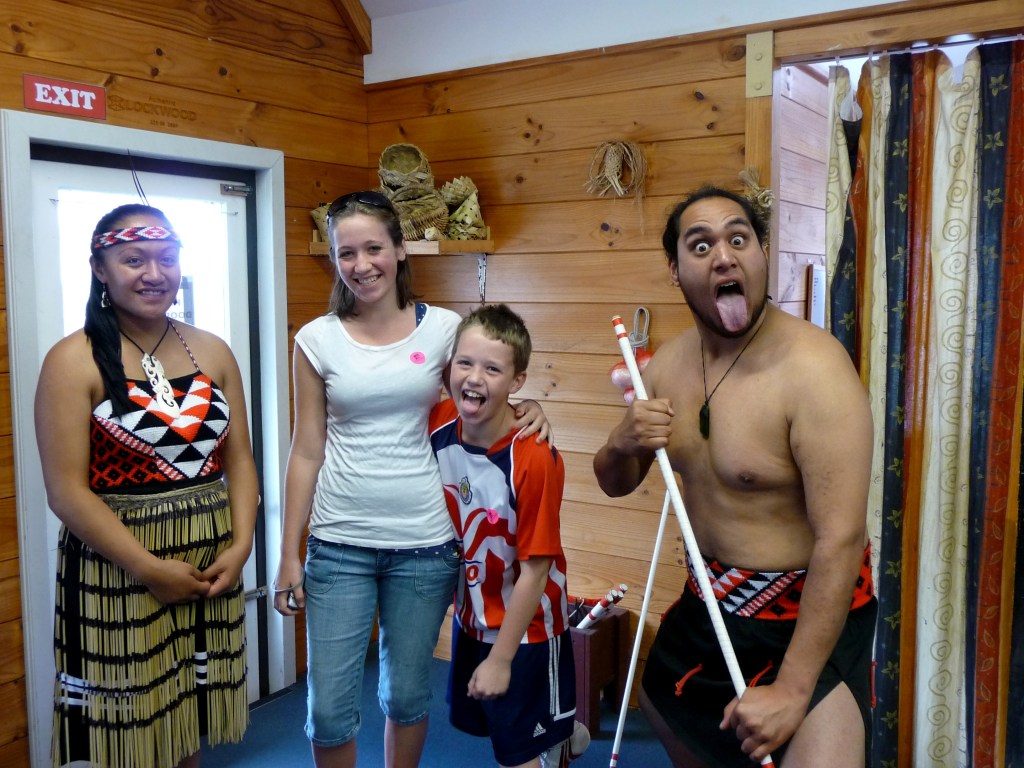
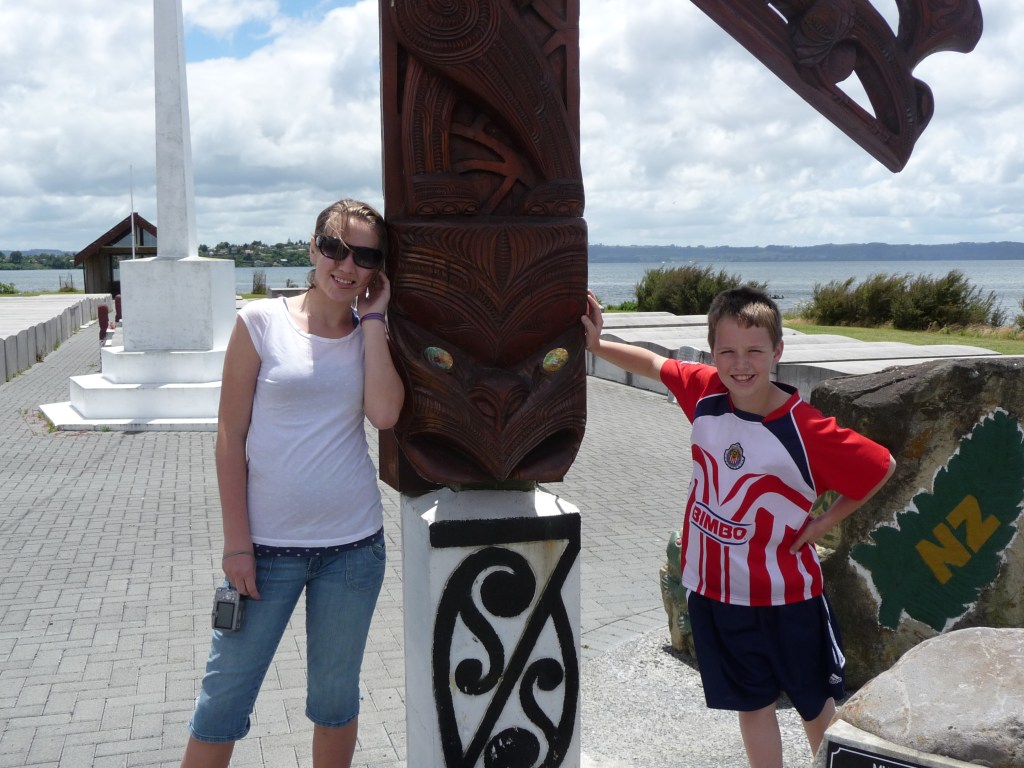
Tauranga is New Zealand’s 5th largest city, with almost 170,000 people. We pulled into a great port location, nestled in the Bay of Plenty, which was a very easy walk to town. There is a nearby white sand beach and Mount Maunganui provides a nice backdrop as well as a hiking opportunity. Lots of passengers chose an excursion to Rotorua to see the geothermal sites and a Maori village. The Maori arrived here in the 13th century. We had visited Rotorua a couple times and concluded that there was a limit to how many times to experience bubbling mud. (Photos below from a shipmate who visited Rotorua).
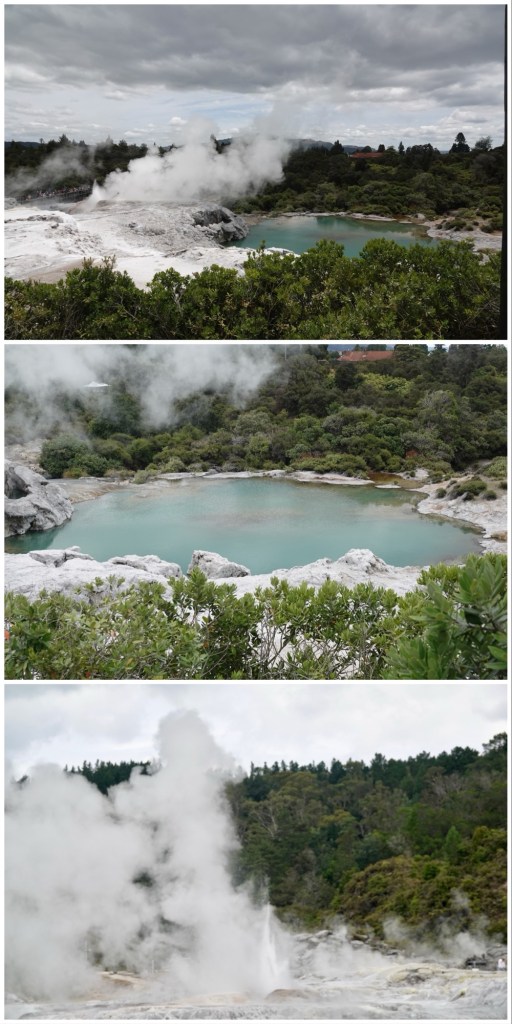
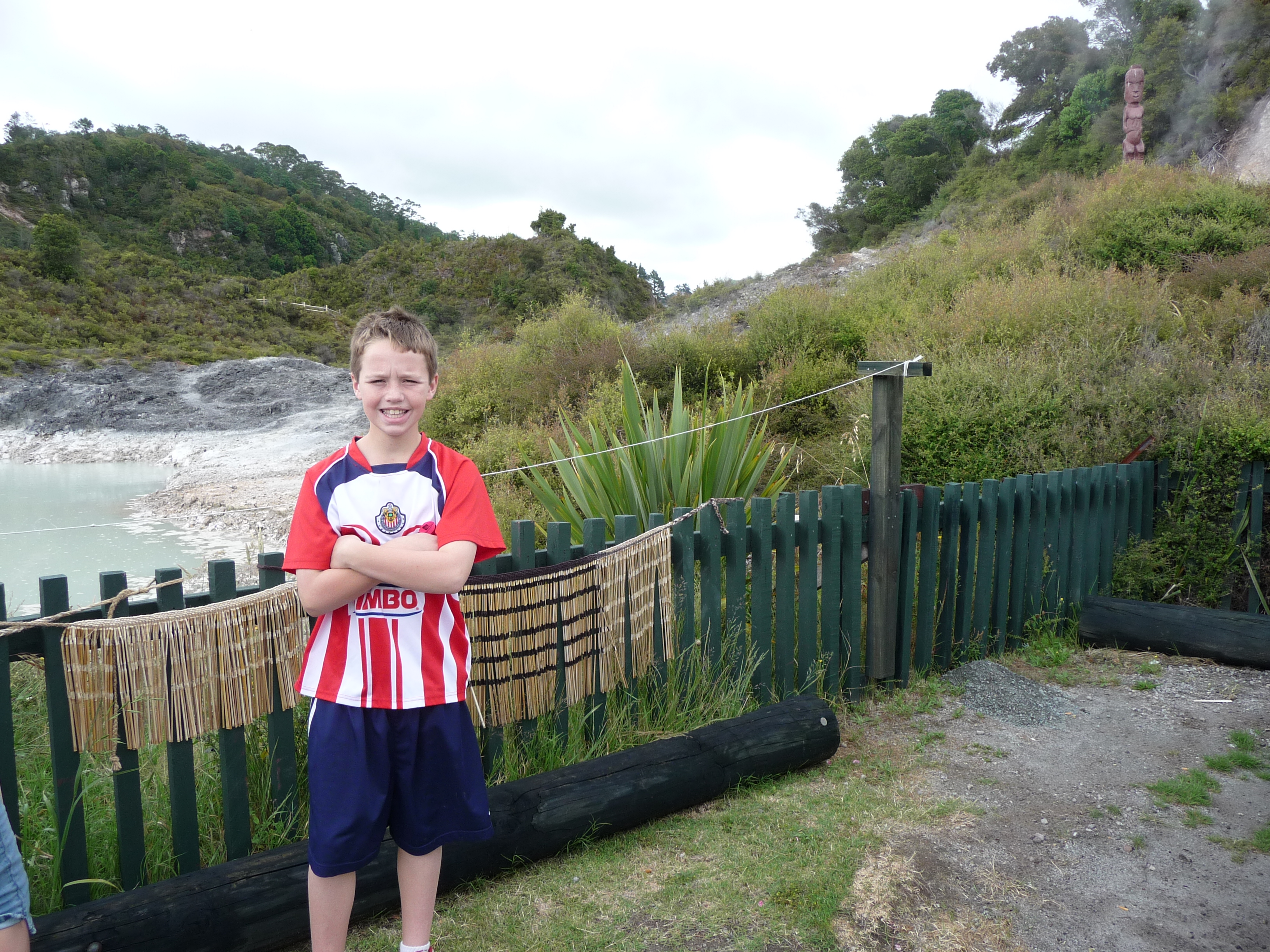
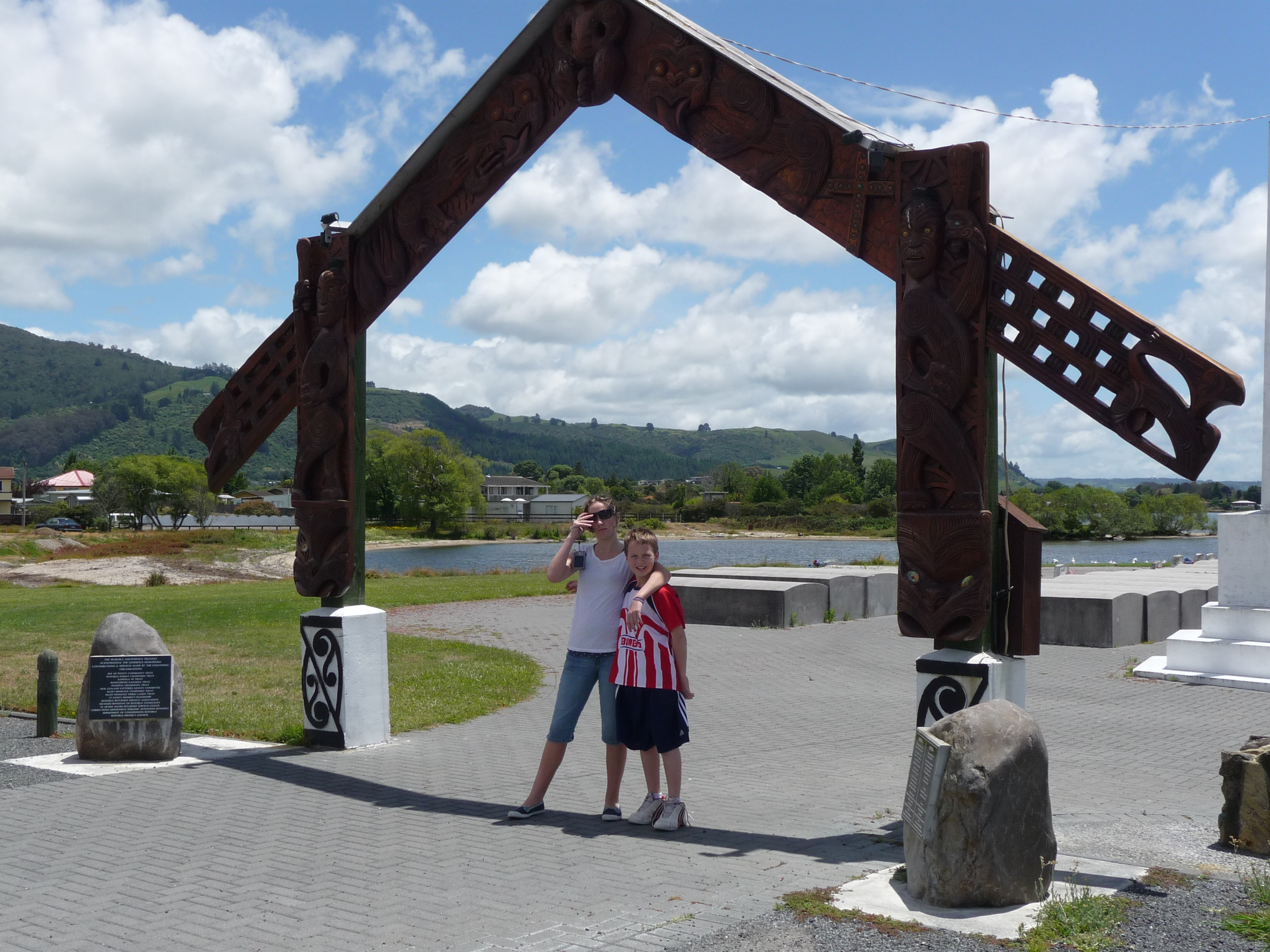
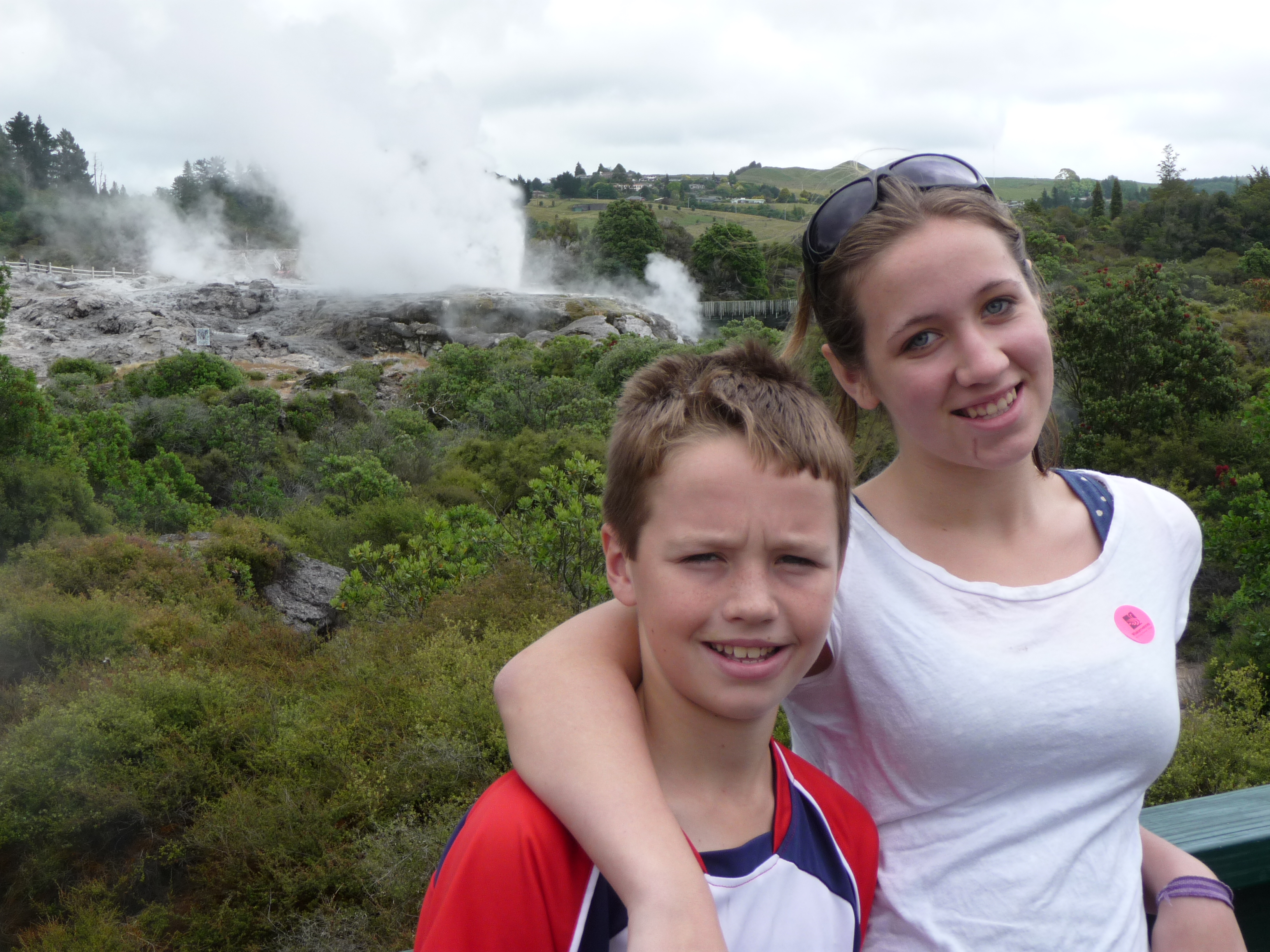
2008 Maddy and Jackson in Rotorua
So, we took the “included” excursion, “Scenic Bay of Plenty.” It was a good choice.
Our driver/guide took us through green rolling hills and small towns to an area full of kiwi fruit and avocado orchards. It was very pleasant scenery and several things stood out:
-there was lots of flat land and green rolling hills. The flat land was planted in corn which was used to feed cattle. The rolling hills were home to lots of cattle. We saw way more cattle than sheep.
-the small towns had lots of little shops. It reminded us of the US before department stores and “big boxes.” It was mentioned that there was a K Mart coming to one of the towns.
-there was a mattress store that had a big sale. I think that’s an international requirement.
-lots of small towns have a McDonalds….also an international requirement.
-one town was named Te Puke. It’s pronounced tay pu kee. The liquor store advertised “wine and liquor Te Puke” –a tough sell if you don’t know the pronunciation.
The extensive Kiwi fruit orchards were impressive. The bushes are loaded with fruit. They’re picked when the sugar content is at the desired level and then chilled to the right temperature. If done correctly, they can last a year. There are 3 kinds of kiwi fruit. We are used to the golden. They have statistics showing how much better they are than oranges and apples with respect to Vitamin C and other nutrients. As you can imagine, they make soaps, oils and liquors which they are happy to sell in their shops.
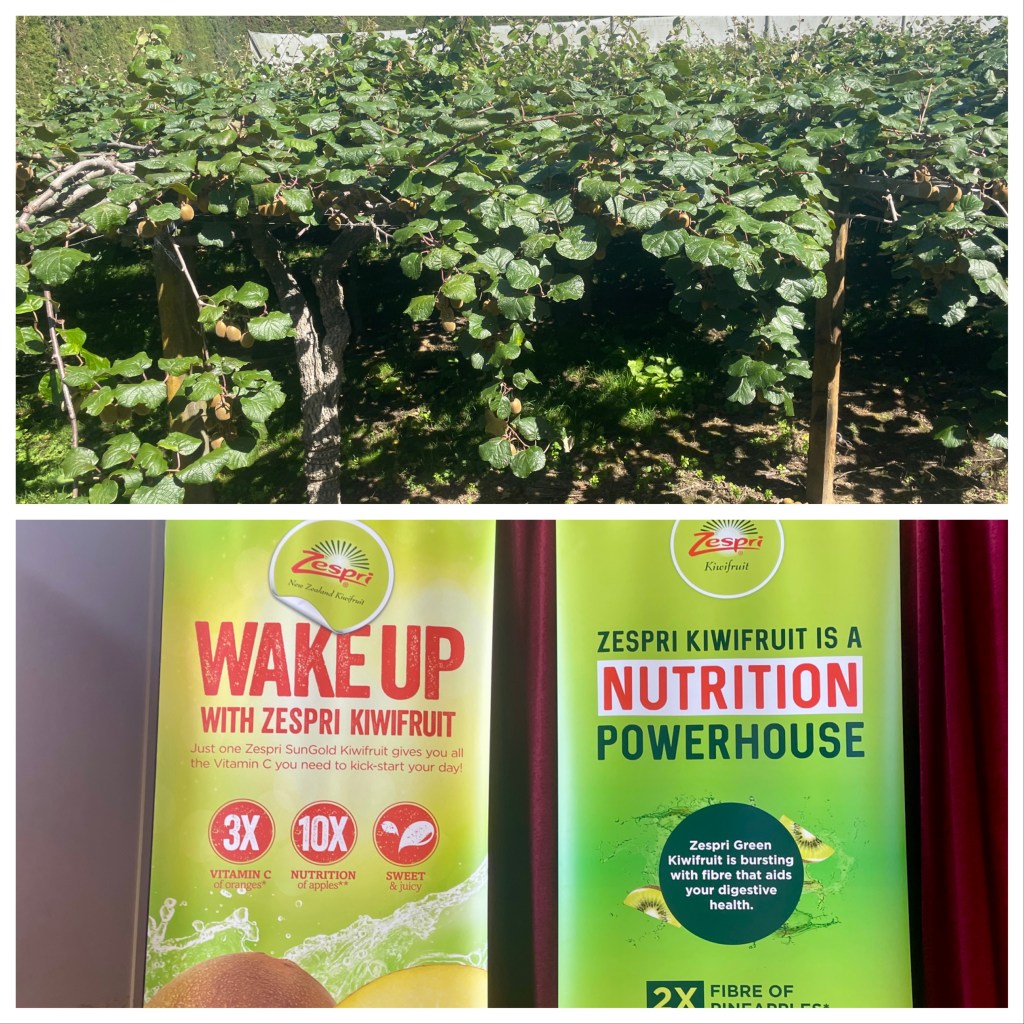
As we passed a kiwi storage facility, our guide commented that they had just been awarded a $24 million settlement. Evidently, a ship full of kiwi fruit was also full of mice. They ruined the fruit, but certainly became healthier.( My suspicion is that the ship was probably retired from the Holland America fleet and not properly cleaned for kiwi fruit).
Our visit to the kiwi facility featured some young Maoris doing some dancing and singing and a Haka. New Zealanders have carried on the Maori tradition of the Haka. It’s an aggressive dance with lots of offensive motions ending in a “growl” with the tongue stuck out. We learned that the stuck out tongues meant, “when we defeat you, you will taste good.” It used to be a feature of a Maori greeting to strangers which meant “leave and stay away.” Abel Tasman was discouraged from landing when Maori canoes met his ship, gave a rendition of the Haka and in the ensuing “interaction” killed 4 of his sailors. He didn’t land. Today the New Zealand All Blacks Rugby team does the Haka before every match. They didn’t carry on the tradition of killing 4 of their adversaries before the match…….but, they look like they could.
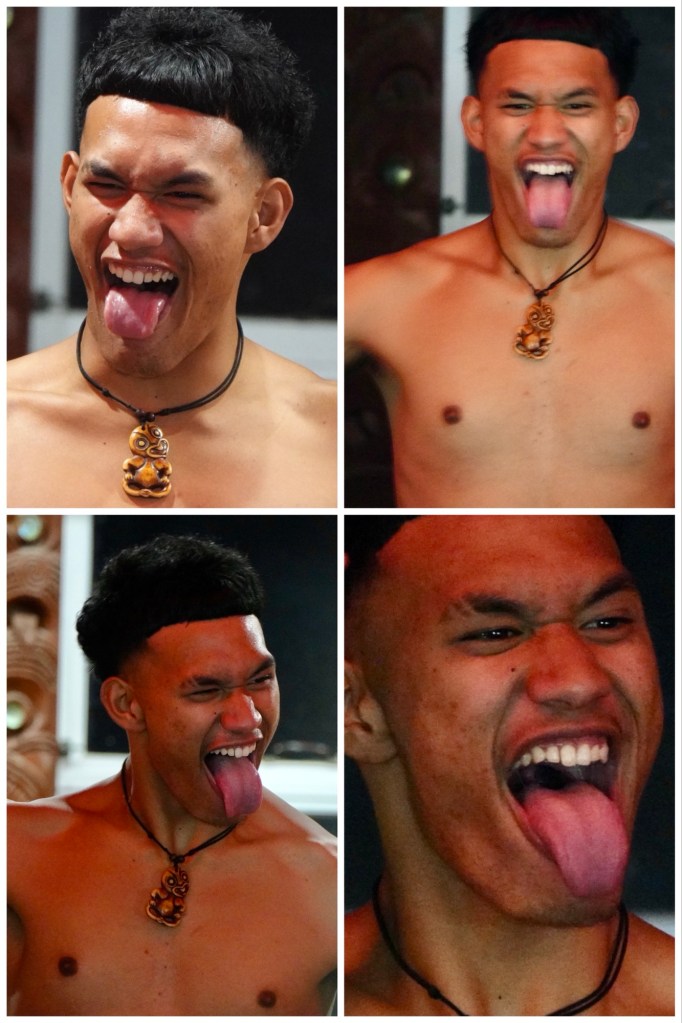
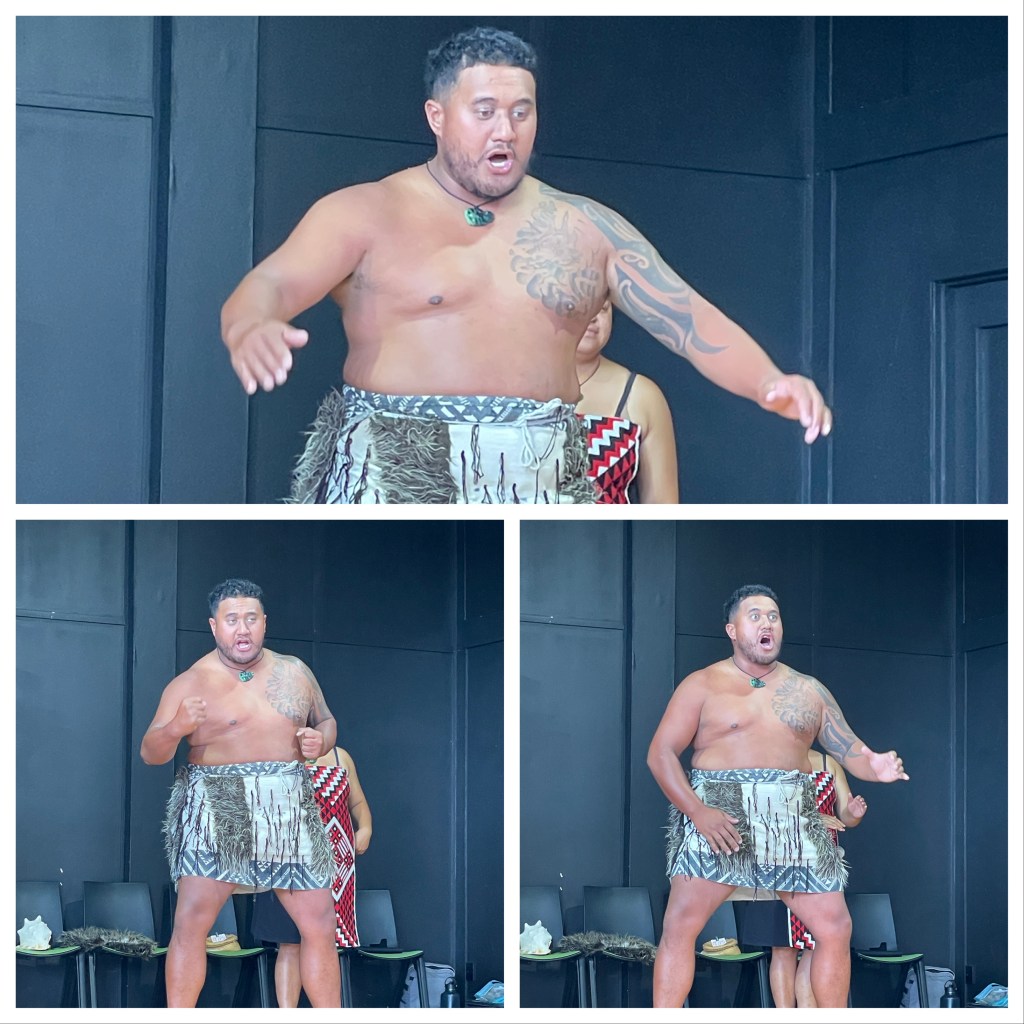
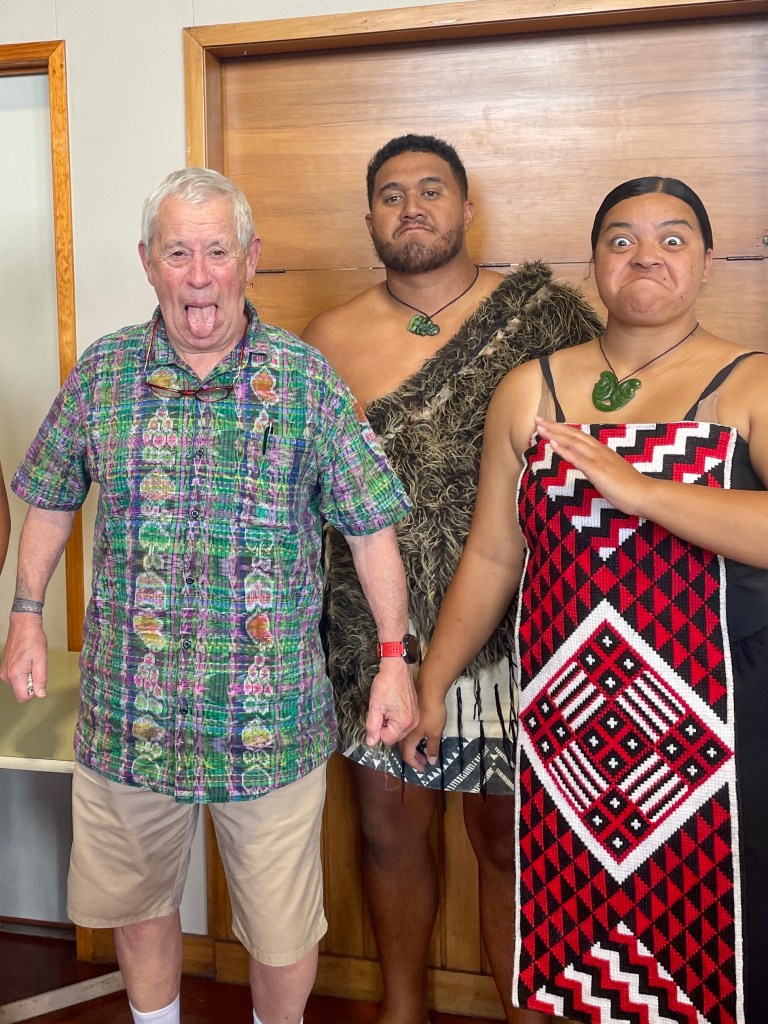
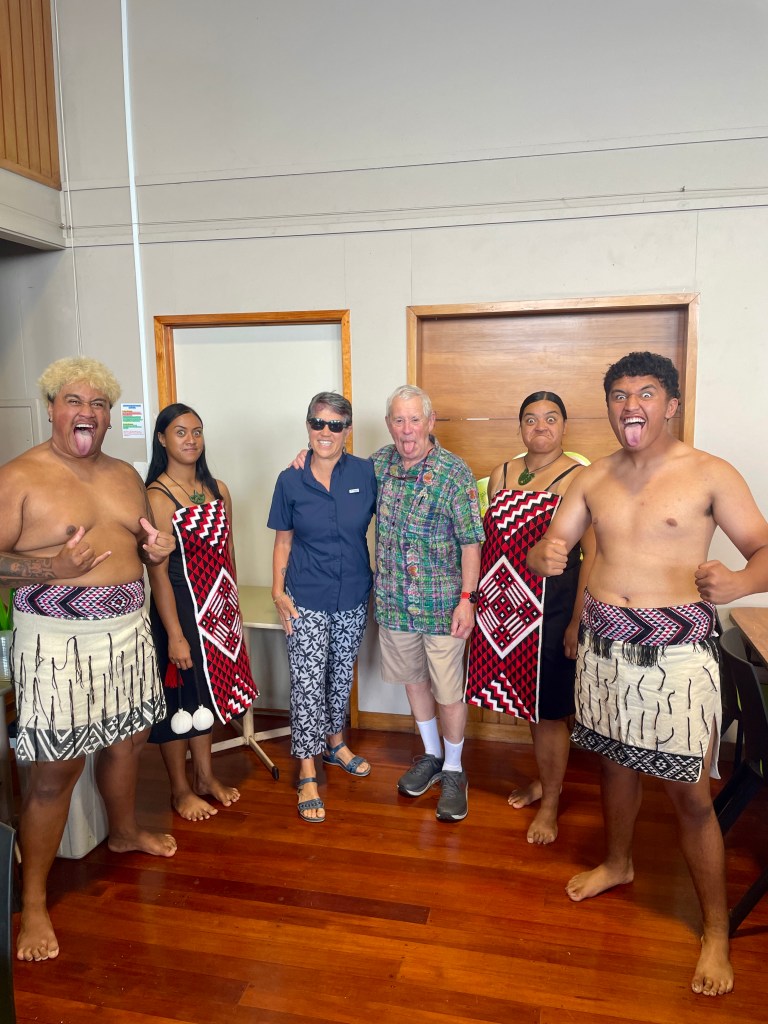
Years ago, when Maddy was 5-6 and Jackson was 2-3, I was recruited to join a Haka exhibition. With no sense of appropriate hand motions or rhythm I embarrassed my way through and stuck my tongue out at the end. If I could have been embarrassed, I would have been. It was for the kids….but who would ever find out. About an hour later, we took the kids to a park with slides and swings. A woman came up to me and, sort of chuckling, said “nice Haka” in a way that suggested ridicule more than talent. I hope that she no longer lives here or at least has a bad memory.
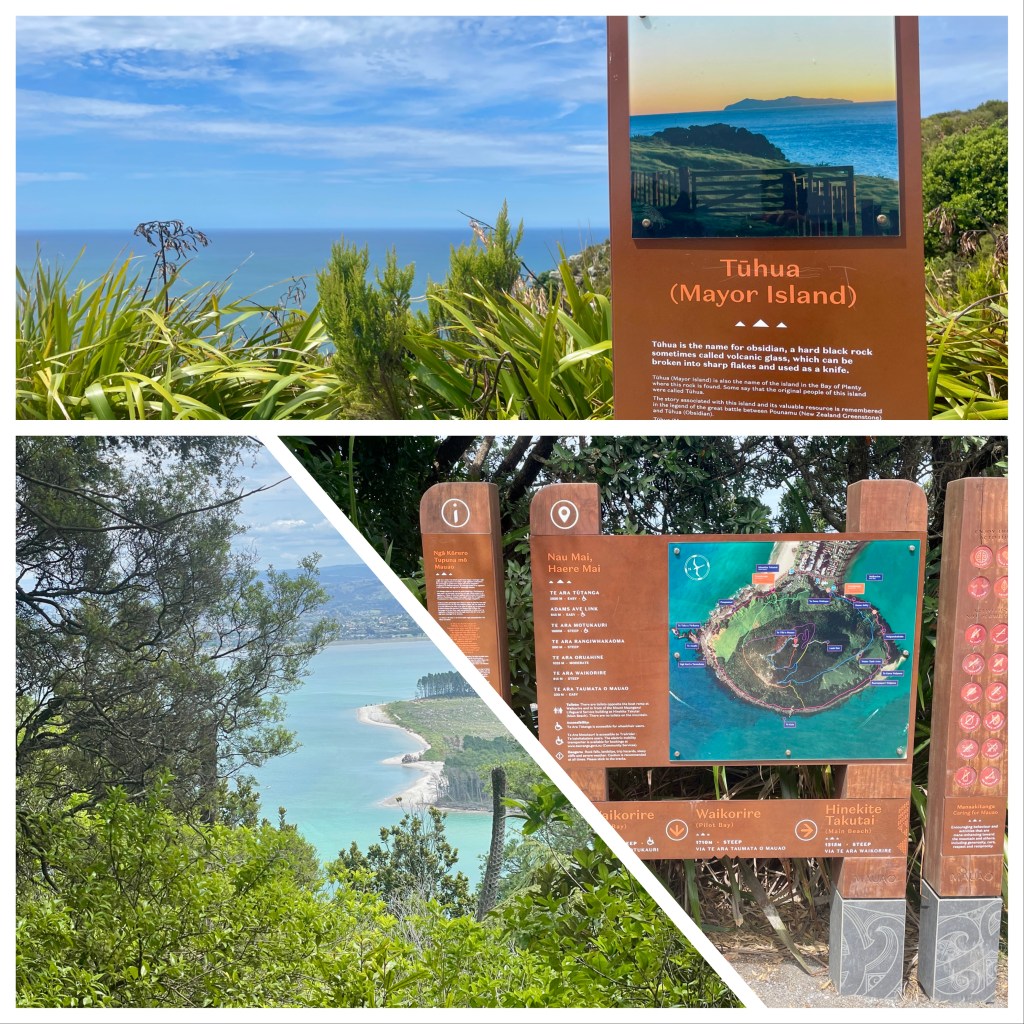
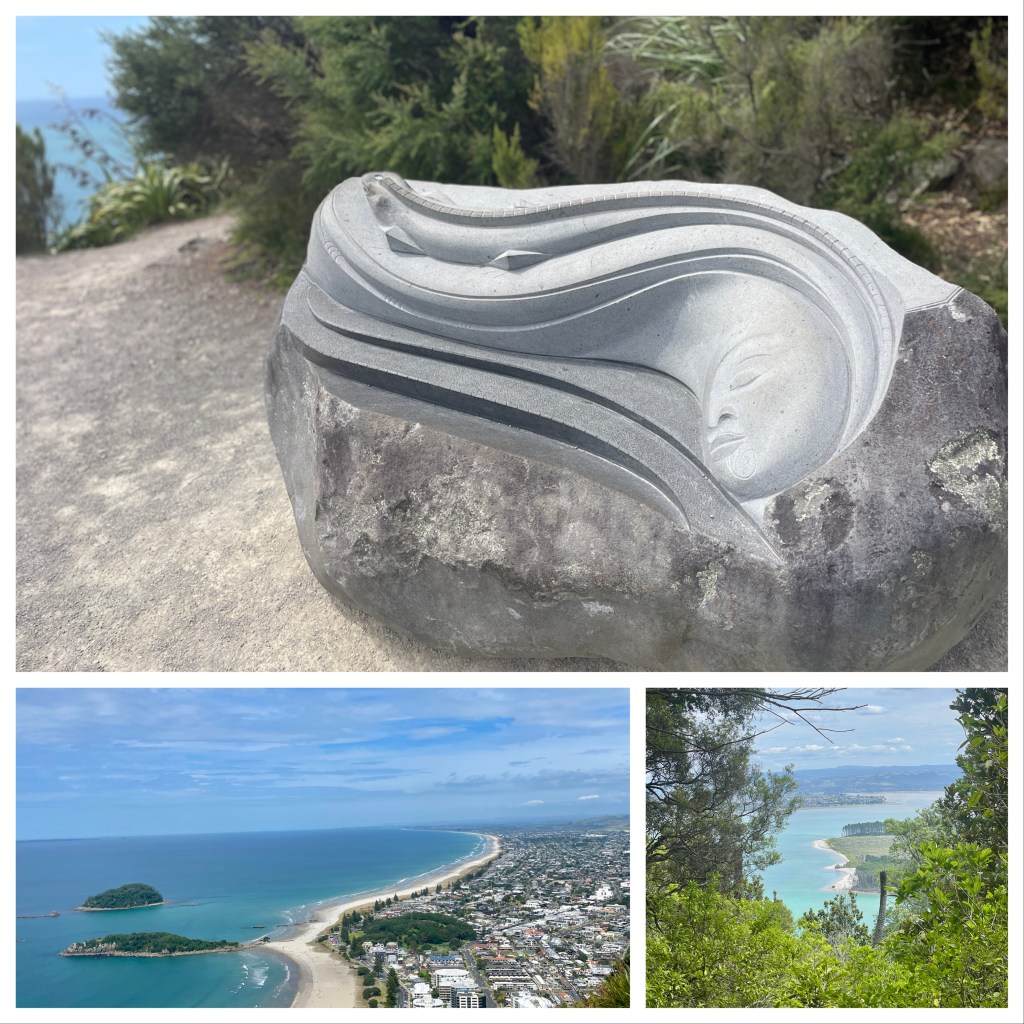
Upon returning to the ship, Karla still had time to hike up Mt. Manganui. Tough uphill but great views. She returned for takeaway fish and chips, complete with news wrapping.
.
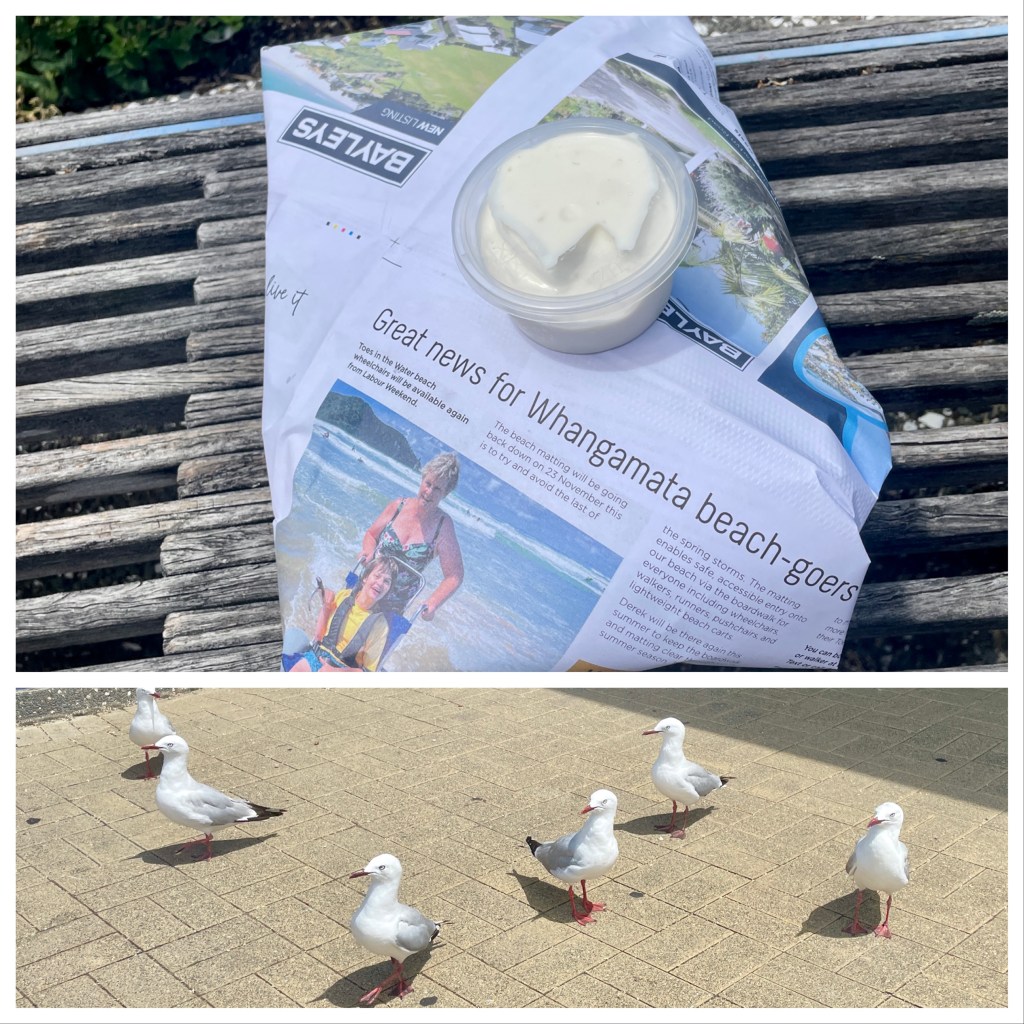
These gulls are waiting for leftovers. -
Auckland

The tongues in the Maori statues are meant to convey to opponents, “when we kill you, you will taste good.” It is also the final motion in the Haka (below). 
Jan. 29
As we were having our lattes and green drinks early in the morning, the Chef walked by. He was pleased to say that they were replenishing supplies in New Zealand. We should get ready for lots of lamb and fish and make sure not to miss the Bison burger. That sounded good even though we had not been fearing starvation. The beverage manager assures us that they will be stocking up on Sauvignon Blanc.
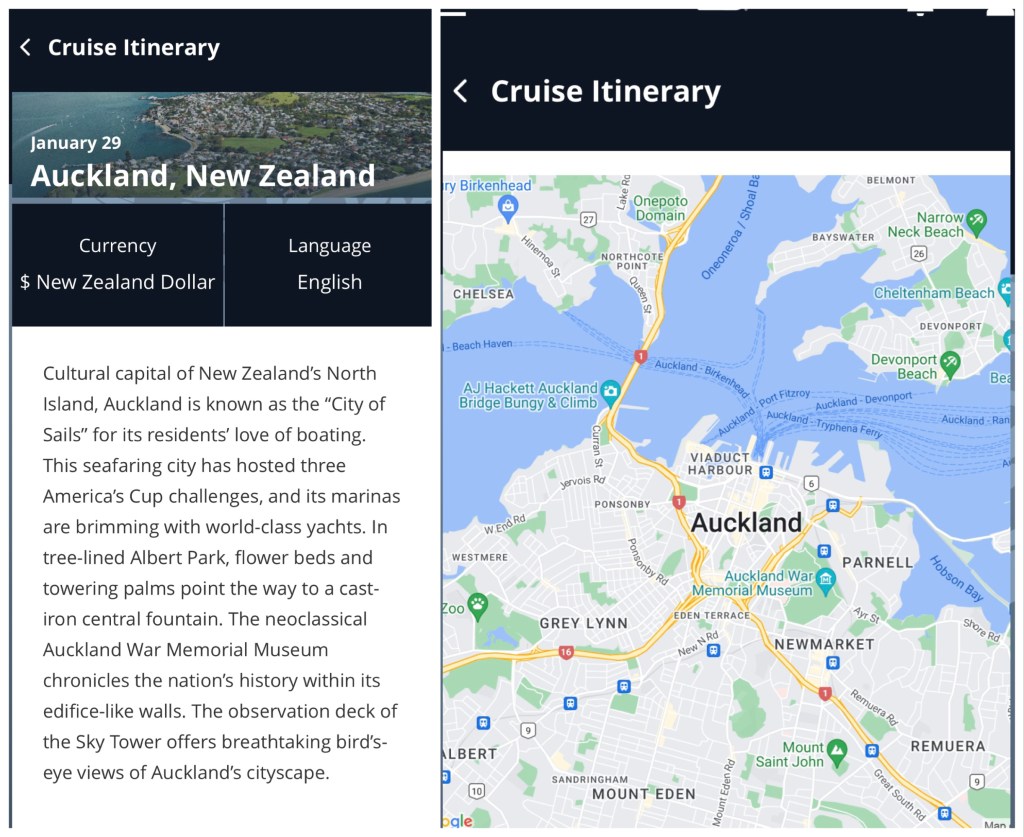
Auckland is by far the largest city in New Zealand. Its 1.7 million people represent about 1/3 of the countries population. With all of the inlets and outlets, there is no shortage of view and waterfront property. And, the climate is great. Our driver/guide mentioned his purchase of a house about 20 years ago. He spent $23,000 and could now sell it for over a million. There is no property tax or capital gains tax, so housing has been a great way to grow wealth. And, it is very hard for younger New Zealanders to enter the housing market…and accumulate wealth.
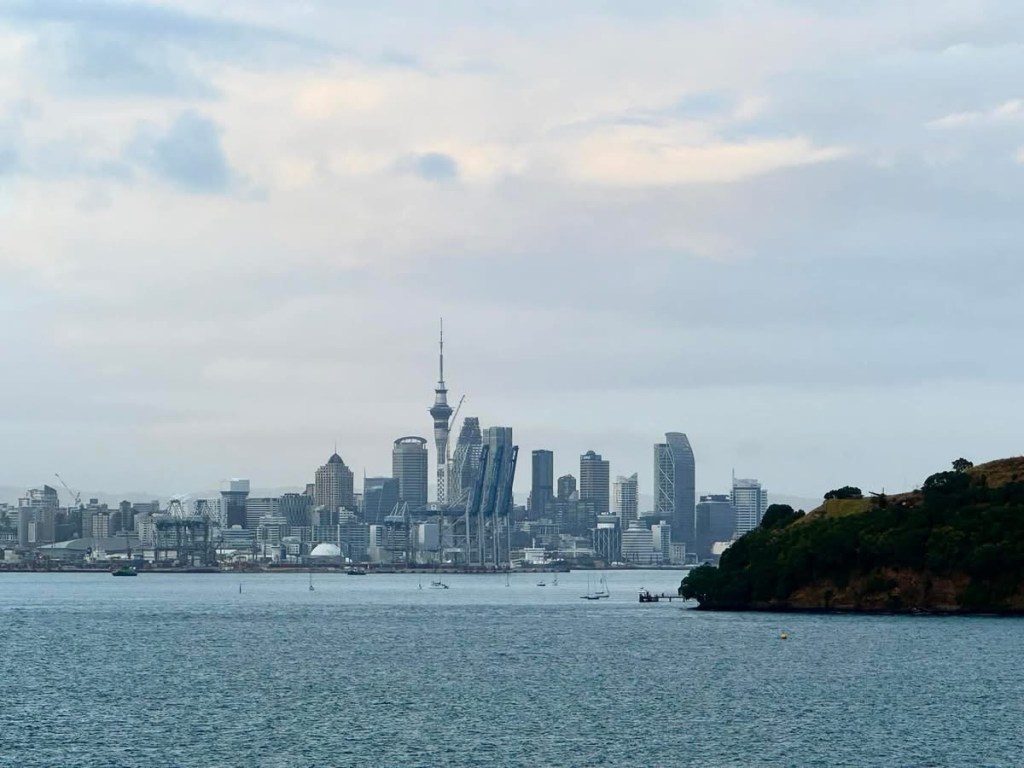
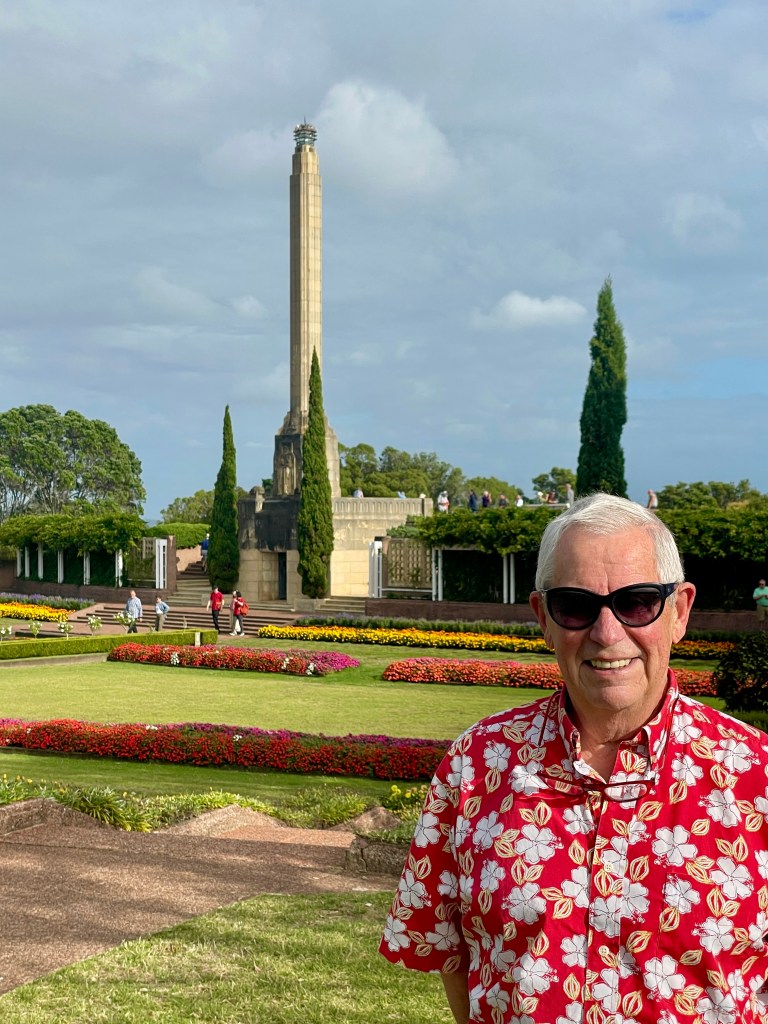
We opted for the standard included excursion….a trip around town and visit to a museum. Our first stop was at a scenic viewpoint. Like about all public spots, it was very well manicured and free of litter. After taking in the view, We walked up a nearby hill. Karla saw a Maori longhouse equivalent (murae) and took some pictures. When she was apprehended by security, she erased those that violated its sacred status. We are pleased that security forces in China and Tibet don’t communicate with those in New Zealand. They let her go with no incarceration.
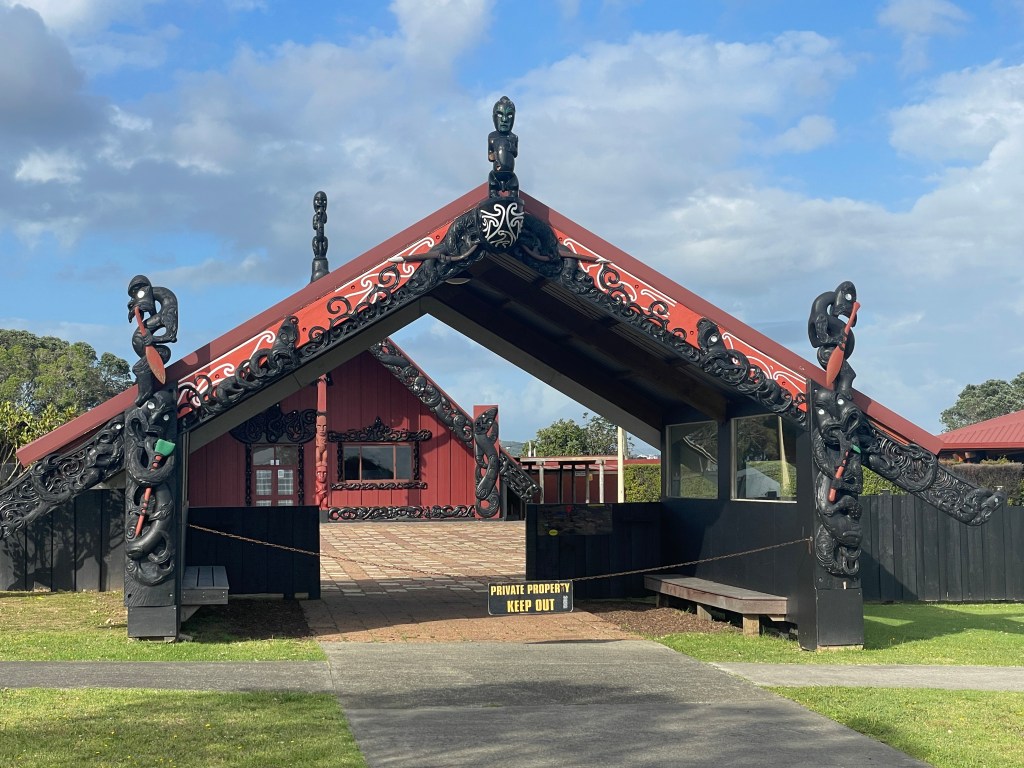
Our driver talked lots about the Maoris. The Treaty of Waitangi (1840) was written in both English and Maori. It is said that the wording wasn’t quite consistent. The Maoris were assured that the Treaty granted them ownership of lands. It wasn’t that clear to the English or, through the years to New Zealanders. Just as in the US, the ownership was questioned as the white inhabitants needed to expand their economies. A great deal of attractive waterfront development is on infill of lands that used to be Maori. It appears to us that the Maori efforts to assert or reassert their influence has been more successful than efforts by American Indians.
The large, 3 story museum was excellent. The first floor was dedicated to Maoris and their heritage. We were so impressed with the stories around settlement and migration, traveling thousands of miles in canoe-like boats.
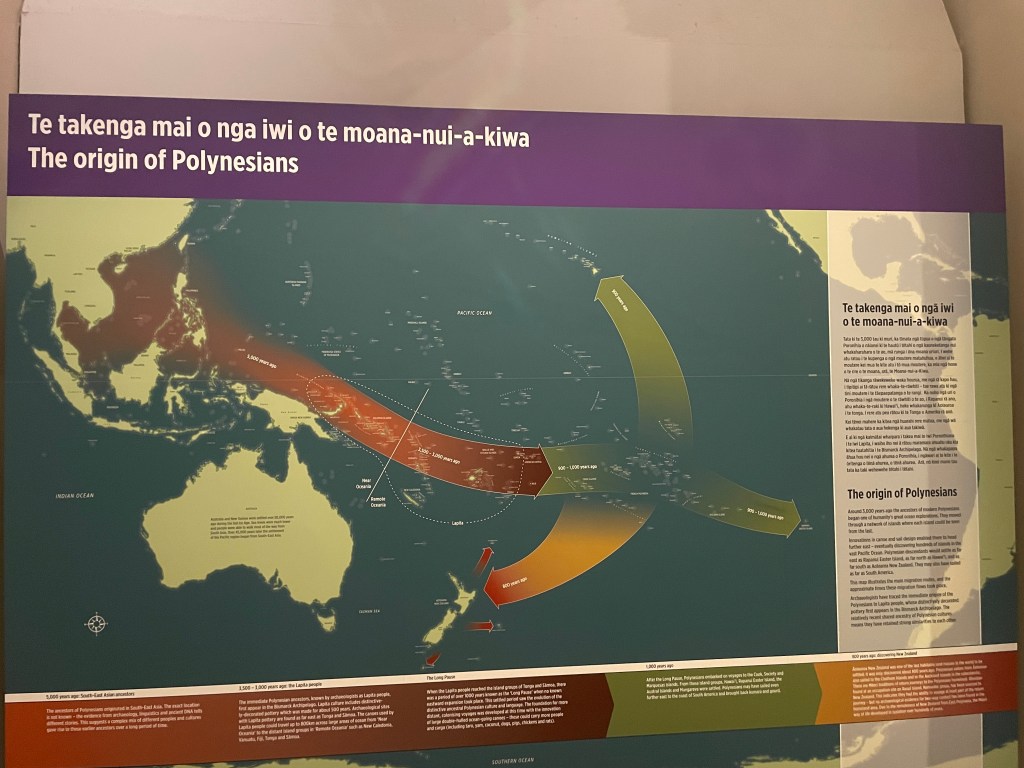
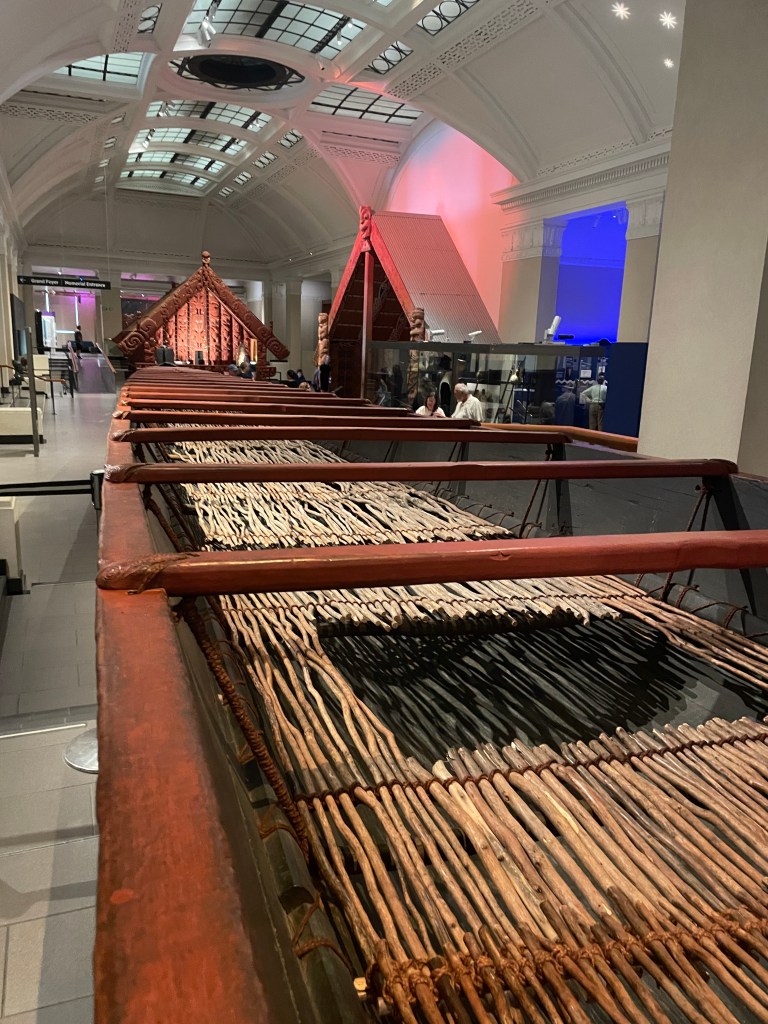
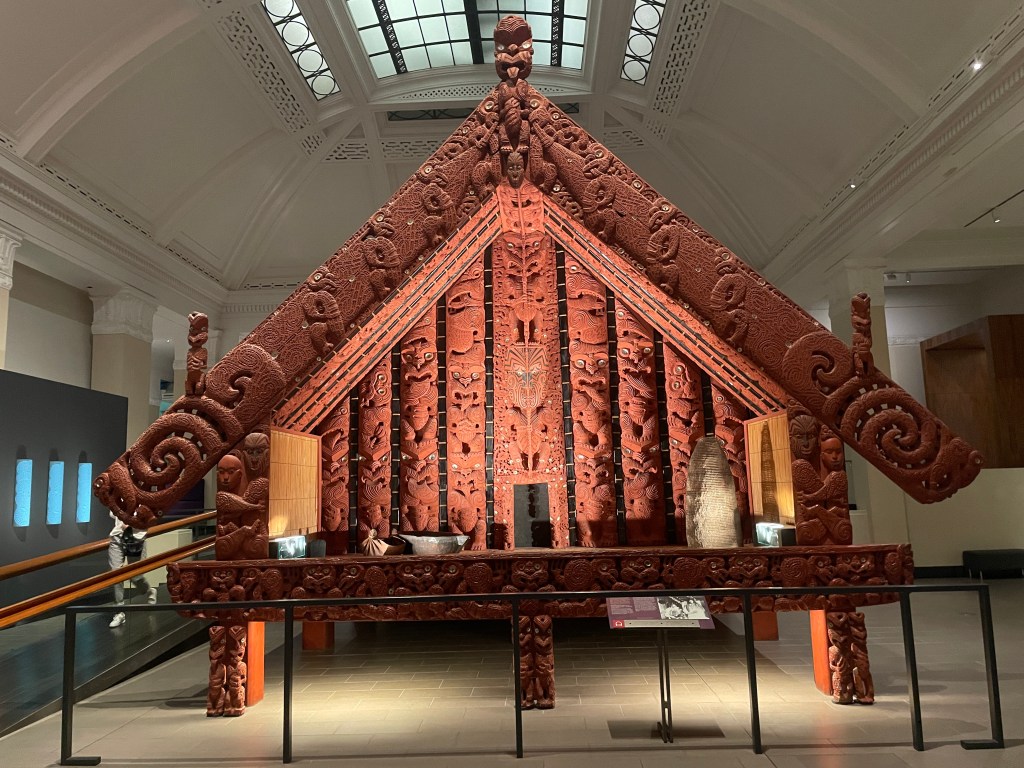
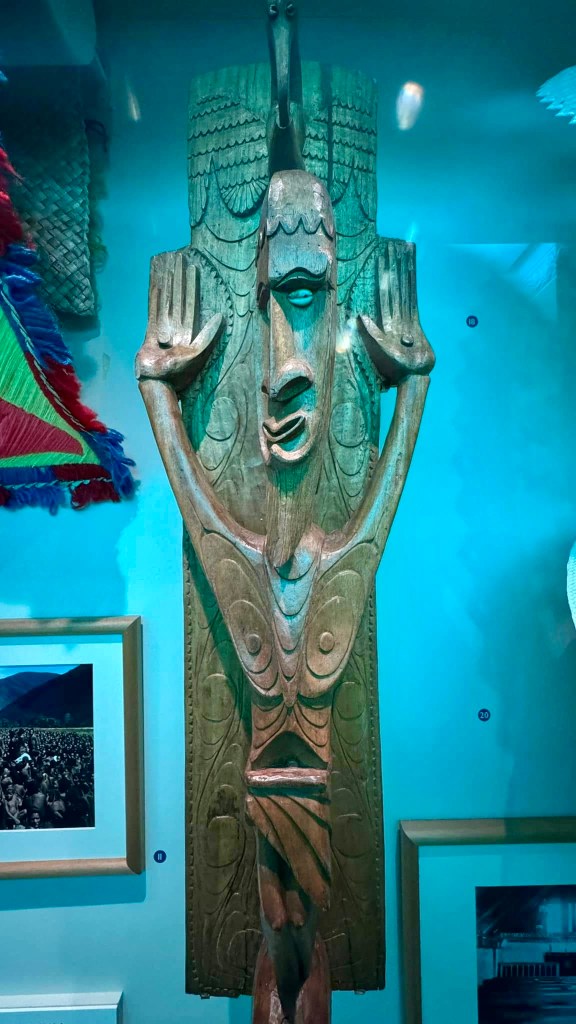
Maori Jesus The 2nd dealt with natural history. The highlights were skeletal remains of HUGE birds ….some were 9-10 feet tall.. and dinosaur skeletons. The 3rd floor was dedicated to New Zealand soldiers and their war efforts. The outstanding impression was of World War 1 involvement. About 100,000 men volunteered. Something like 1/6 were killed and another 1/3 wounded. These tended to be “farmers’ sons.” Their loss took a real toll on the economy not to mention the emotional loss. New Zealanders continue to be involved in UN peacekeeping missions.
Our afternoon featured efforts to replace a broken hearing aid and get paint on Karla’s nails. Neither effort was successful. However, what was successful was the 5:00 music in the Explorers Lounge. A new singer joined the ship. He sang lots of James Taylor and Jackson Browne. Karla knows all of the words…and the singer appreciated it. Others started to sing along. By the time we got to Sweet Caroline, there were lots and lots of people following Karla’s voice and hand motions. It’s the sort of thing that can’t be planned, but really worked. The singer had to be very (pleasantly) surprised.
Earlier visit in 2018
When we were here in 2018, we toured a working sheep farm with sheering and herding demonstrations, and took a long hot hike around the Harbor on the second day, ending at a winery for refreshments.

2018 visit and sheep shearing demo 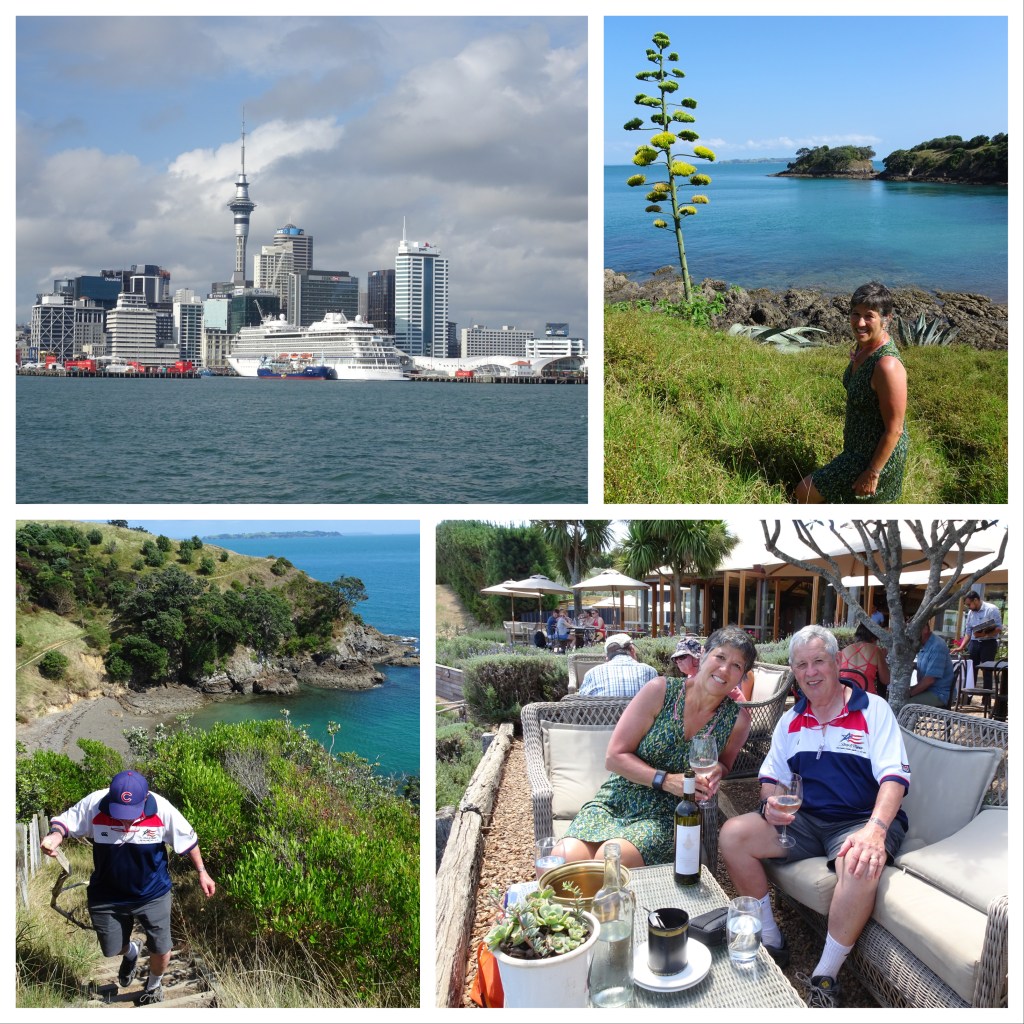
2018 Visit 2008 Christmas with kids
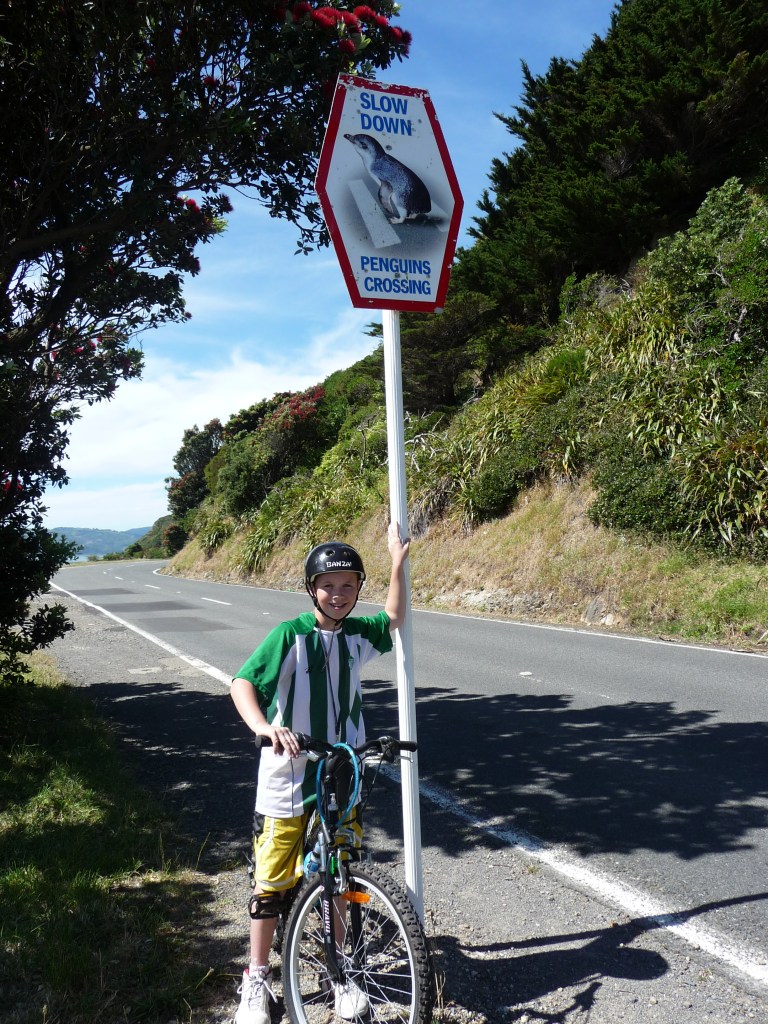
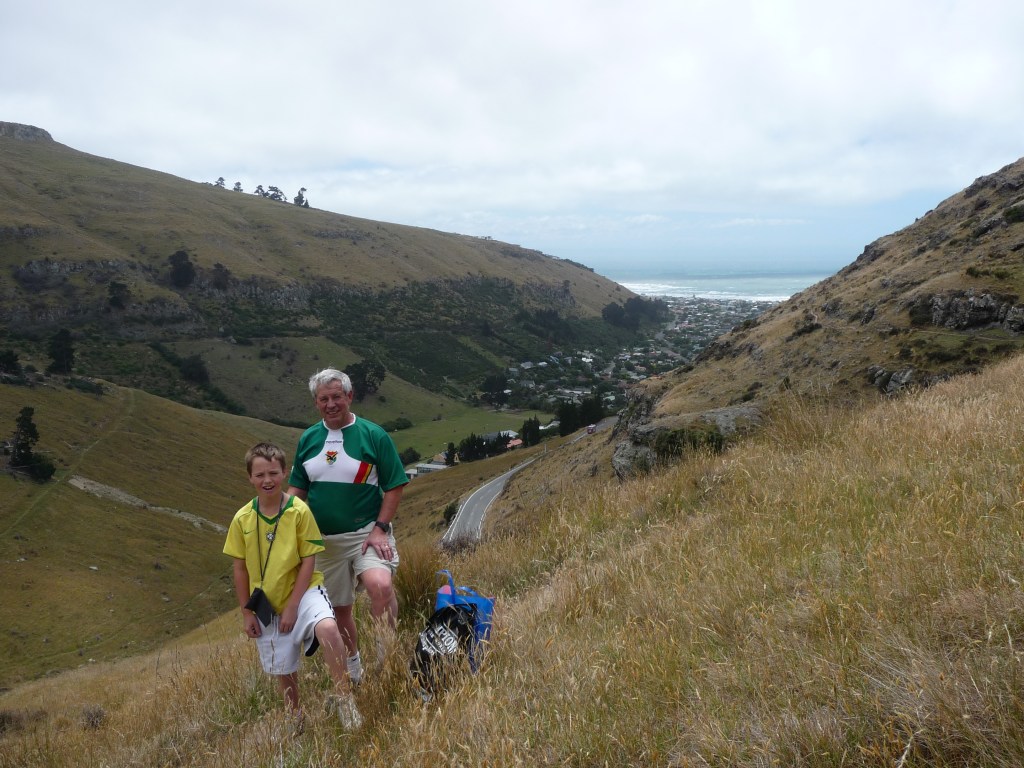
-
Bay of Islands, NZ
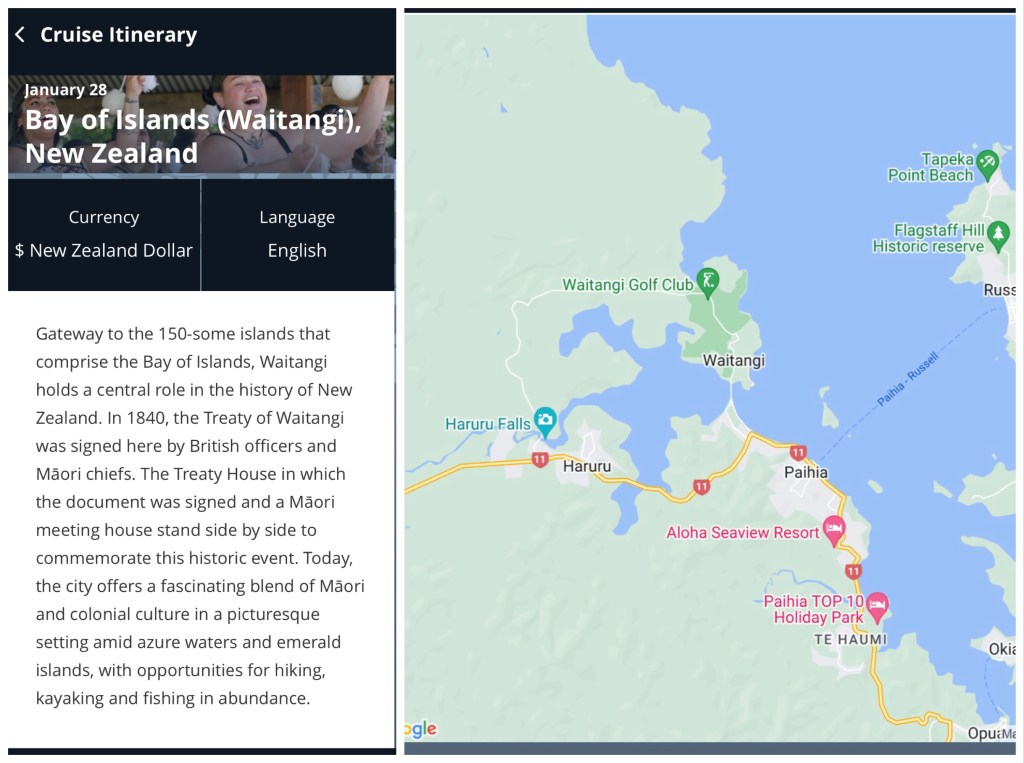
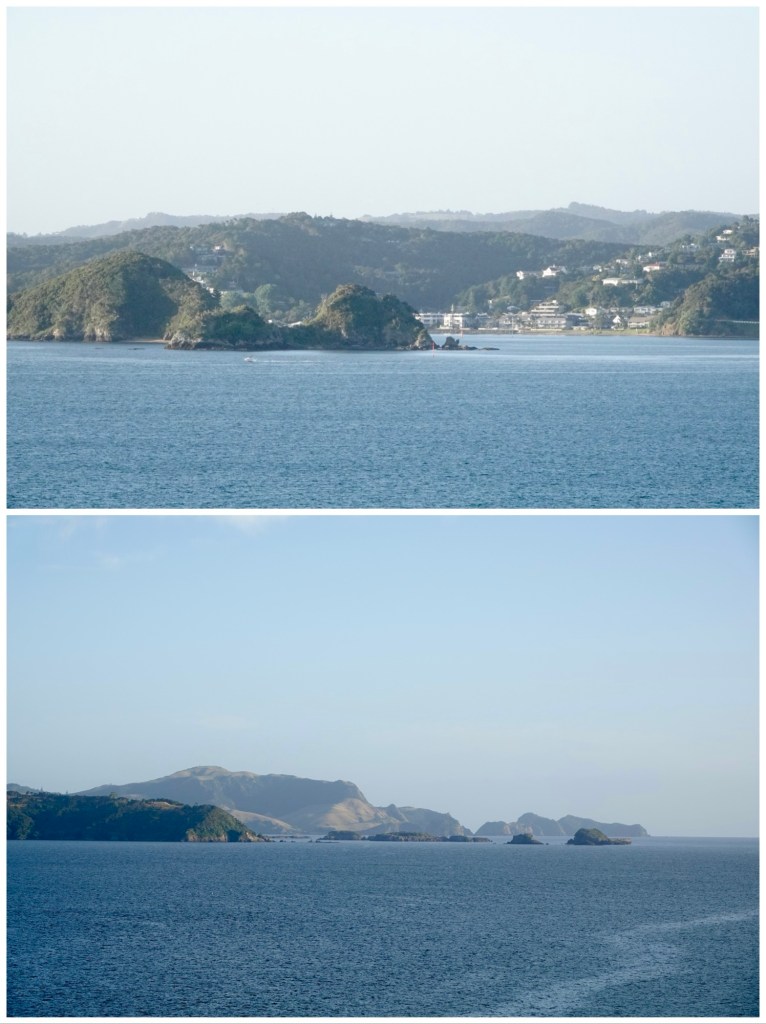
Entering the Bay of Islands 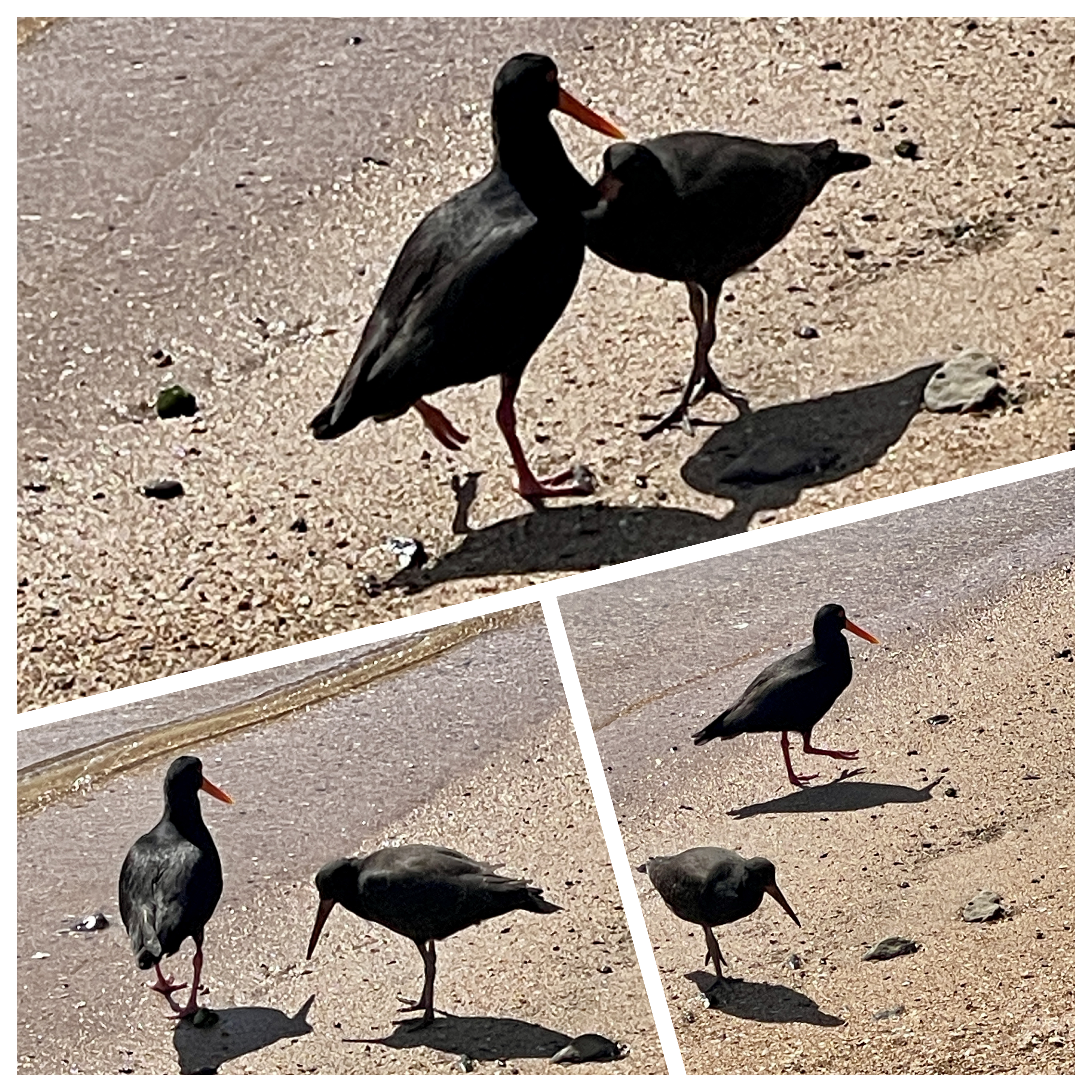
Jan. 28
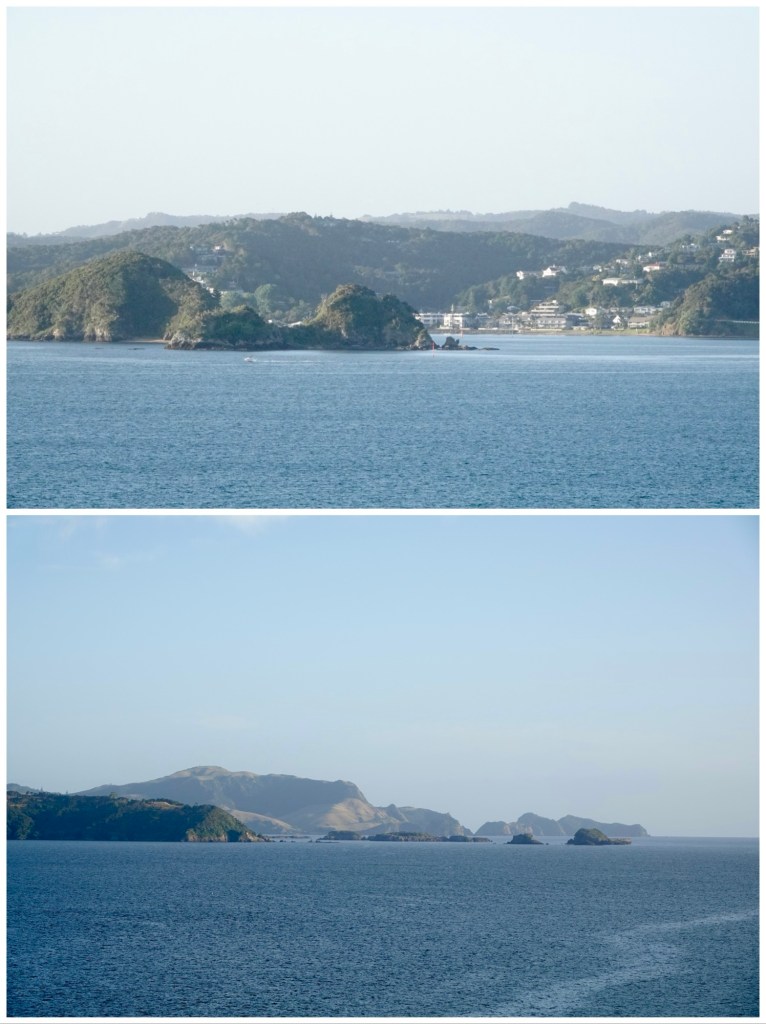
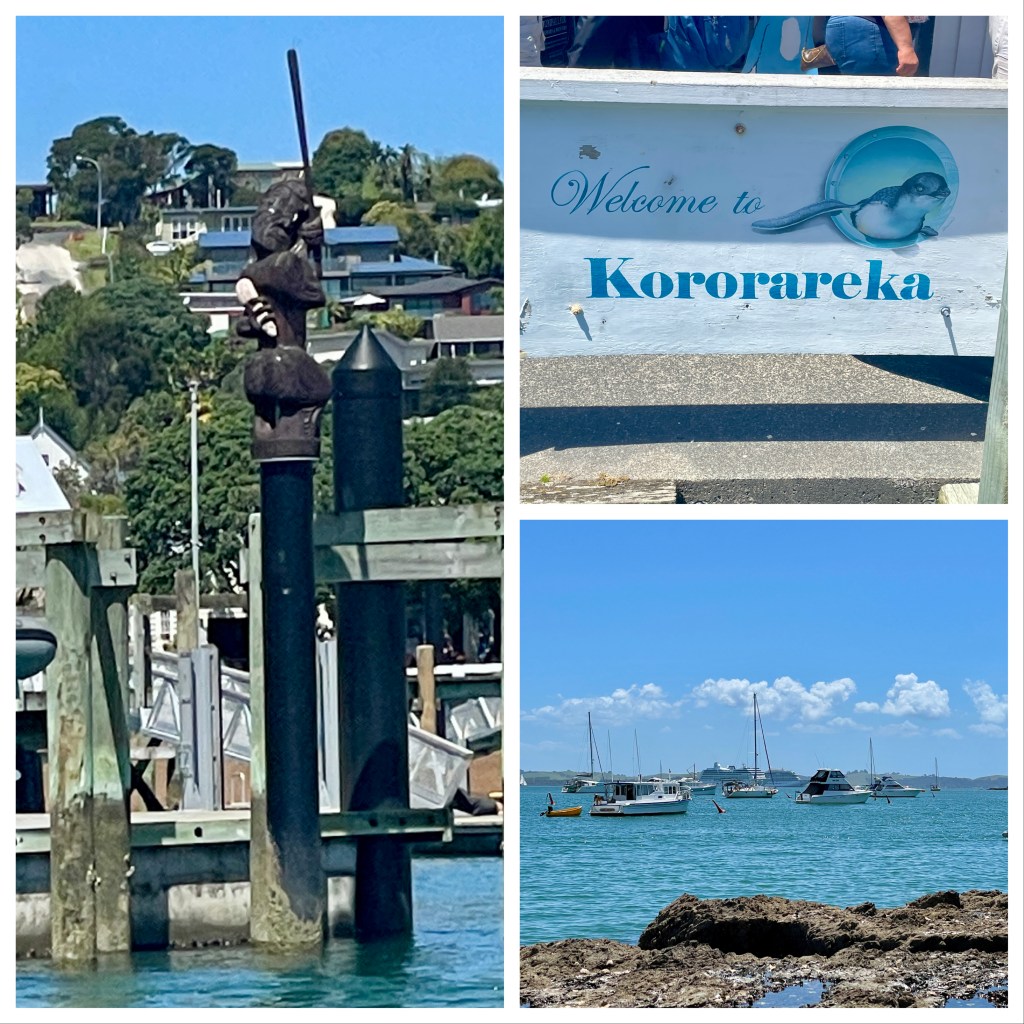
In the late 18th century, Captain Cook sailed into the bay where we are anchored. There are about 140 islands here and he cleverly named it The Bay of Islands. Last time we were here, we were anchored near Russell, an old whaling village…now a more upscale shopping and vacationing center. This year, we anchored near Waitangi, about a 20 minute ferry ride from Russell.
Waitangi’s claim to fame is being the site of the signing of the Treaty of Waitangi by the British and Maori that preserved the rights of the Maori to indigenous lands, governance and rights. However, as with most Treaties, the rights conveyed are still being disputed with claims that the Maori and British versions were different and unclear. Recent legislative attempts to “clarify” has resulted in some Maori groups claiming that rights are being taken away. Walking the streets of New Zealand city-centers, we’d often come upon slogans and signs that say: “Honor the Treaty.”
Our excursion was a 3 1/2 hour bus ride around the island. Our driver/guide took us through great rolling hills geography. There were several small towns, lots of farms and animals and a gorgeous countryside. The pleasant 75* and partly cloudy skies made it more enjoyable. We walked around a park, seeing a Maori canoe and a waterfall.
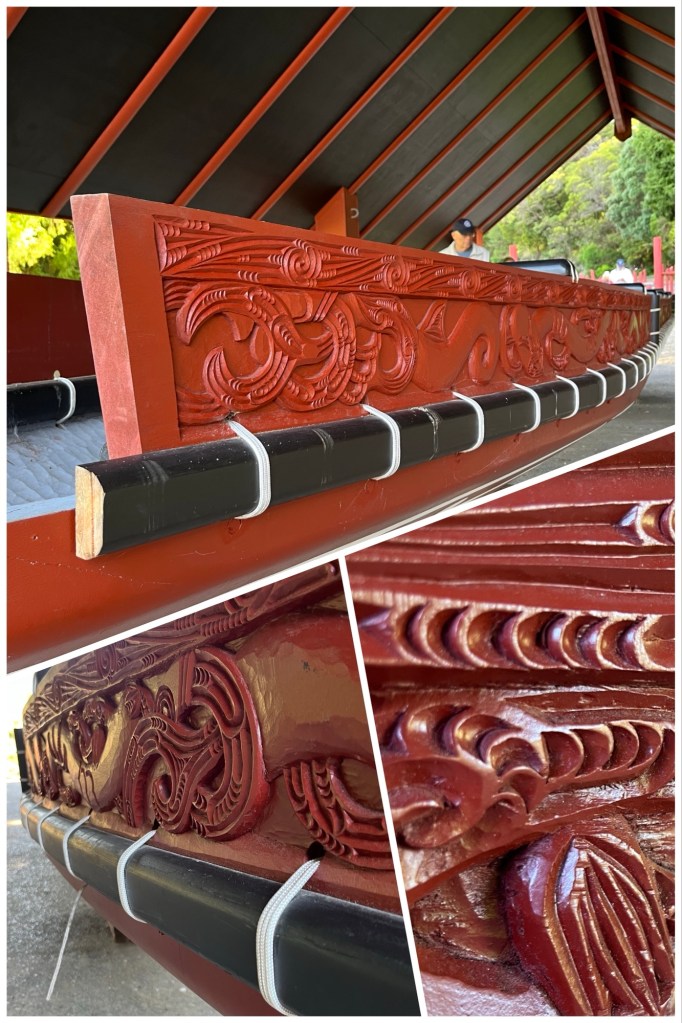
Maori canoe 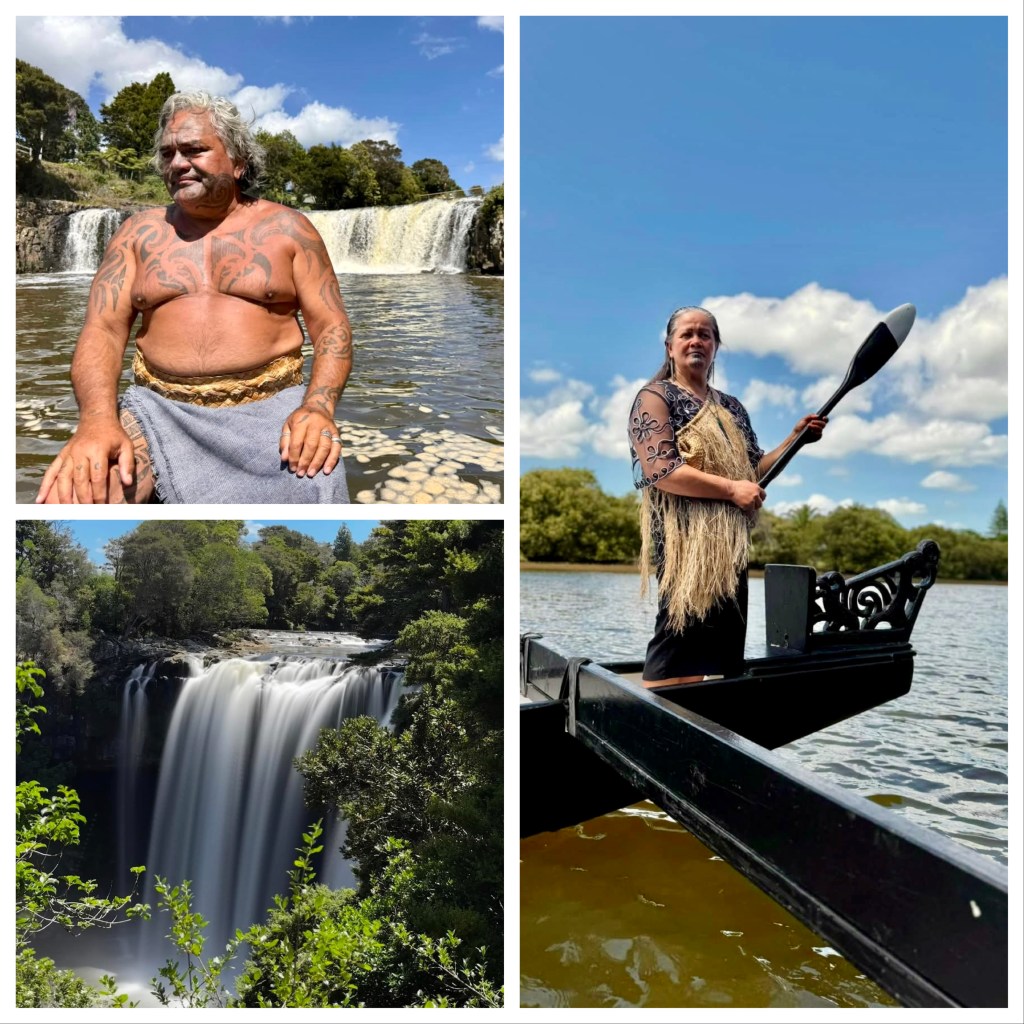
Traditional Maori face and body tattoos 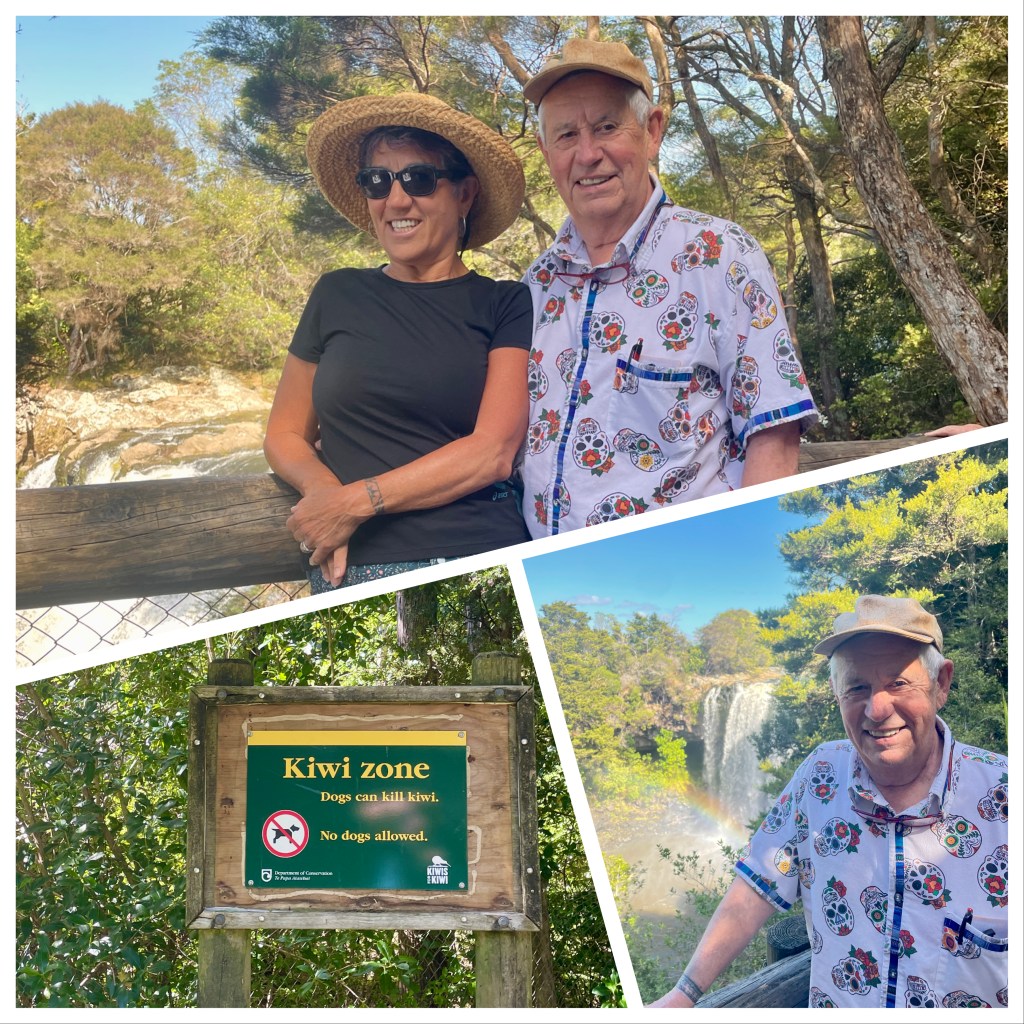
Waterfall hike; no kiwis seen A few thoughts:
-This seems like a great place to live. But, it’s so far away from family and friends.
-We drove miles without seeing any litter. The roads are remarkably clean.
-The wildlife are interesting. Prior to the Maoris arrival, there were lots of flightless birds with no natural predators. Most didn’t survive the Maoris’ hunger. Rats accompanied the white missionaries and settlers and now the flightless birds are gone. However, in 1837, possums were introduced to develop a fur trade. That effort wasn’t successful so it was tried again in 1858. That worked better. Possums reproduced without natural enemies and their population increased to an estimated 60-70 million….10 to 15 times the number of New Zealanders. That’s a lot of passels! Eradication efforts have reduced their number to an estimated 30 million. It would be great if the fur trade were to pick up. Who wouldn’t want a possum shawl….or possum pillow case?
-At two of our stops, we saw a number of RV’s parked in a designated area…near public toilets. It’s legal and provides an opportunity for homeless people. Very comfortable looking spots. So, why not encourage something similar in Portland? Last year, I read that the Portland area governments spent $531 million on homeless/houseless people…..about $71,000 per person. Next year it will probably be about the same. RV’s can cost $30,000 to 100’s of thousands. What about using the $531 million to buy RV’s (on the lower end of prices) for able bodied houseless people? Then give them an additional $10,000 for gas and other expenses….along with a map to Mar a Lago, where the climate is much more comfortable. Then the resources could be used for those who can’t or shouldn’t drive. Perhaps, we should hire New Zealanders to help run our programs. They might also help us with litter and graffiti.
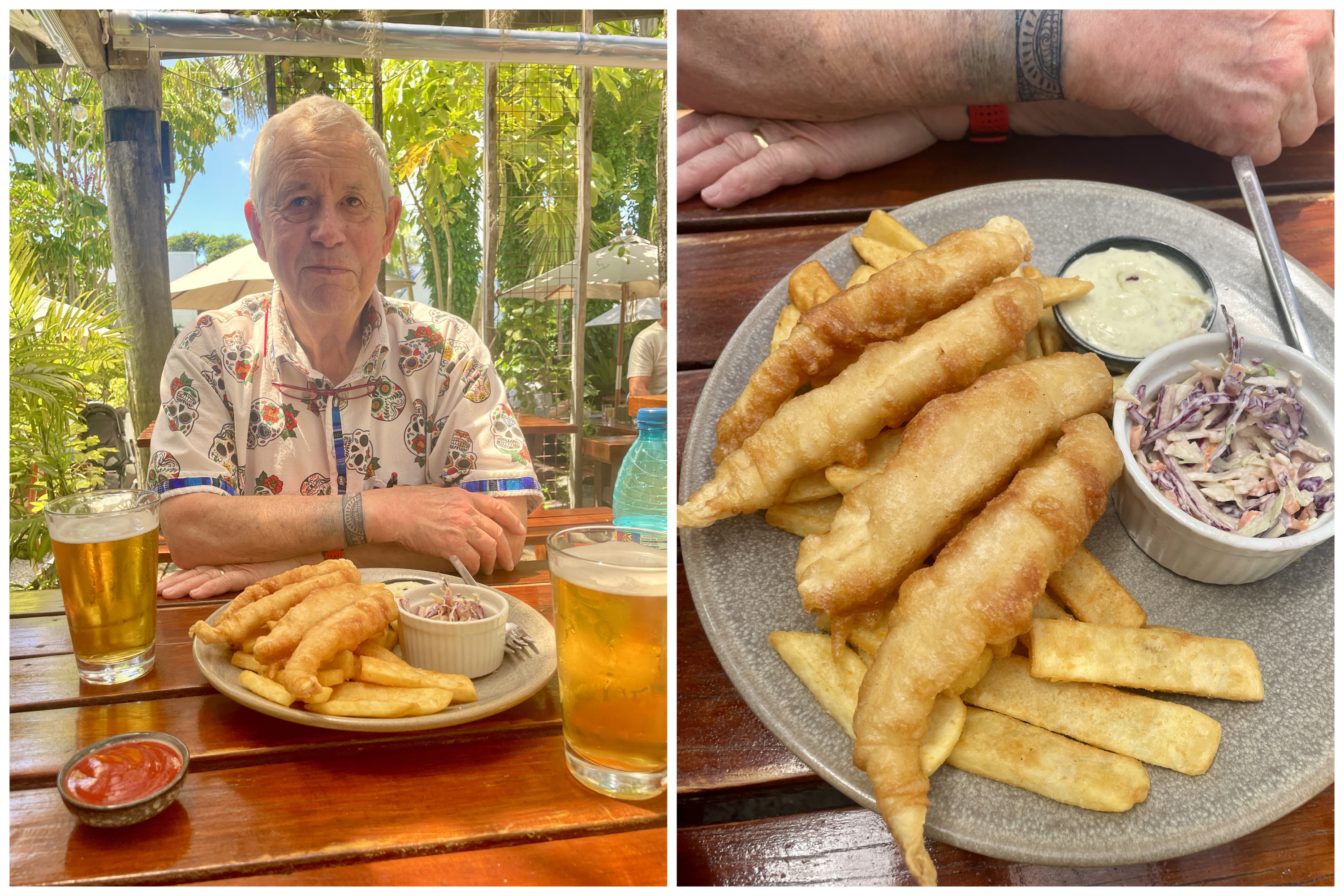
In the afternoon, we took the ferry to Russell. Great fish and chips and beer. Afterwards, Karla went shopping and walked the beaches looking for shells and watching the beach combing birds. She made it back before departure time….although ship security called and asked if I knew where she was. A good visit!
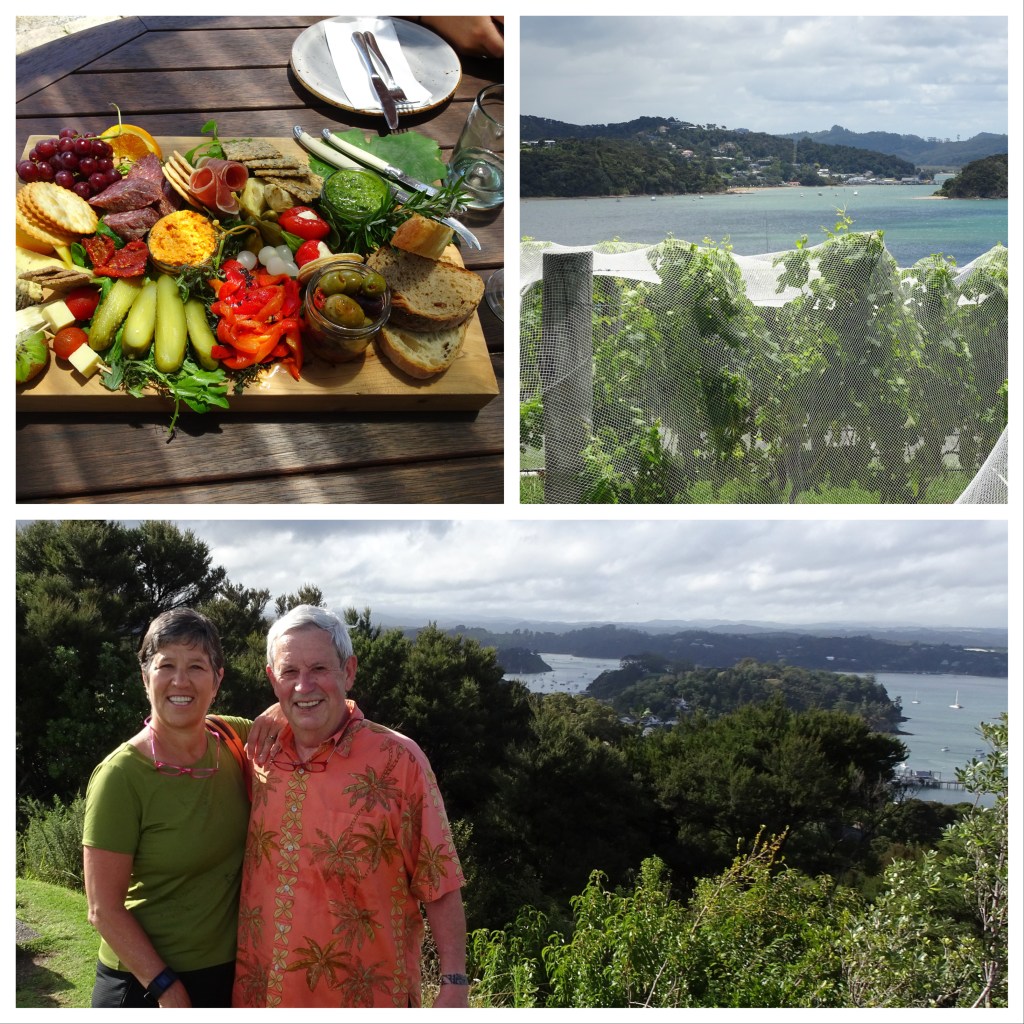
Photos from our 2018 visit to Russell—Onata Estate Winery 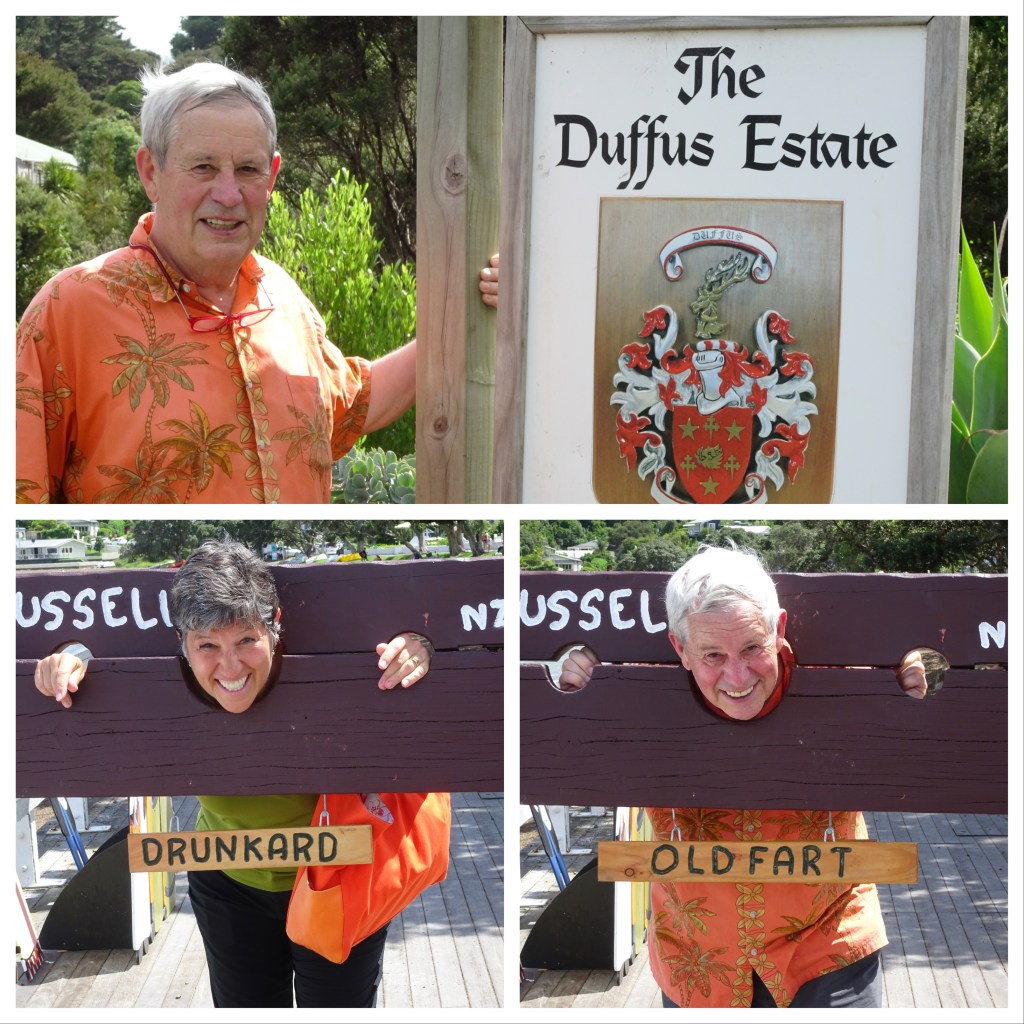
2018– Downtown Russell pillory 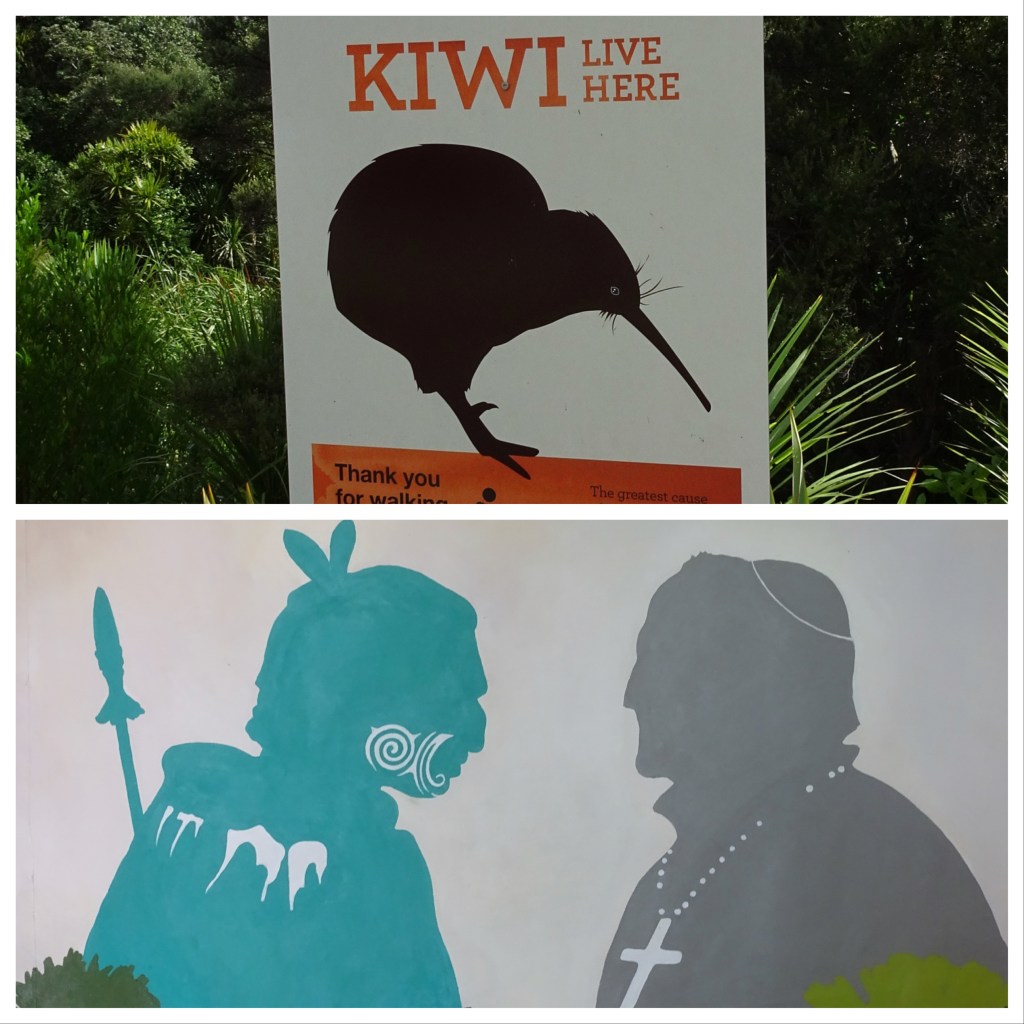
-
Nearing NZ
Jan. 27
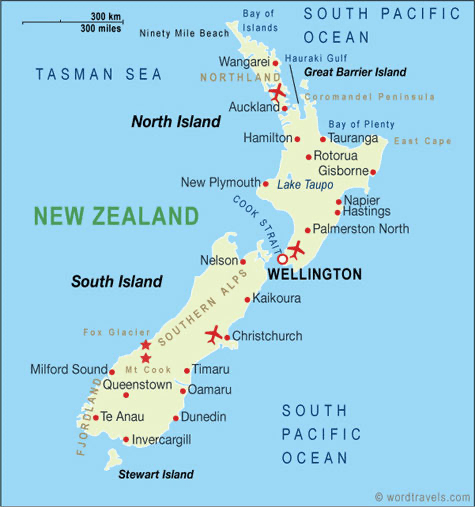
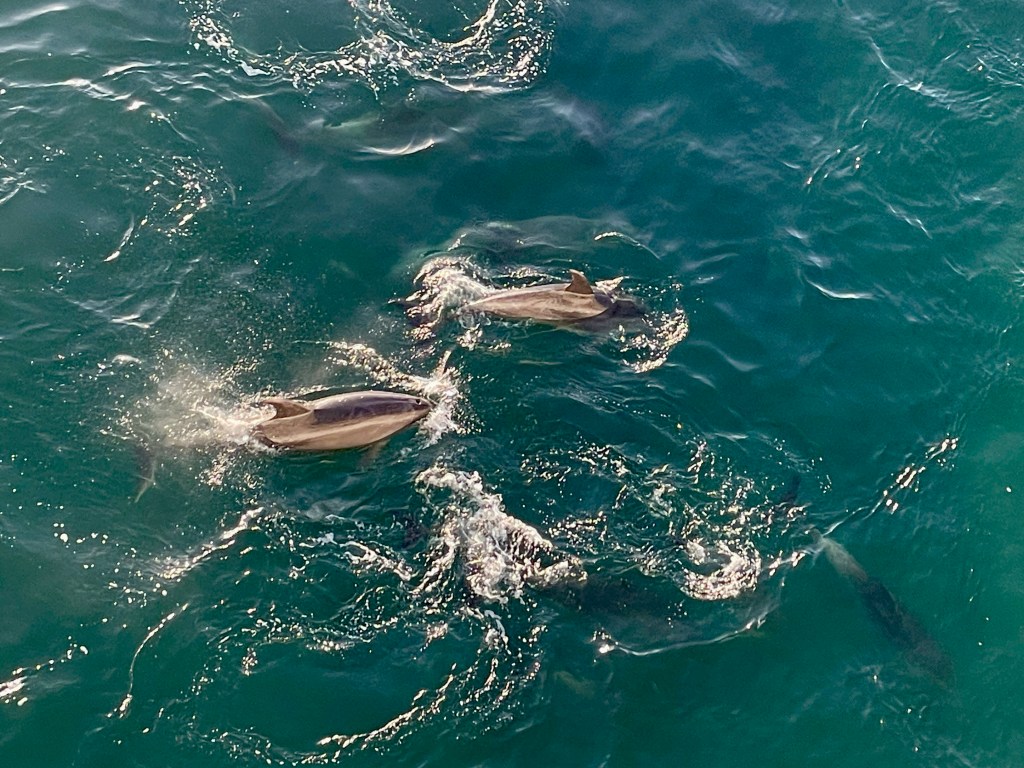
We’re completing 4 days at sea and preparing for 5 consecutive stops in New Zealand, beginning with the Bay of Islands. All of our stops are on the North Island. Then, we have 3 days on the Tasman Sea before arriving in Australia. It looks like Groundhog’s Day will be celebrated on the Tasman Sea.
Today was an unusual day. We had two NFL playoff games at reasonable hours. Having crossed the International dateline, we’re now 23 hours ahead of Washington. Football games starting at 10 and 1 at home were showing at 9 and 12. At half-time of the second game, the Viking Choir sang 5 songs. They were very good, not just because Karla was singing.
We have always enjoyed New Zealand….nice scenery, nice people. On a trip with Maddy and Jackson many years ago, we even considered buying a house on the coast. It would have been a good investment, but it’s just too far away.
With its remote location, the islands of New Zealand were the last major South Pacific islands settled. Besides the North and South islands, there are about 600 smaller islands. In the 1280-1350 period, settlers arrived from the Cook Islands. The Maori culture developed in peace until Abel Tasman arrived in 1642. He departed soon, after experiencing a menacing Haka performance and having 4 of his men killed. Captain Cook paid a more benign scientific visit in 1769. In the early 1800’s, contact with the Europeans increased. On the bright side, Europeans brought potatoes. On the darker side, they introduced muskets. The muskets increased the killing efficiency of the Maoris; about 30-40,000 of them were killed in their intra-tribal conflicts. Missionaries soon followed, with their bibles and diseases. The Maori population was reduced by about 40 per cent.
In 1840, the Treaty of Waitangi was signed which assured that Maoris could retain control of their lands, but gave the English political control. In 1841, New Zealand became a Crown Colony. Whaling, sealing and trade drove their economy. In 1852-1867, there was a “gold rush” which brought more settlers. England offered free passage on ships to citizens who purchased land or free land if they paid their way on ships.
By the end of the 19th century, New Zealand was known as a very progressive country. In 1893, women gained the right to vote. In 1894, they established a minimum wage. as well as compulsory arbitration between employers and unions. In 1895, they developed an old age pension system.
Today, New Zealand is a Constitutional Monarchy. King Charles is the King, but the New Zealanders run the government. It is considered one of the most stable and progressive governments and gets high marks for its achievements in quality of life and human rights. Of the 5.25 million people, about 70 per cent are Europeans, 14 per cent Maori, and 11 per cent Asian.
-
On Board Lectures
Jan. 26
Each day, we read The Viking Daily and plan our activities. We always start with exercise, but then have to figure out the rest of the day. Minimally, Karla has Beginners Bridge and Choir. Minimally, I take a nap. Usually, we have music (guitar and singing) by Paolo at 5. We both look at education sessions and lectures on ports of call.
The education sessions have been very good. My favorite lecturer is Patrick Goodness. He attended seminary on the way to becoming a Catholic priest. However, he got diverted to comparative religions and cultivated an interest in the cultures of the South Sea Islands. His particular skill is to educate on the peculiarities of the cultures in a variety of South Sea communities and then surprise us with a look at ourselves.The overall theme is that gods and myths help us to understand the transcendent and that yesterday’s religion is today’s myth.
He pointed out a number of these “strange” religions that had a creation myth, a great flood, virgin births (many on December 25), life after death, and even rising from the dead. There were main gods and sub-gods that were responsible for these things as well as the sun, the weather, crops, the after-life, etc. After getting the audience in the flow, he figuratively held up a mirror. We think of Catholicism, for example, as monotheistic. But, beyond God, Catholics have Jesus, the Holy Spirit, Mary, and thousands of Saints who assist believers in countless activities. There are even saints for the internet, arms dealers, gas station attendants, beer, and hangovers. He asks, “Are we really so different?”
Continuing with the theme, can you imagine a culture with a religion that features a talking snake, a man with a rib pulled out of him in order to produce a female, a world founded on incest, and where the first man lived to over 900 years of age…even with a rib injury. Or, a world in which an infallible pope places Galileo under house arrest for the rest of his life for claiming that the Earth revolves around the sun. Or, an attorney and sometimes Vice Presidential candidate, William Jennings Bryan, swearing that the Earth is only 6,000 and a few years old at the “Monkey Trials” about 100 years ago.
Goodness gave a talk on cannibalism and described its variety of functions in society. Among other customs, it was sometimes common to eat a brave enemy to capture his spirit. Or, to eat a deceased relative to benefit from their virtues. After getting a variety of reactions, he switched to another strange culture. Catholics eat bread dipped in wine and say that it becomes a human body that they are consuming..
Claudia Hackbarth has given lectures on the evolution of Earth and the humans who have populated it. She points out that the earth is 4-6 billion years old. Relatively recently, in this time frame, human life started in Africa and over 100’s of thousands of years migrated into Europe and across Asia….and across the Bering Straits into America. This happened on a planet which is in a galaxy that is one of twenty million galaxies in a universe that is expanding. (Can you imagine how many gods would be necessary to handle all of this?) There are 6 billion earth like planets, with perhaps 300 million being habitable. Closer to home, there is very possibly a form of life on moons circling Jupiter and Saturn.
This travel can make one feel very small and insignificant. I am reminded of a 1950’s Twilight Zone episode in which the whole program featured a very evil ruler with strong control over his world. At the very end of the program 2 people were walking along a road. One pointed to the ground and asked the other, “Isn’t that something moving down there?” The other picked up the drop of water sized item to look at it. He wasn’t careful enough and the first person said, “Oh, you squashed it.” Served the ruler right. But, are we all living in drops of water relatively?
We’re a bit surprised that Viking allows all of this heresy, but it makes for a better trip. (Parenthetically, I add that we asked a lecturer in the Antarctic why she didn’t mention climate change in her remarks on melting ice and the impacts. She said Holland America wouldn’t “let her.”)
-
Sea Days
Jan. 24-25
We woke up and went about our business without realizing that we had missed the International Dateline. I think that I heard a bump when we crossed it, but am not sure. We are not especially busy so we haven’t worried about what might have been accomplished had we experienced a January 24.
I wanted to spend a bit of time on exploration. According to conventional history, there was lots of that going on over here. In fact, I’m somewhat of an expert on the subject. In the 5th grade, I dressed in dyed nylons and an “explorer hat” and carried a wooden sword while speaking about Columbus and other famous explorers to several classes at Multnomah School. I moved through Columbus discovering America to other Voyages of Discovery with the strength of the Pope’s Treaty of Tordesillas dividing the world between Spain and Portugal. In 1494, the Spaniards unleashed a number of explorers to gather available gold and silver, subdue and Christianize the natives, and establish colonies. Portugal was able to colonize Brazil in accord with the Pope’s guidelines.
Around the same time Bartolomeu Dias sailed around Africa in 1488, trying to find a way to India. In 1498, Vasco de Gama made it around Africa to India. It wasn’t clear to me at the time (5th grade) that these voyages were prompted by the Ottomans taking control of Istanbul and blocking the overland trade routes from the east. Columbus headed West to find the Indies, not knowing that the Americas would get in his way . Dias and de Gama headed around Africa to get to the same destination. Over the next couple of centuries, the British, French and Dutch joined the trading, colonizing, Christianizing efforts. There was lots of discovery going on.
There were several asterisks. Current theory is that Asians moved across the Bering Strait and discovered America thousands of years earlier. The Vikings landed in Newfoundland 500 years before Columbus. Amerigo Vespucci arrived in the Americas a few years after Columbus, but got the continents named for him. At least, Columbus was able to name the Indians, thinking that he had arrived at the East Indies. The existence of the South American sweet potato in the South Sea Islands suggests that there was more travel going on. As I wrote earlier, there were thousands of years of exploration and settlement going on in the South Seas before the Europeans knew they were there.
Another new addition to my fifth grade education… the Chinese were very active before the Europeans thought about exploring. According to Chinese history, Genghis Khan discovered Europe in 1223. That serves the Europeans right since they later “discovered” lots of areas where people already lived. The Chinese sailor Zheng He dominated Chinese trade from 1405 to 1433. He commanded 63 ships that were about 10 times the size of the Nina, Pinta and Santa Maria. His fleet traveled and traded in Japan, the South Sea Islands and India….before they were discovered. For whatever reason, a new emperor turned his focus inward and the Chinese discontinued lots of their voyages.
History seems more complicated than it was in 1952….or in lots of western textbooks.
-
Rarotonga
Jan. 22
Turtles and Tatts
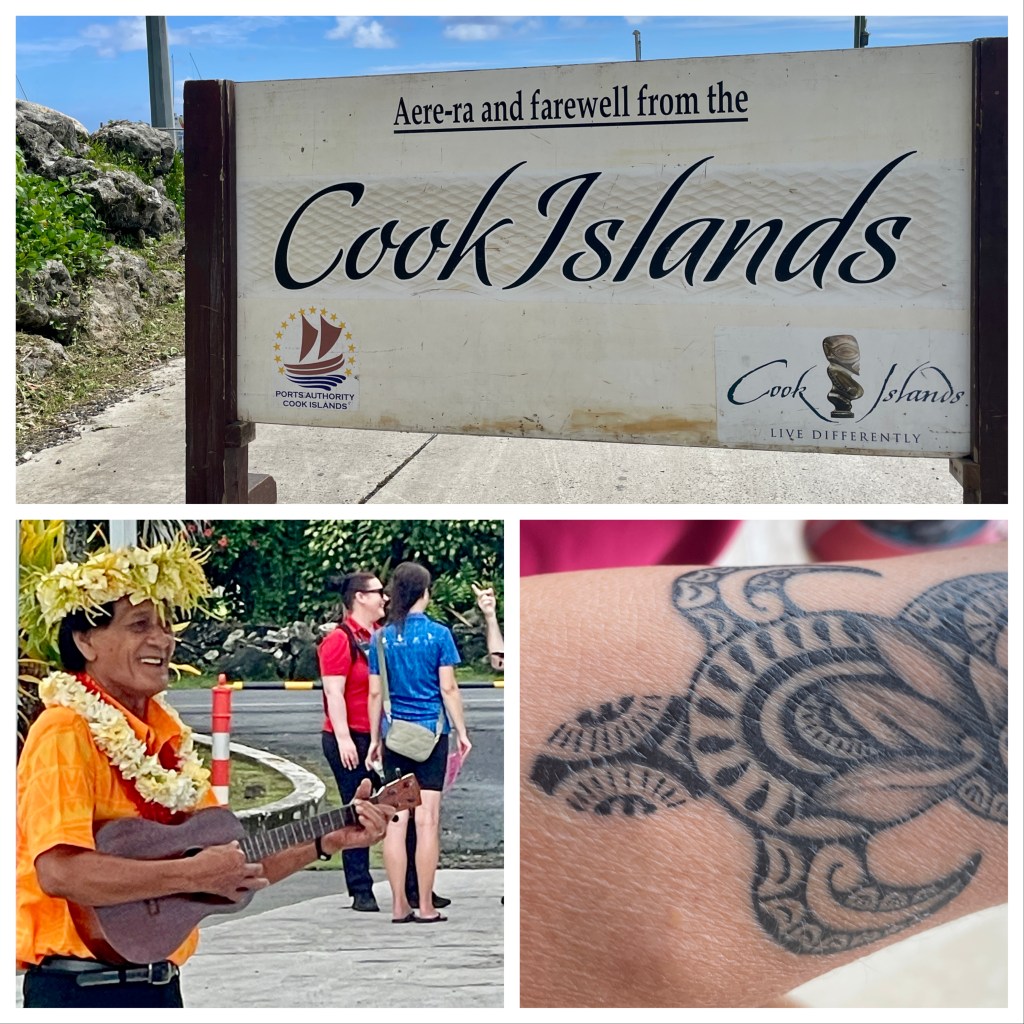
Having experienced trips around a couple Polynesian islands, we decided to focus our energies in Rarotonga. Karla arranged a “swim with the turtles adventure” for 7 people. They departed on a tender upon our arrival and were picked up on the dock. Their 2 hour adventure won high marks.
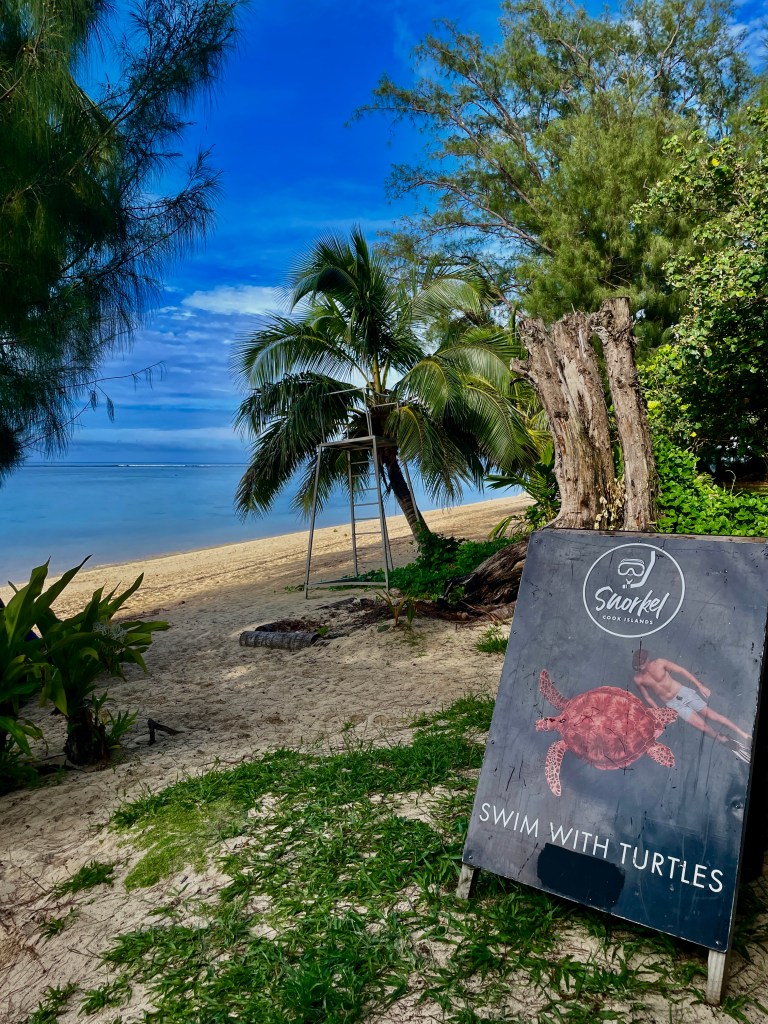

I’ll let her describe the experience:
The turtle experience was fabulous: there were 9 of us from the cruise and the tour operator sent a taxi to pick us up and deliver us to the Avaavaroa passage beach site (about 20 minutes away) where we met our young and very enthusiastic tour leaders. After orienting us to the bounds of the swimming area and safety considerations, they conducted a brief swim test of each of us and asked if there was anyone who wanted to be pulled on a foam lifeguard buoy. There were a couple takers. We saw plenty of sea turtles (all green; no hawksbills) including “big mama,” about 85 years old. The turtles were swimming and resting on rocks and our guides snapped photos as they could. It was a great day; the water was a nice temp–neither too warm nor too cold –and the sea was calmer than expected, as we were warned of strong currents.
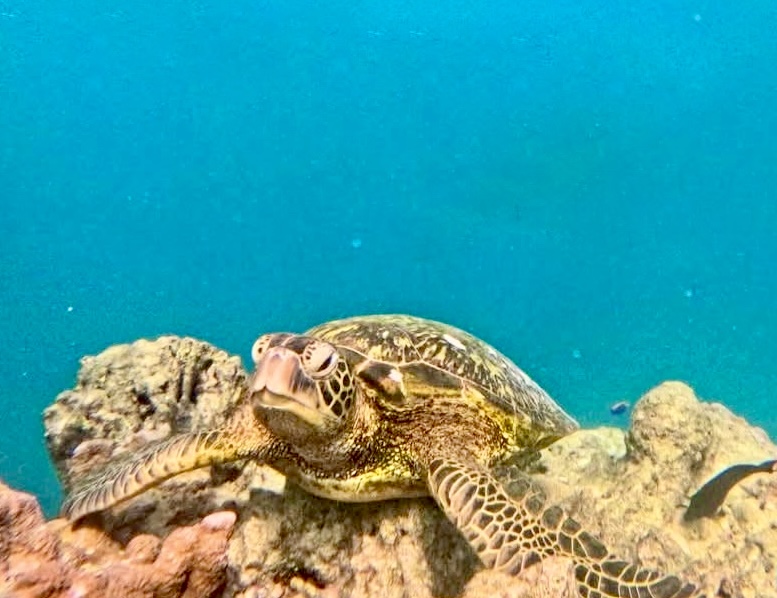
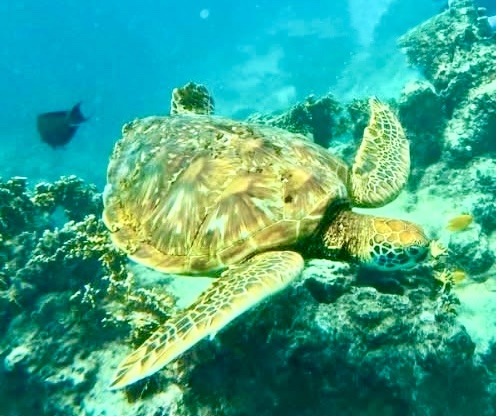
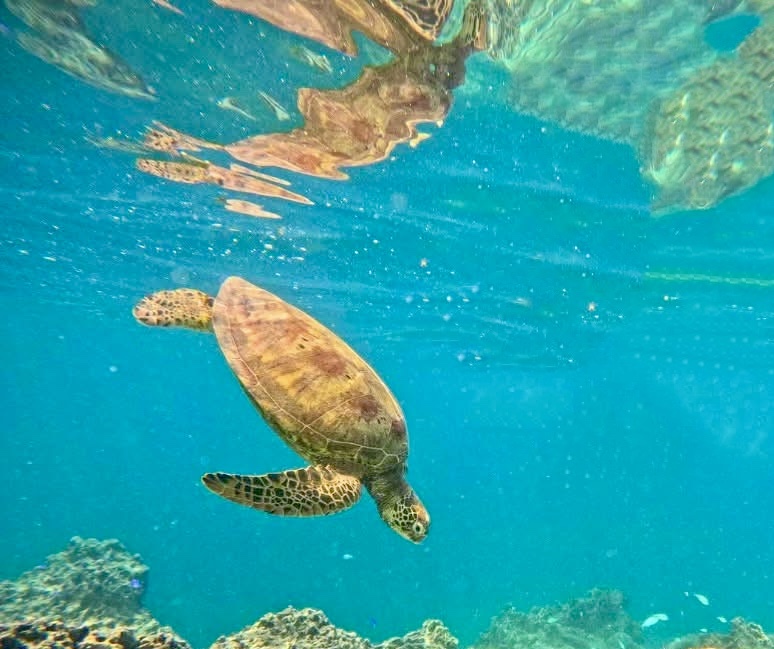
Back to Fred: My mission was to get us tattooed before we left Rarotonga. Emails to several shops resulted in no responses….even the “chat here” invitation was a blank. When we got off the tender, I asked a young security person where to find a tattoo shop. He pointed me in the right direction and I arrived about 8:15. One of the artists arrived a few minutes later and I thought I was in business. But, he said “no” to US dollars. An ATM said ‘no” to my visa and the bank wasn’t open. I returned to the shop, feeling a bit defeated. By then, the owner had arrived and she was much more accommodating. She said they could handle me and accept US dollars on a 1:1 basis with New Zealand dollars. NZ dollars are worth 65-70 cents US. However, they wouldn’t be able to fit Karla in. I said that she just wanted a little turtle and she finally scheduled Karla for 3.
I explained that I wanted a wrist tattoo, like we got 5-6 years ago in Bora Bora. I didn’t want a copy; rather I wanted to see what he could do with the same words we had provided the artist in Bora Bora….sun ocean, people, whales, community. The artist was able to identify the unoccupied wrist and started drawing…..then cutting….then inking. It’s a bit painful; I described it as harder than childbirth, but not too bad. He finished with a product that was better than I had expected. I couldn’t find the whale, but he said, “there wasn’t room.” I was still pleased with the outcome. I tried to tip him, but it was in US dollars and he wouldn’t accept them. Tipping is not common. I returned to the ship and Karla found me a bit later….happy with her turtle experience.
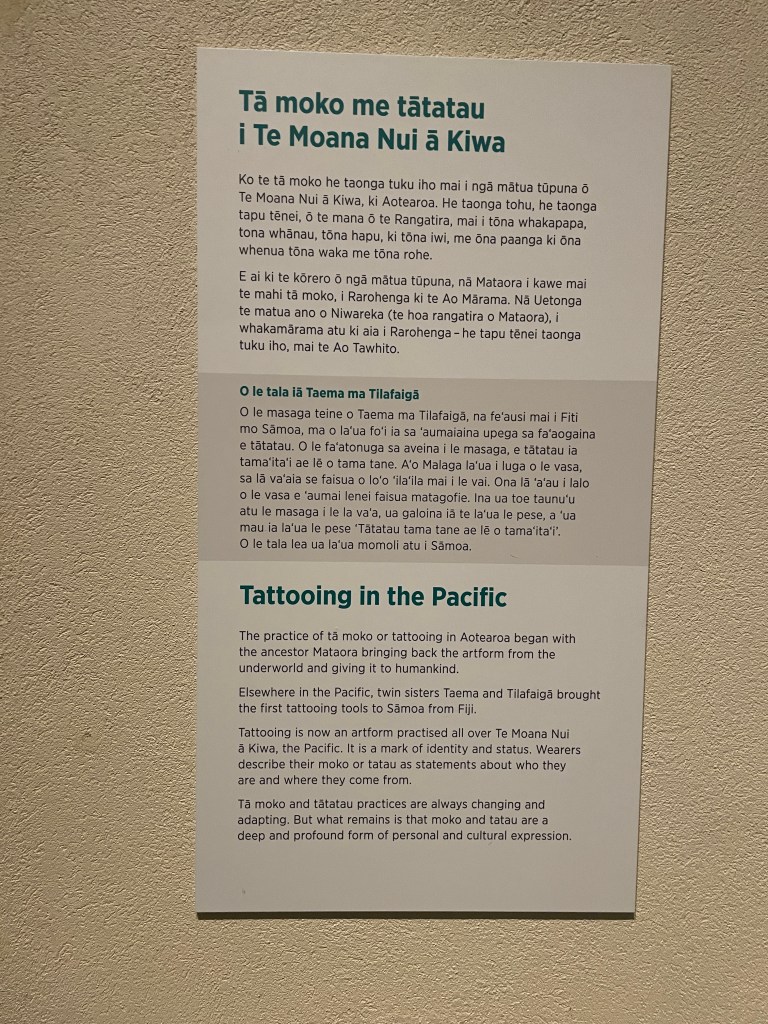
A little about tattooing: it is practiced as an artform all around the Pacific, with the “tatau” being marks of identity or status– saying something about who they are and where they come from. Captain Cook commented in his journals (1769) about tattooing among the people of the South Pacific. Turtles (hong) symbolize endurance, long life, prosperity, protection (hard shell), family, and spiritual energy (mana). In Hawaiian culture they are viewed as spiritual guides, being thought to have led Polynesians in their migrations across the Pacific.
We walked to the shop so she could get a sense of where to be at 3. After some discussion, they agreed to take her then. A young artist started drawing a turtle with a flower on its back. He completed the turtle outline pretty fast, but then drew and redrew the flower and other details 4-5 times. I was watching and thought several of his “early drafts” were fine. But, he would rub them off and then redraw. When he finished, It looked somewhere between great and spectacular. Karla was more than pleased. This guy accepted a tip, but reluctantly.
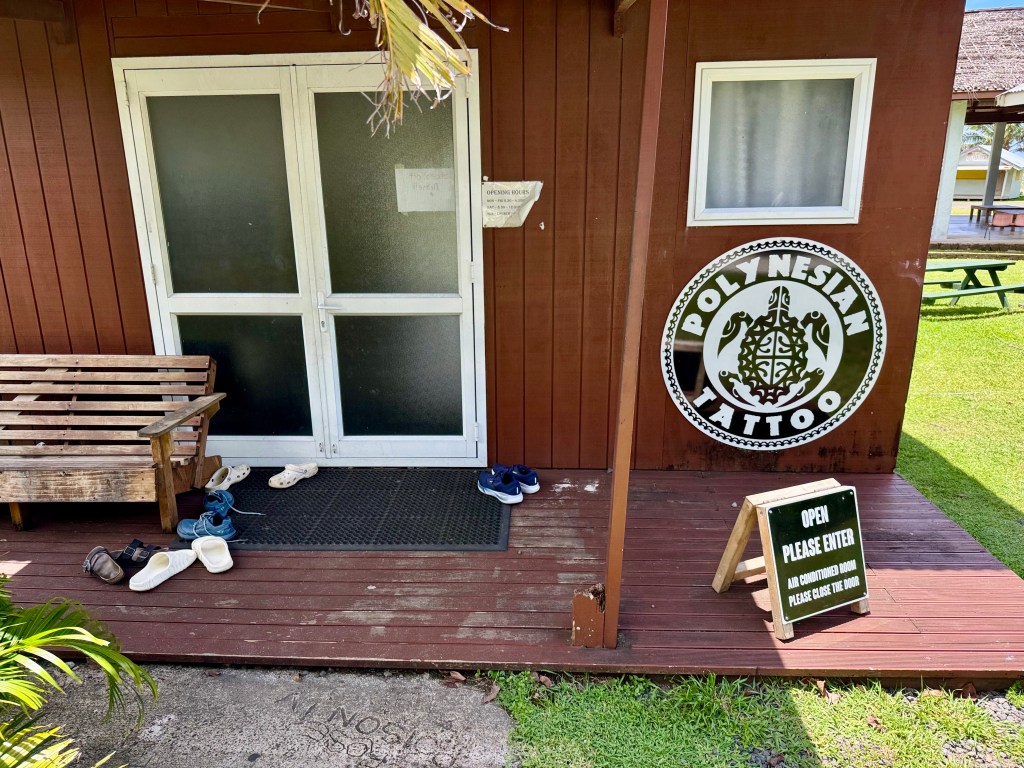
A friend passed by and snapped this photo of our shoes outside the shop 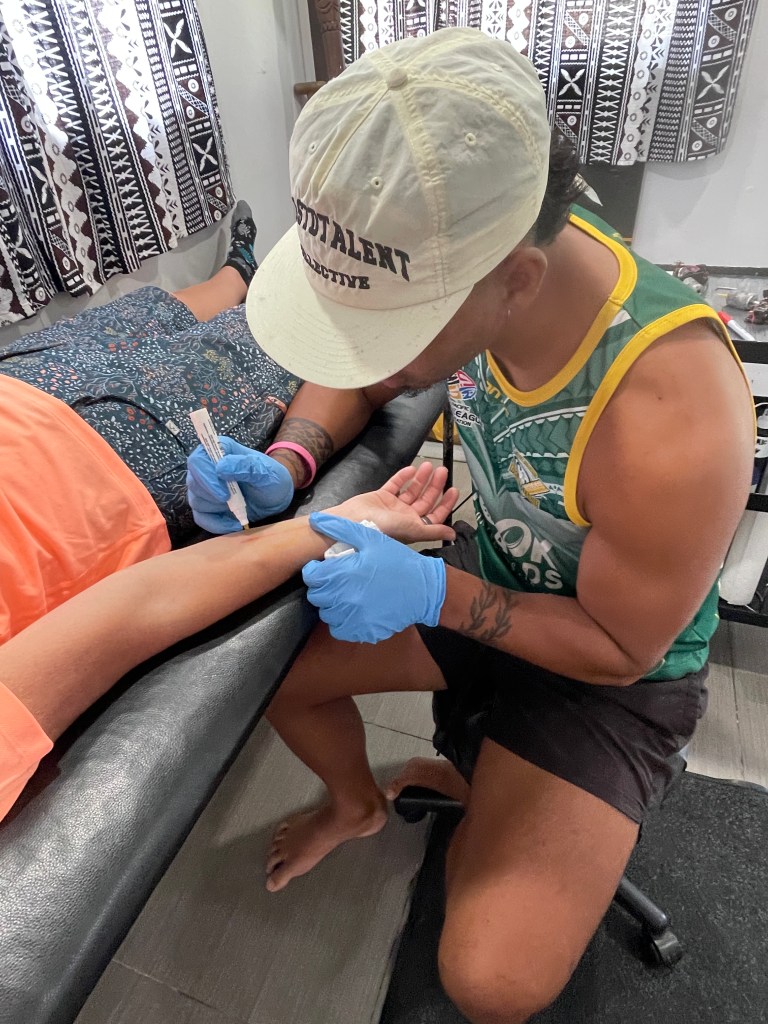
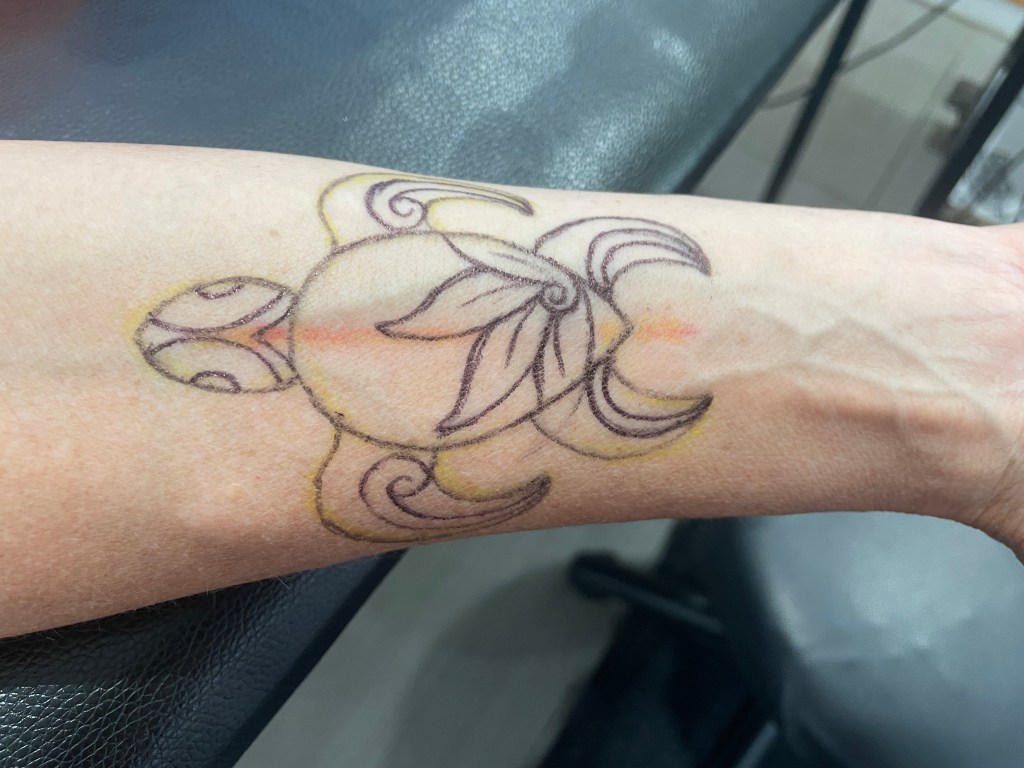
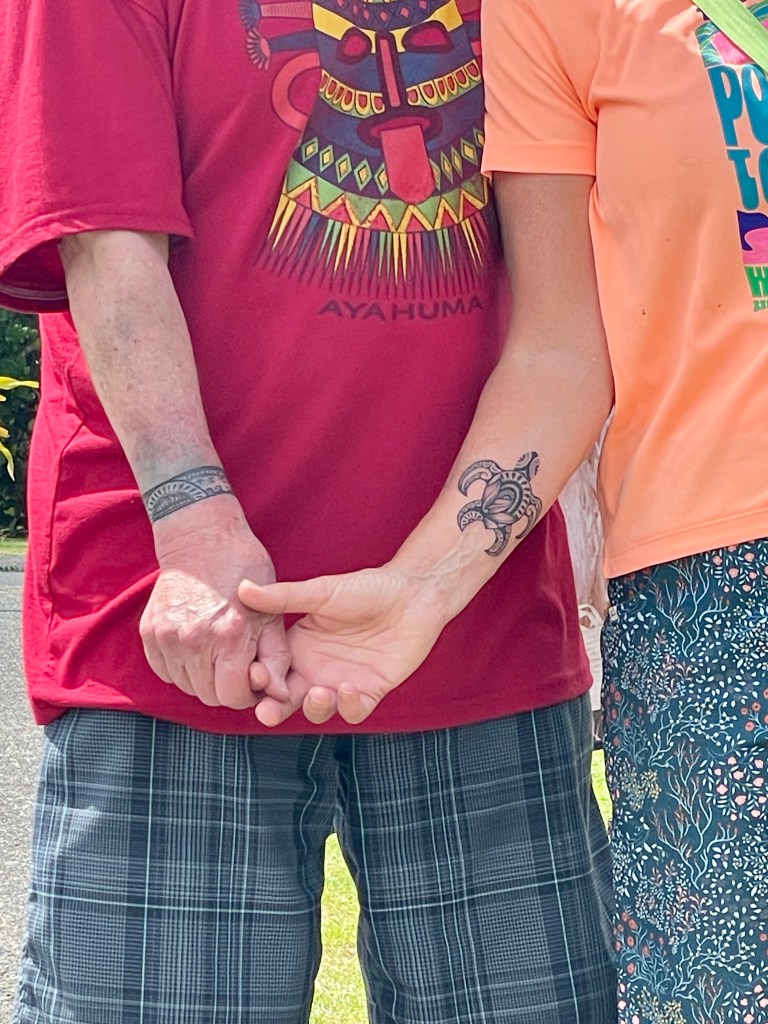

We were lucky that it all worked, but, of course, sometimes you make your own luck. As we got on the tender, there were ,”how long do you think that will last” comments. People had trouble believing that they were real tattoos. I had to use my response after the Bora Bora tattoos….”I’d like mine to last another 10 years; Karla wants something more like 30.”
Our memories of Rarotonga are positive. Karla commented that our scorecard is really more about what we did than the island itself. All of the islands are volcanic, lush, and tropical; not all of them have turtles and tatts.
-
Subscribe
Subscribed
Already have a WordPress.com account? Log in now.
 Millers World Cruise 2025