-
Greenwich, England
May 5-6
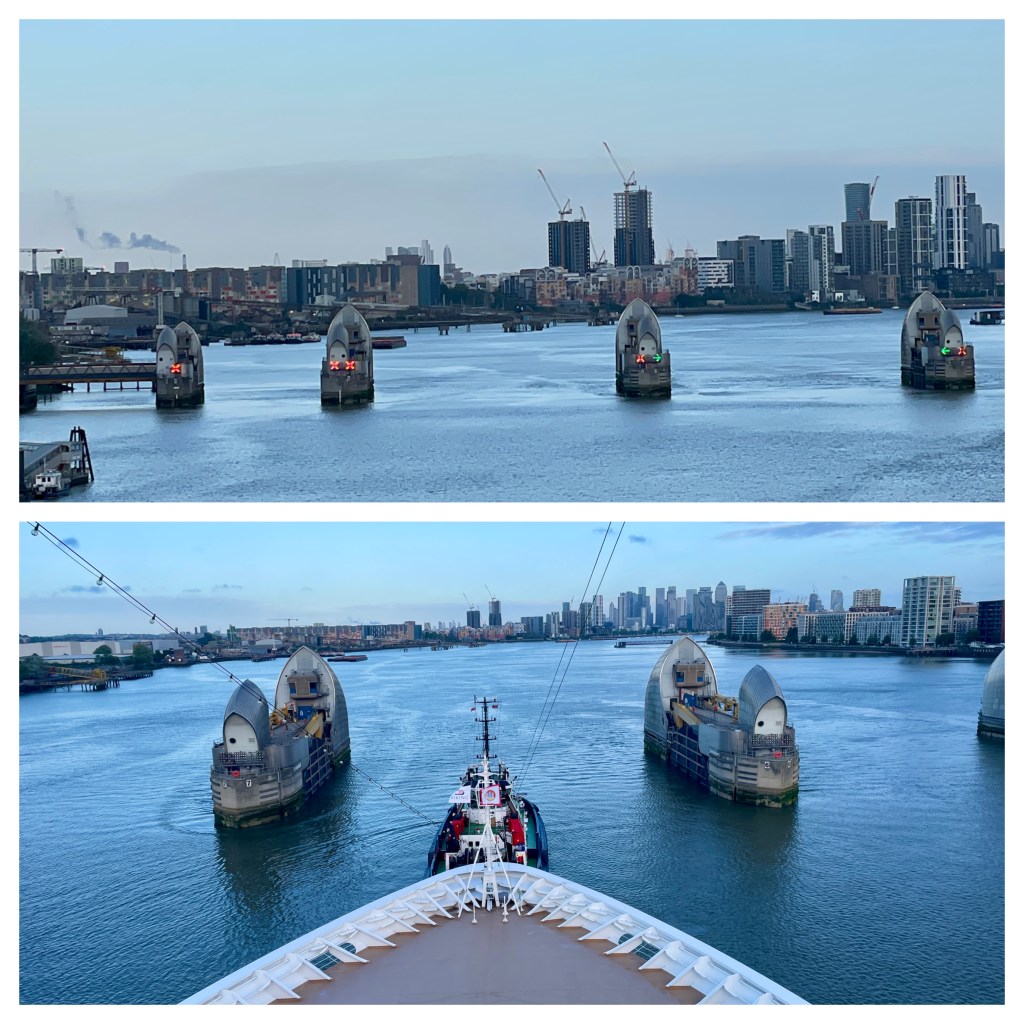
Entering the Thames River and the lane controls On our last evening before docking at Greenwich, we had a great dinner with our best friends group honoring JoAnna’s birthday….which would take place several days later. One might think it was so she could be sure to get presents. But, she and Mary brought a bottle of 1975 Port so that speculation doesn’t work. Two of our favorite crew members, Grace and Damian, were the servers so it made the evening special.
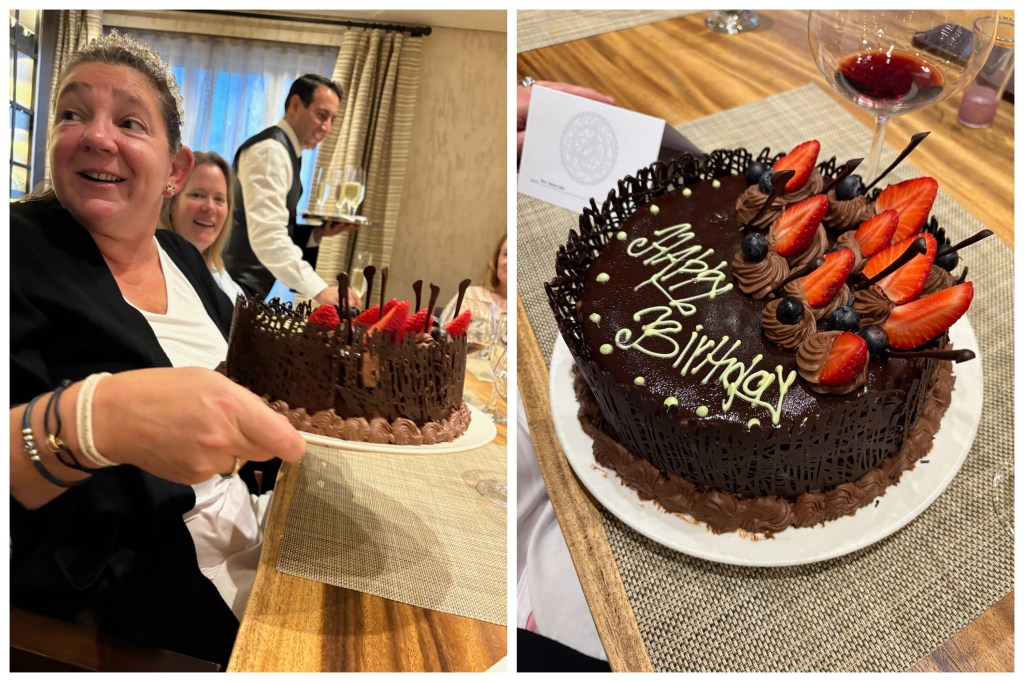
Joanna and Mary, with Damian serving wine. 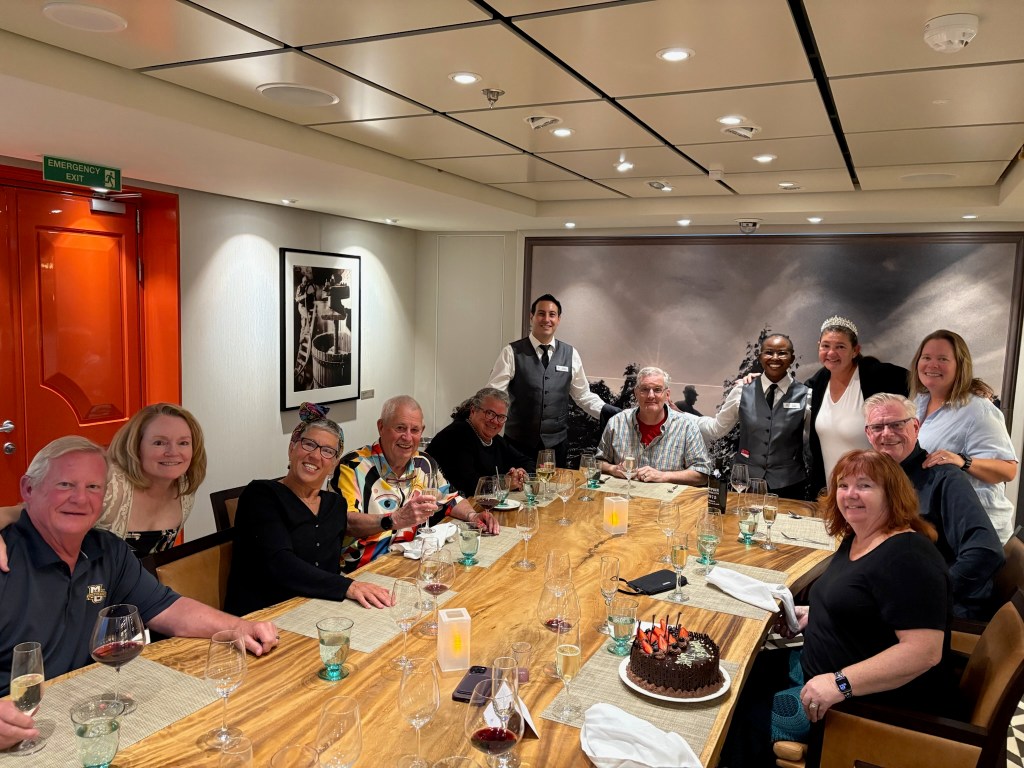
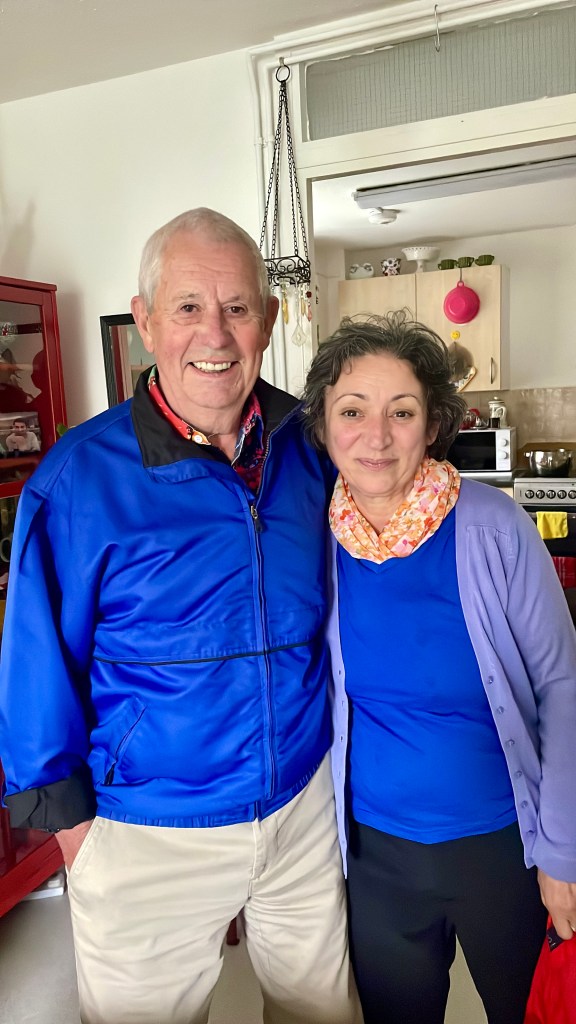
From left to right: Dave, Mary, Karla, Fred, Kathy, Damian, Mike, Grace, Joanna, Mary, Kevin and Mary. In Greenwich, we had breakfast with some friends from our last cruise who are traveling from London to the US. Then, we visited Soreya, mother of our 3-year exchange student, Dastan. We visited Dastan in Sarajevo last year; he’s working with the UN. He’s now in South Sudan, favoring easy assignments. The travel allowed us (Karla) to become familiar with the tube-train system. I just followed her around. It was worth it for Soreya’s meal.
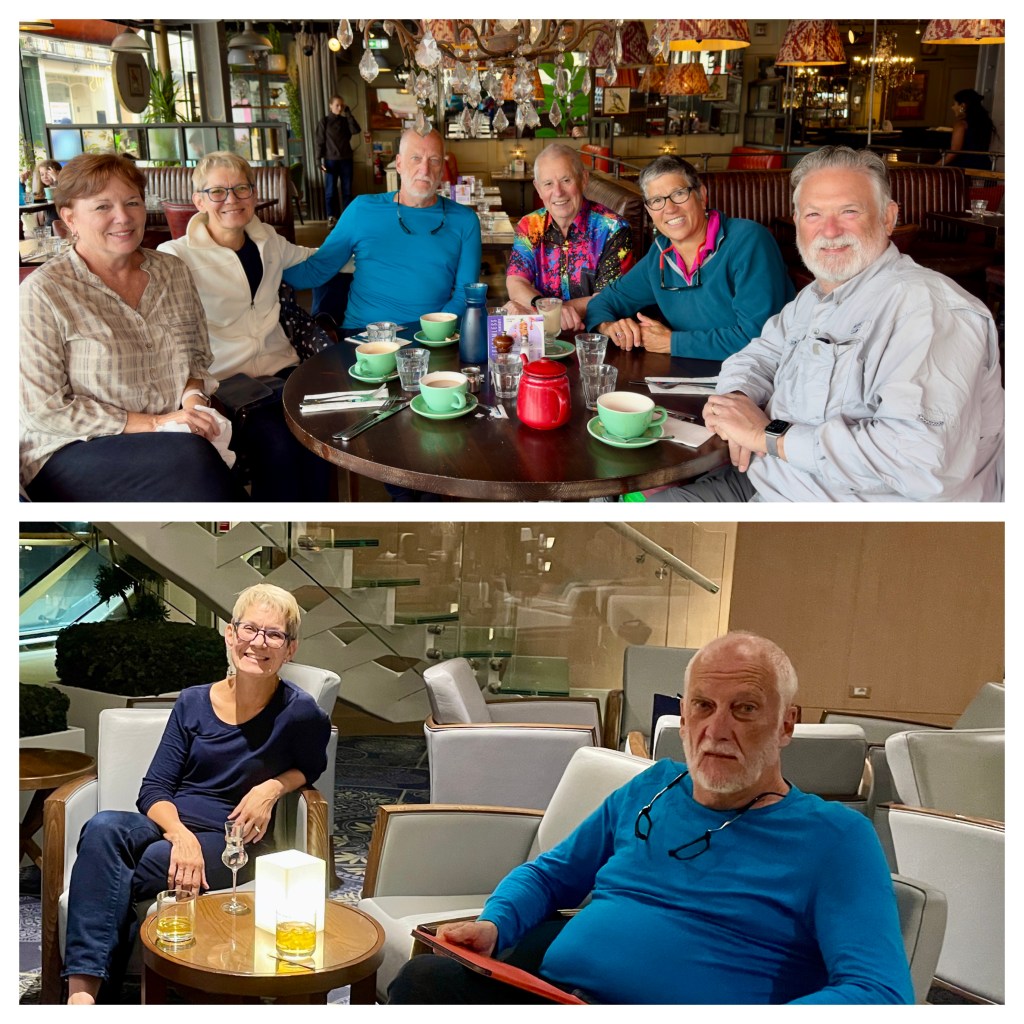
With Judy and Bill Murden, from previous world cruise, who were boarding in London to travel to NY; and Ted and Rose Brooks. 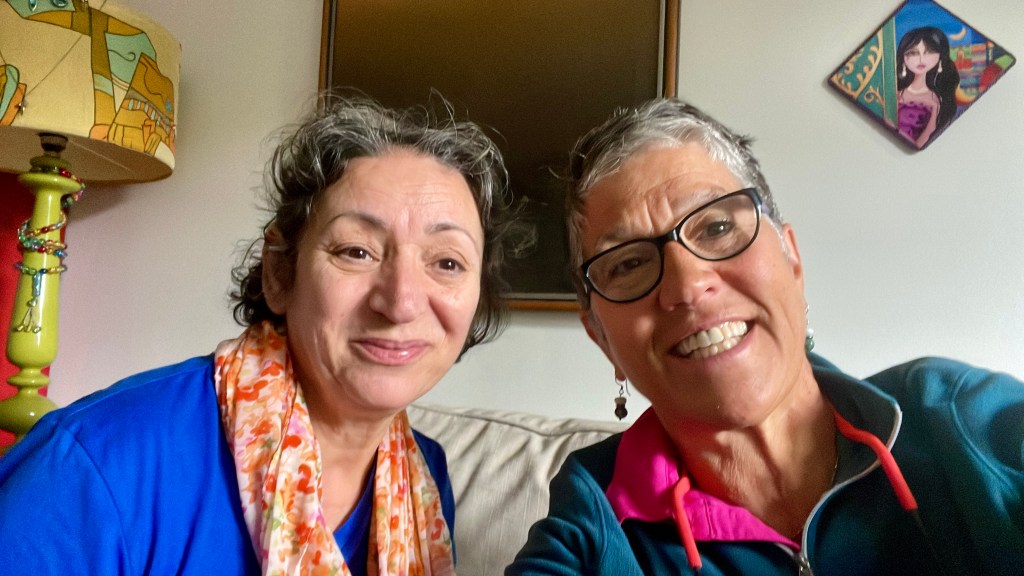
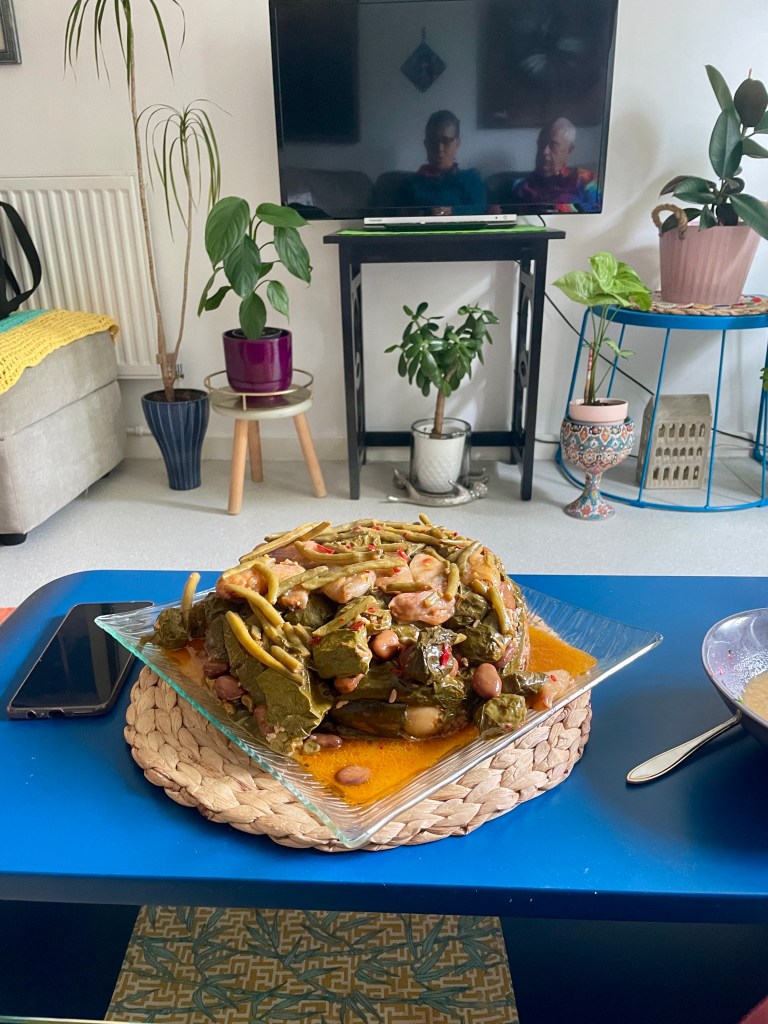
Delicious dolma 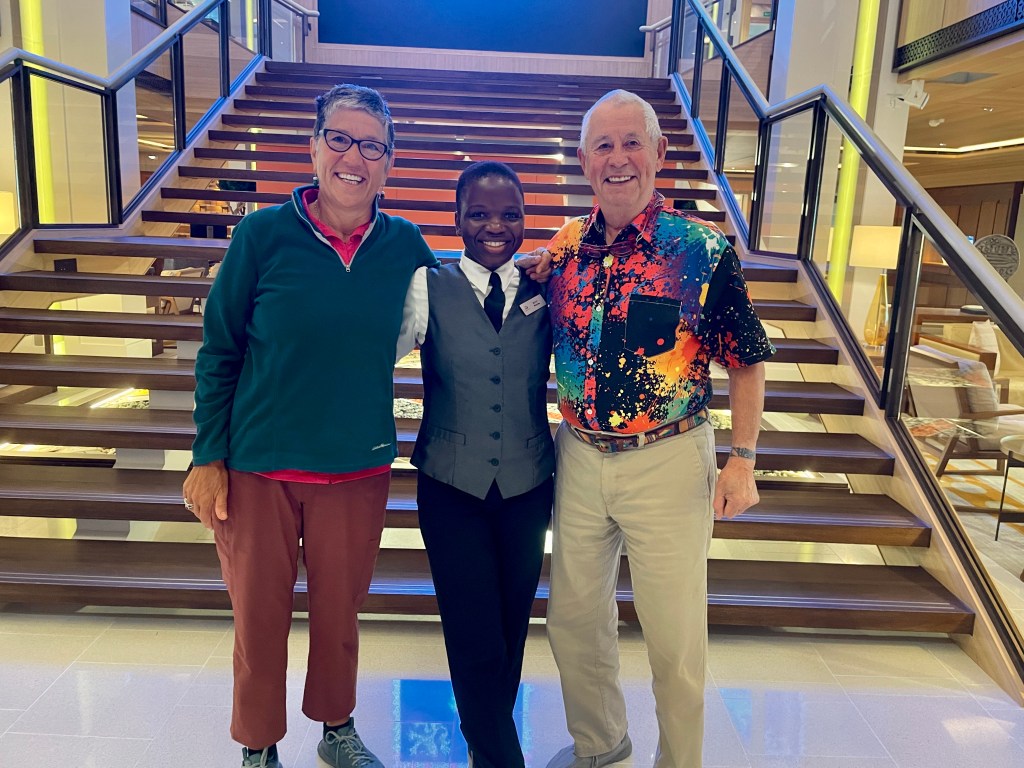
With Minor, one of our favorites 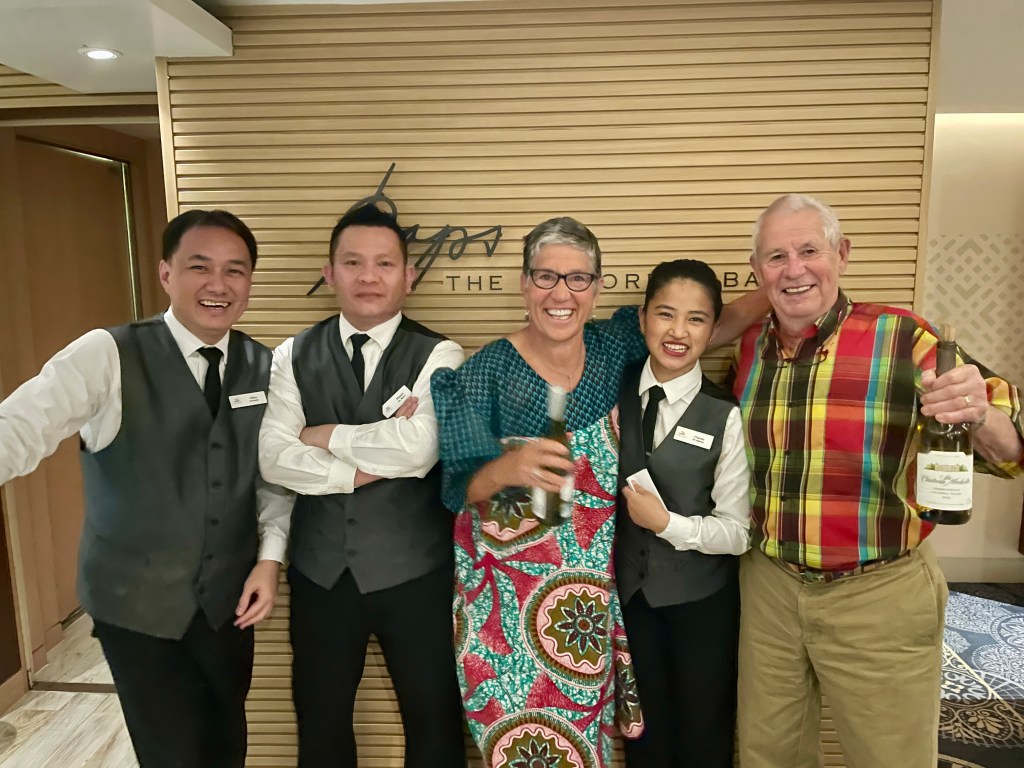
Explorer’s lounge bar staff 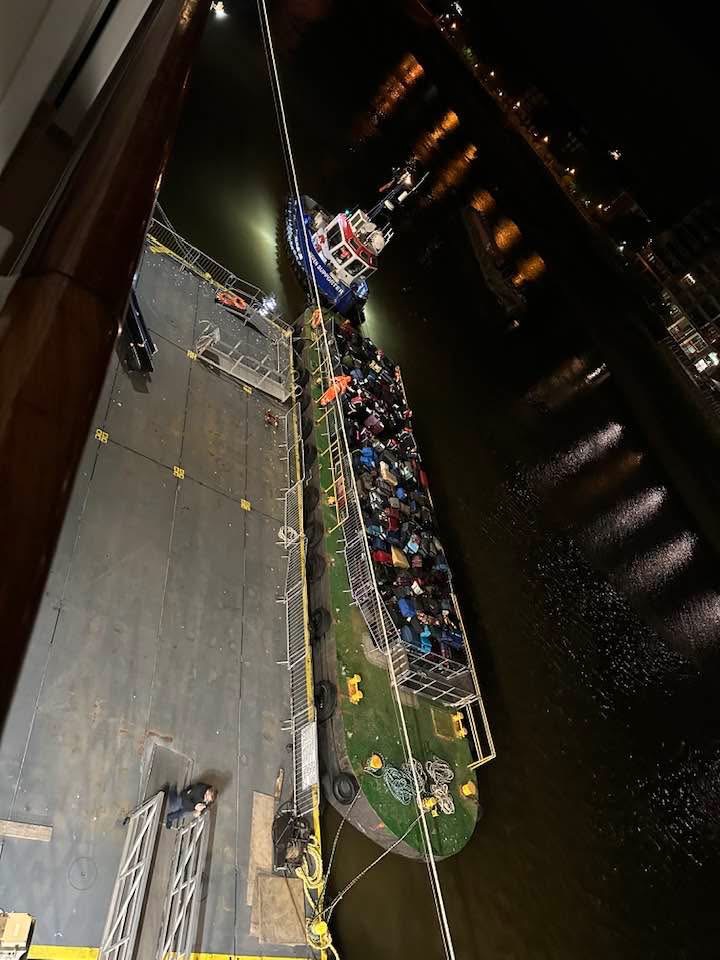
Greenwich is a tender port, so our luggage had to be transported to shore for the bus trips to the airport. This is a photo of the loaded barge. 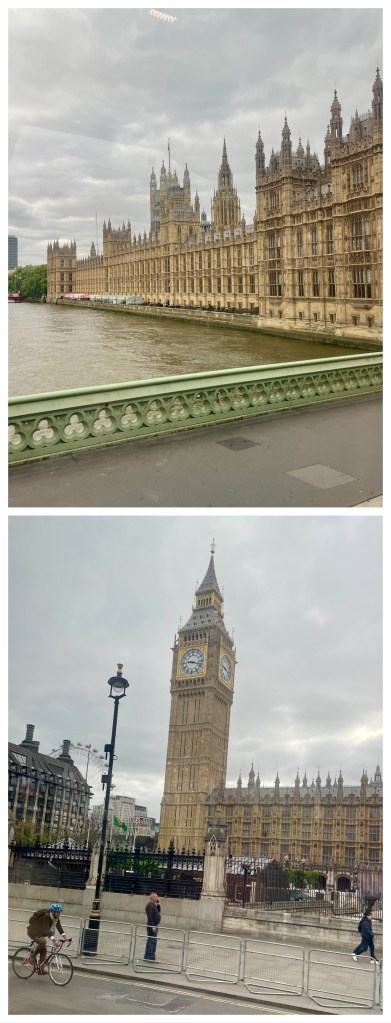
Parliament Building and Big Ben (on the way to the airport. Viking does a good job of herding cats. We were split into departure times, moved to a bus…after identifying our luggage…and delivered to Heathrow. I am now sitting with Karla in the FIRST CLASS lounge. My mission is to drink enough wine to facilitate sleep on our 9 hour flight. We leave about 1:30pm and arrive in Seattle at about 3:30pm; It’s amazing how fast planes travel these days! Next challenge is overcoming jet lag.
Since we’ve been away from news for a while, I thought that I’d check Truth Social to see what’s going on in the US of A. Who would know better than your president?
"All this talk about ME being pope....or serving a 3rd term...or BOTH. Why can't people be happy with ME being the GREATEST president in history? Look at the price of eggs...the number of immigrants. What could be going better? And, just wait until the TARIFFS kick in. Remember your TRUMP meme coin..and Melania's too. And, Donny and Eric have a GREAT deal on crypto. There are so many opportunities in this country since I took over from sleepy, CROOKED Biden. Speaking of immigrants, I'll be offering special status for immigrants who buy Trump 2028 hats; I'll allow them due process before sending them to El Salvador. You know what else...I'm placing a 100 percent tariff on Vatican City. That last WOKE pope has been ripping us off for years. As my cabinet says, it's now possible for all Americans to RESPECT their president. Let the woke. liberal-Fascists talk about DEI, Trans, climate change, "equality" and the constitution. WE'll MAKE AMERICA GREAT AGAIN!!
About ready to take off. Nice trip, nice traveling companion, and nice to get home.
-
Dover, England
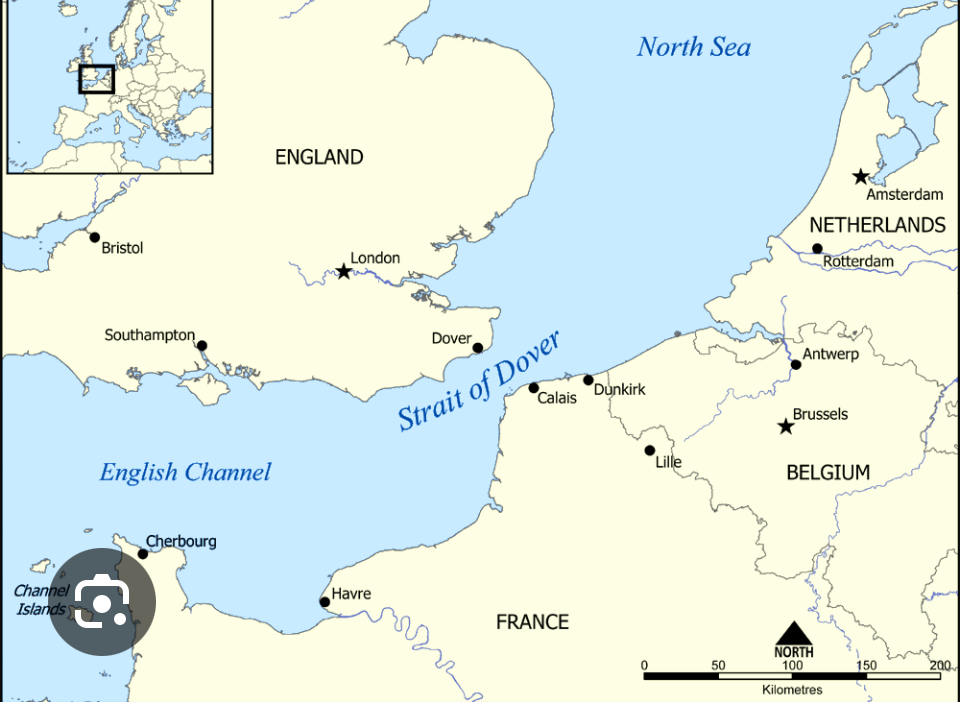
Our route– to Dover from France and then up and around the corner and down the Thames to Greenwich (just outside London). May 4
Oh Boy! Dover. There’s not much here. Last visit found us traveling to Canterbury for a day….which was OK …once. Tomorrow, I think that we’ll focus on exercise and packing.
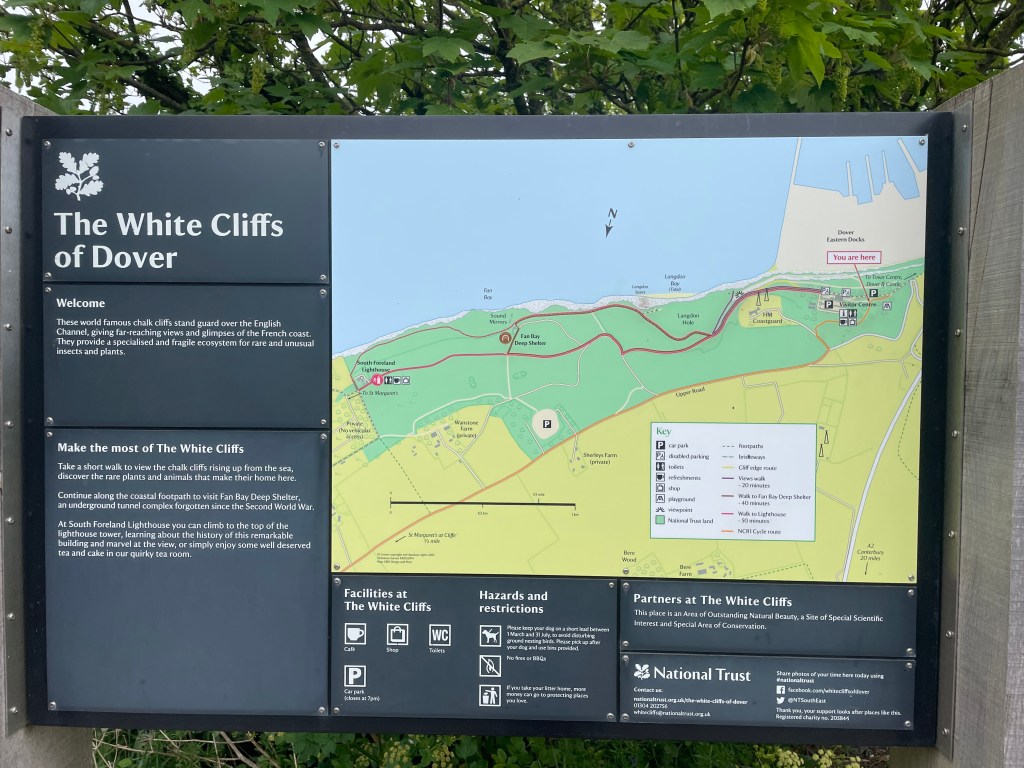
Dover is a port town perched on the narrowest part of the English Channel….about 21 miles across.There are about 40,000 residents in the area. They get around 360,000 visitors per year; many passing through. The web site brags that “the town center isn’t that special.” There are beaches to visit and white cliffs to walk. A museum and abandoned fortress are in the area. It seems most famous for being attacked….by the Romans when they did that kind of thing…by the French in Napoleon’s time…by the Germans in World War 2. Unless there are angry Italians, French or Germans we aren’t expecting too much action.
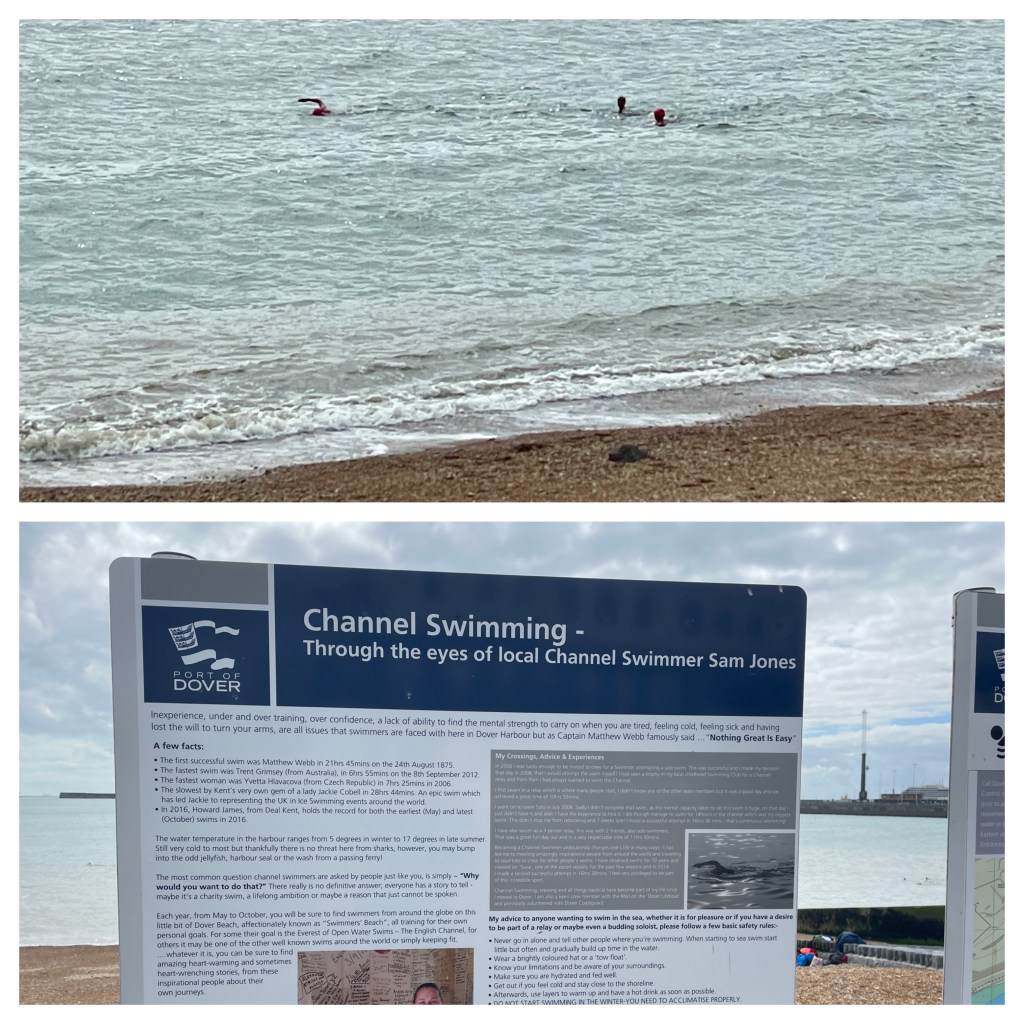
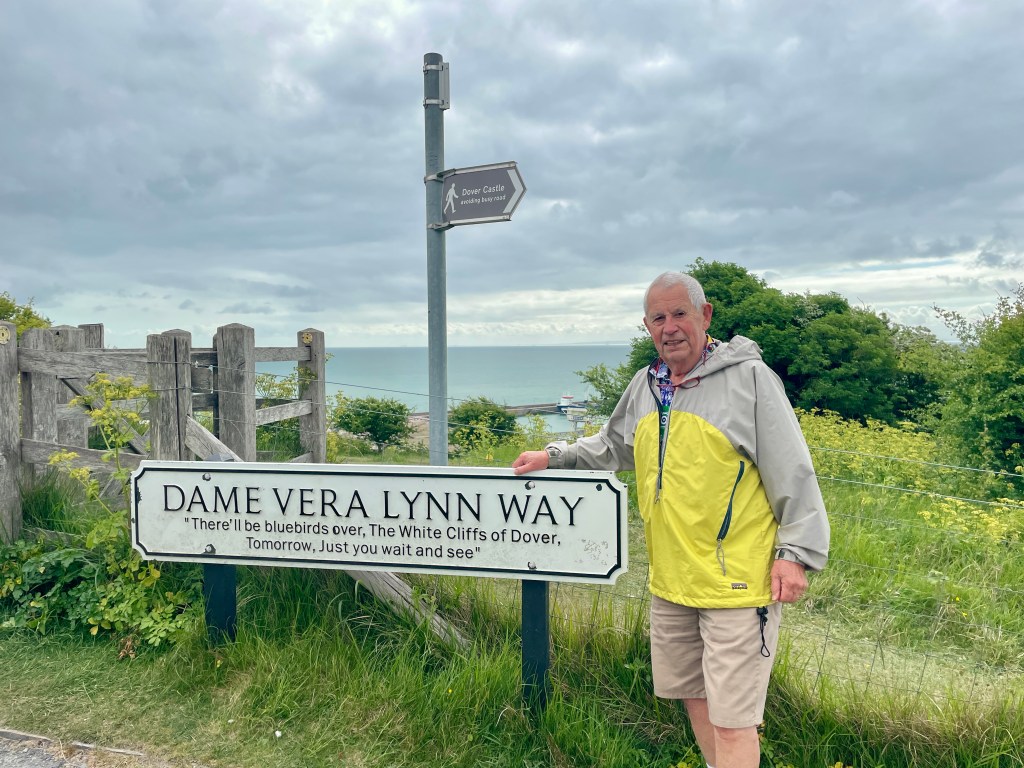
We walked a coastal path to the lighthouse trail and noticed these channel swimmers. 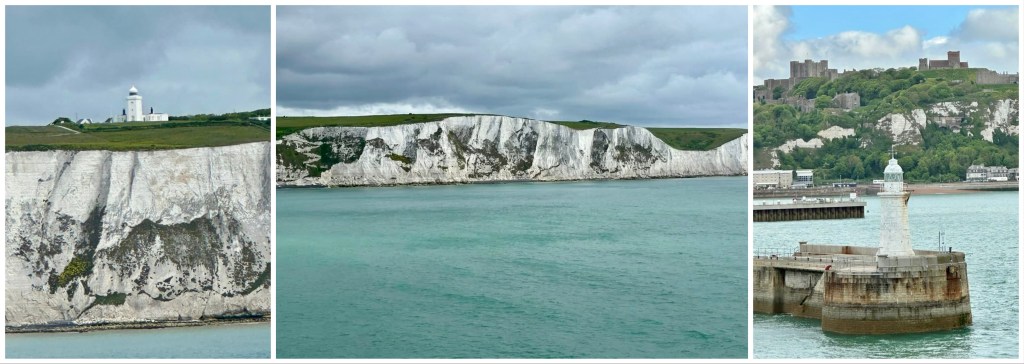
The famed white cliffs mentioned by Julius Caesar in 55BCE when the Romans were looking for a landing place. The white cliffs are from geologic activity and the white sea bottom mud (formed by sea algae skeletons turning to chalk). 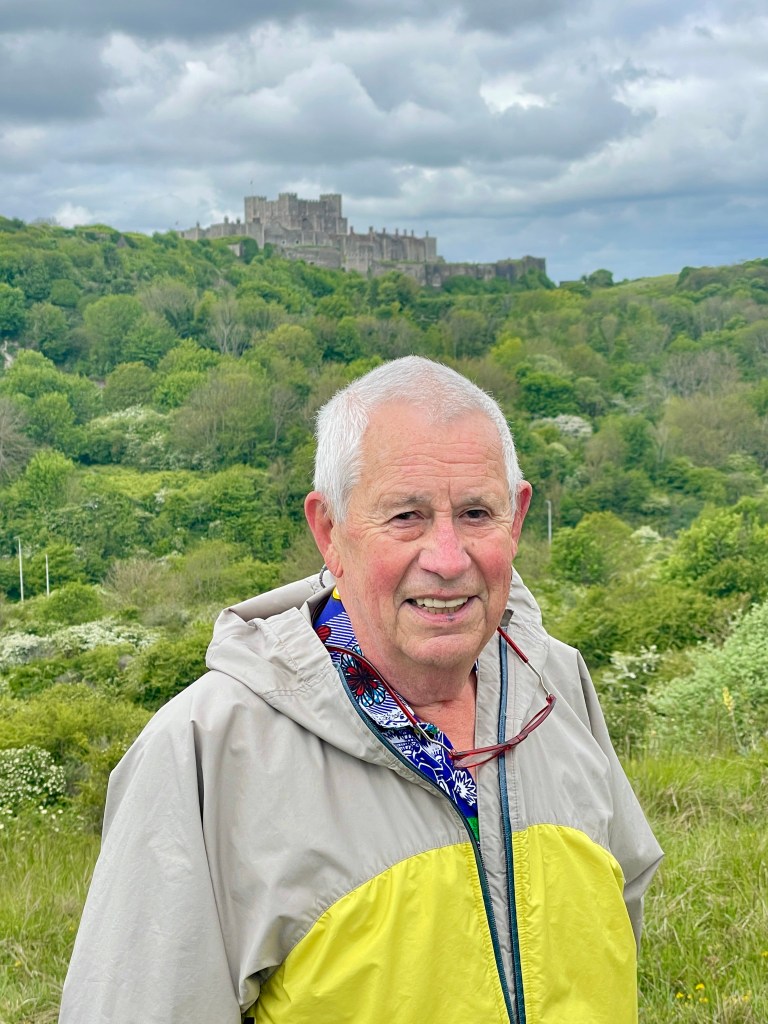
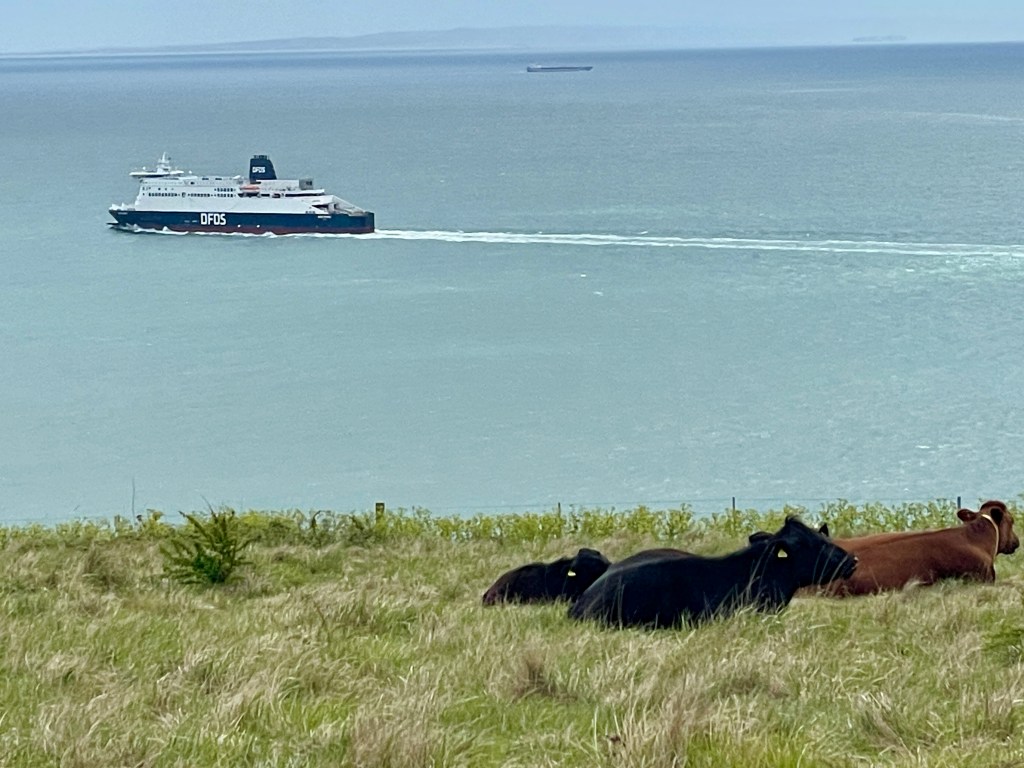
Clear view of the ferry to France from the trail. 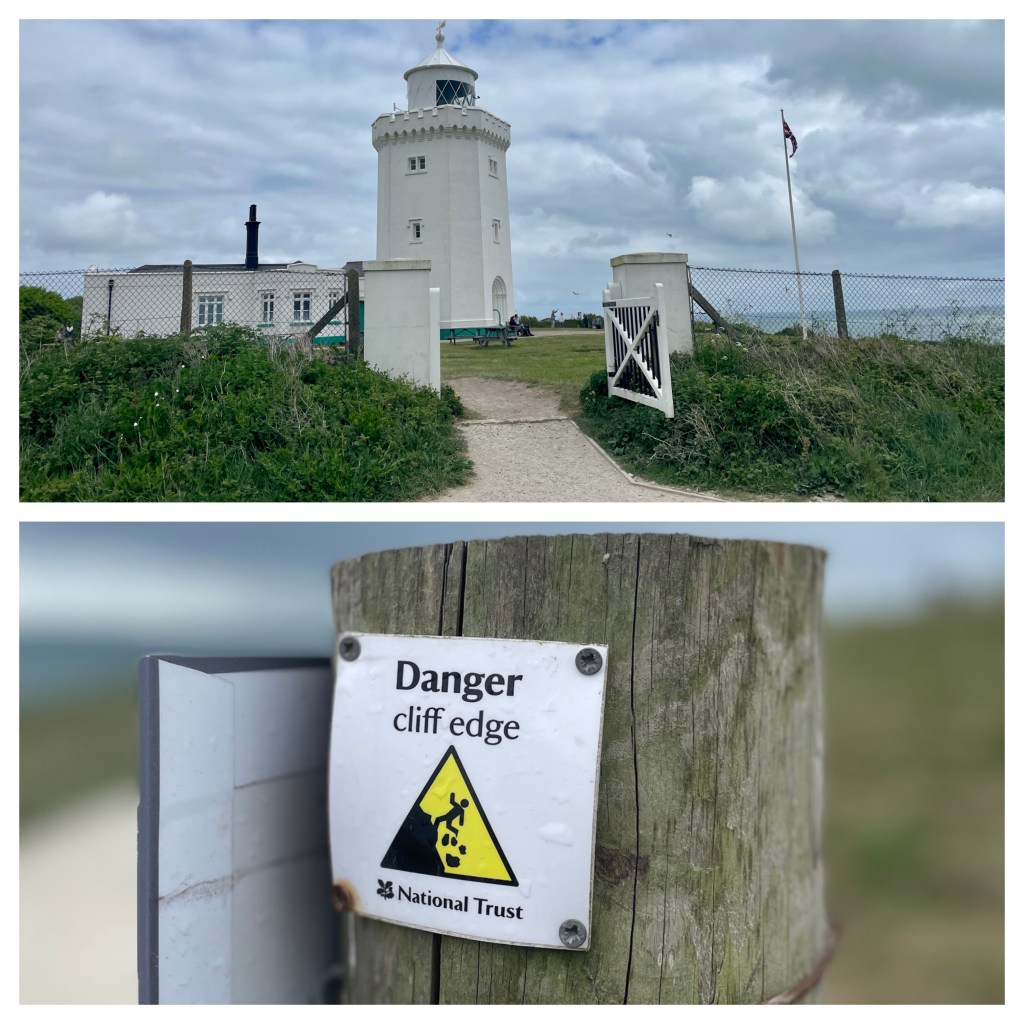
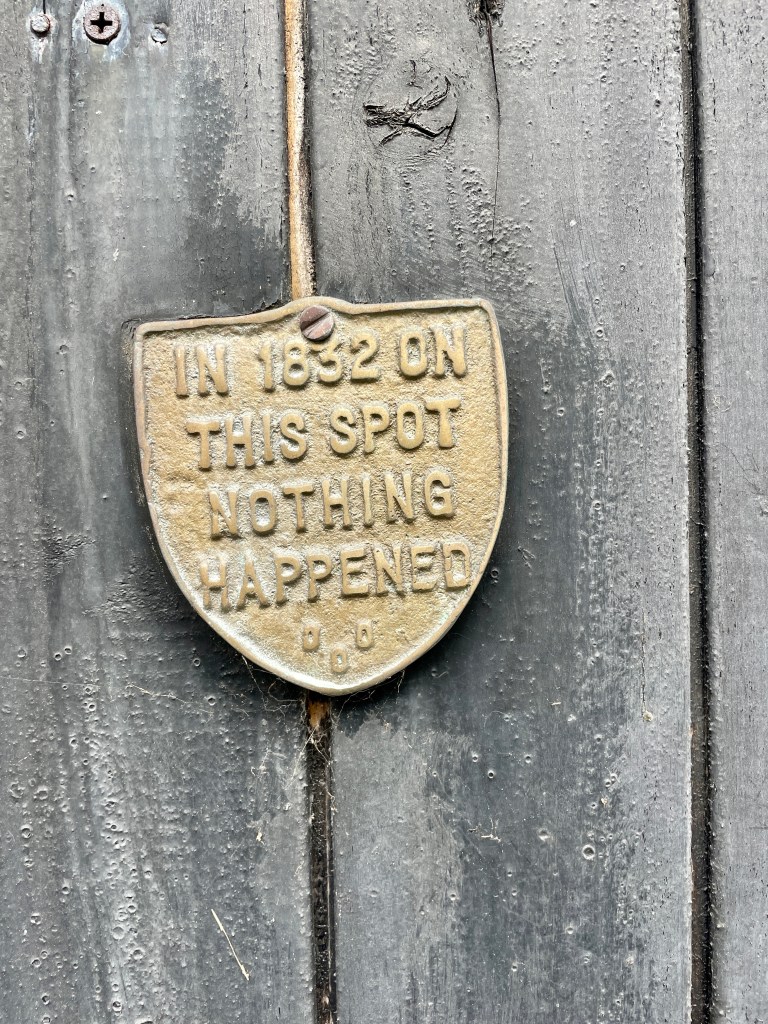
Victorian era lighthouse used to warn mariners; we love the signs. 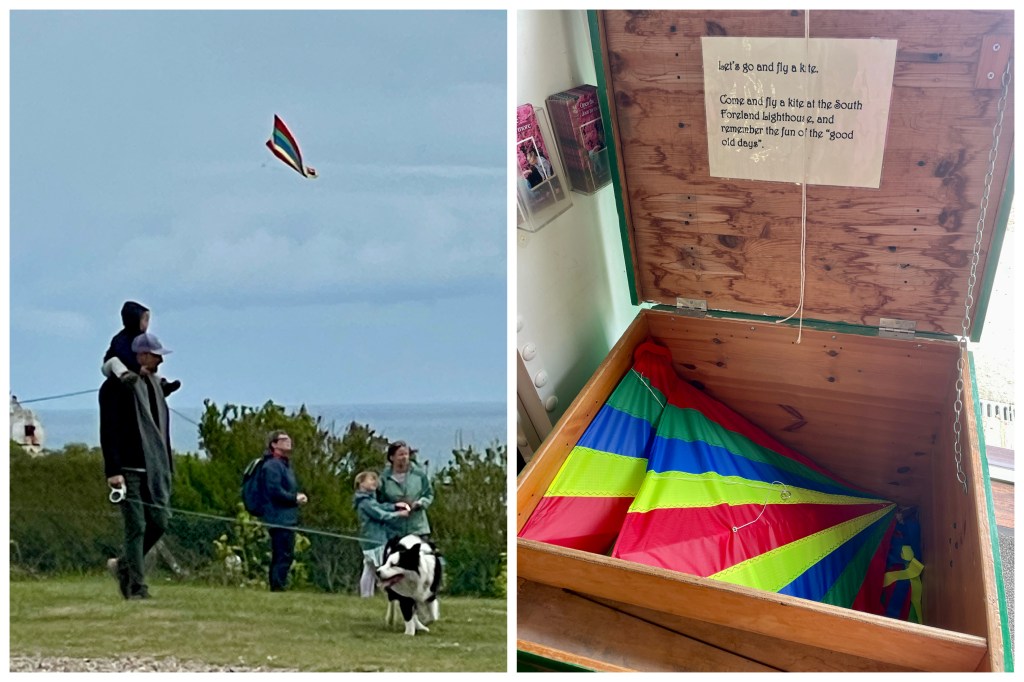
Always windy, a great place to fly a kite and loaners available in the gift shop. Karla walked the white cliffs to a lighthouse last time we were here. She decided to do so again and I tagged along….for the first 10,000 steps. I returned to town and looked around until the shuttle bus arrived. Karla hiked to the castle after touching the lighthouse.
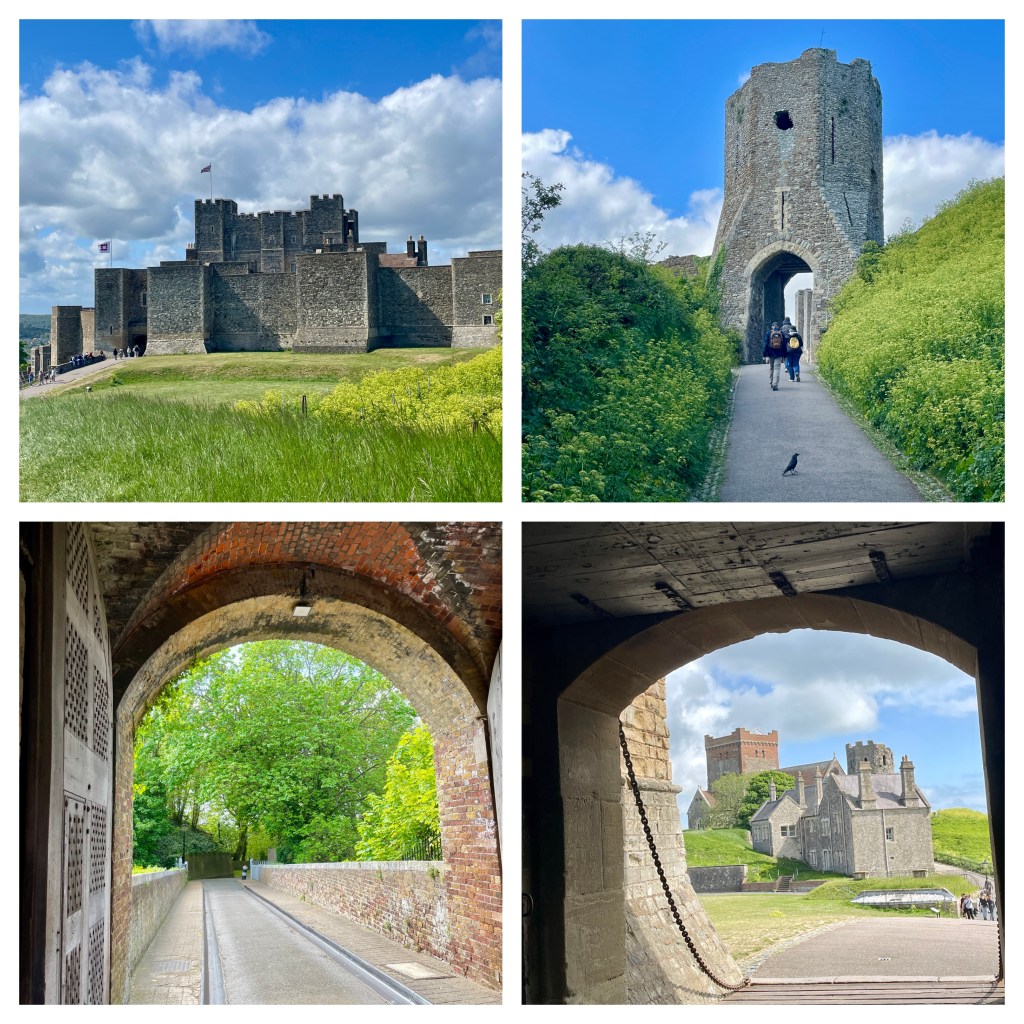
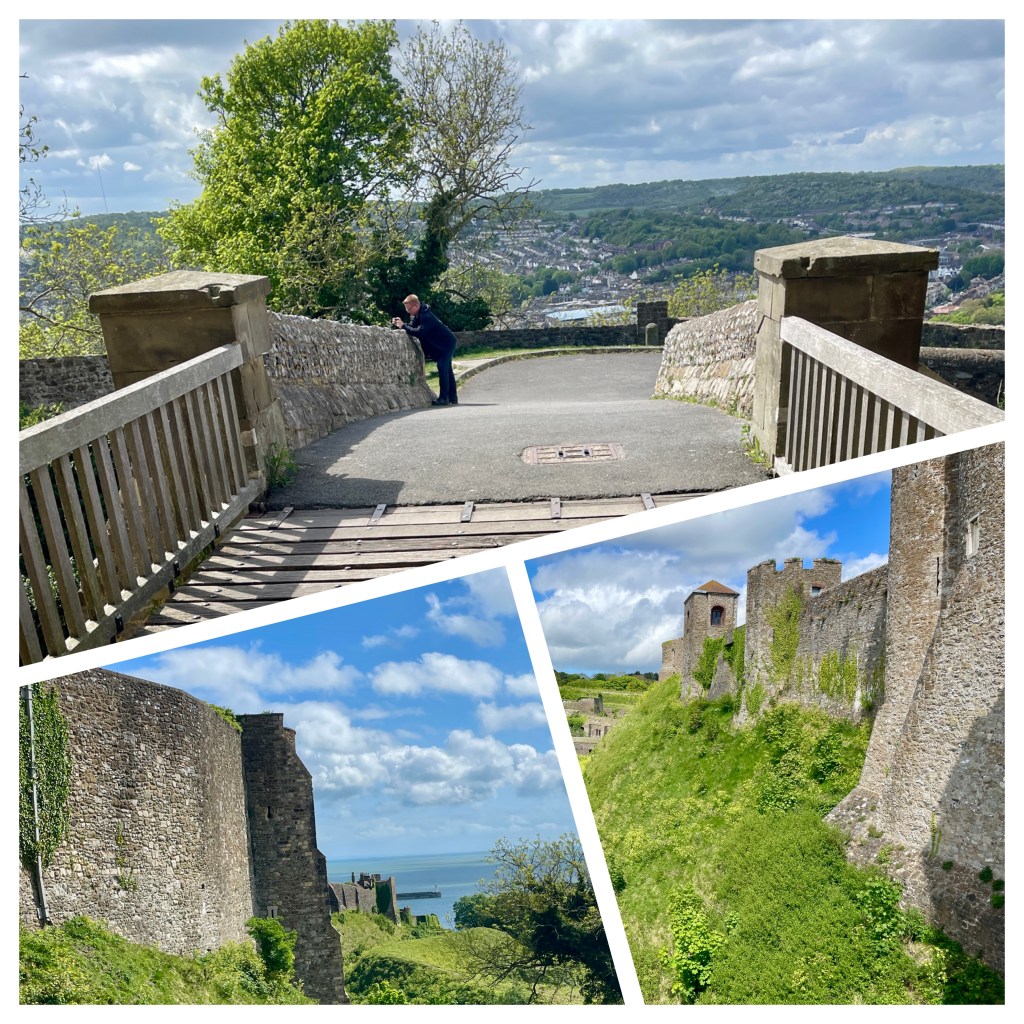
Dover castle has a long history dating back to the 11th century. 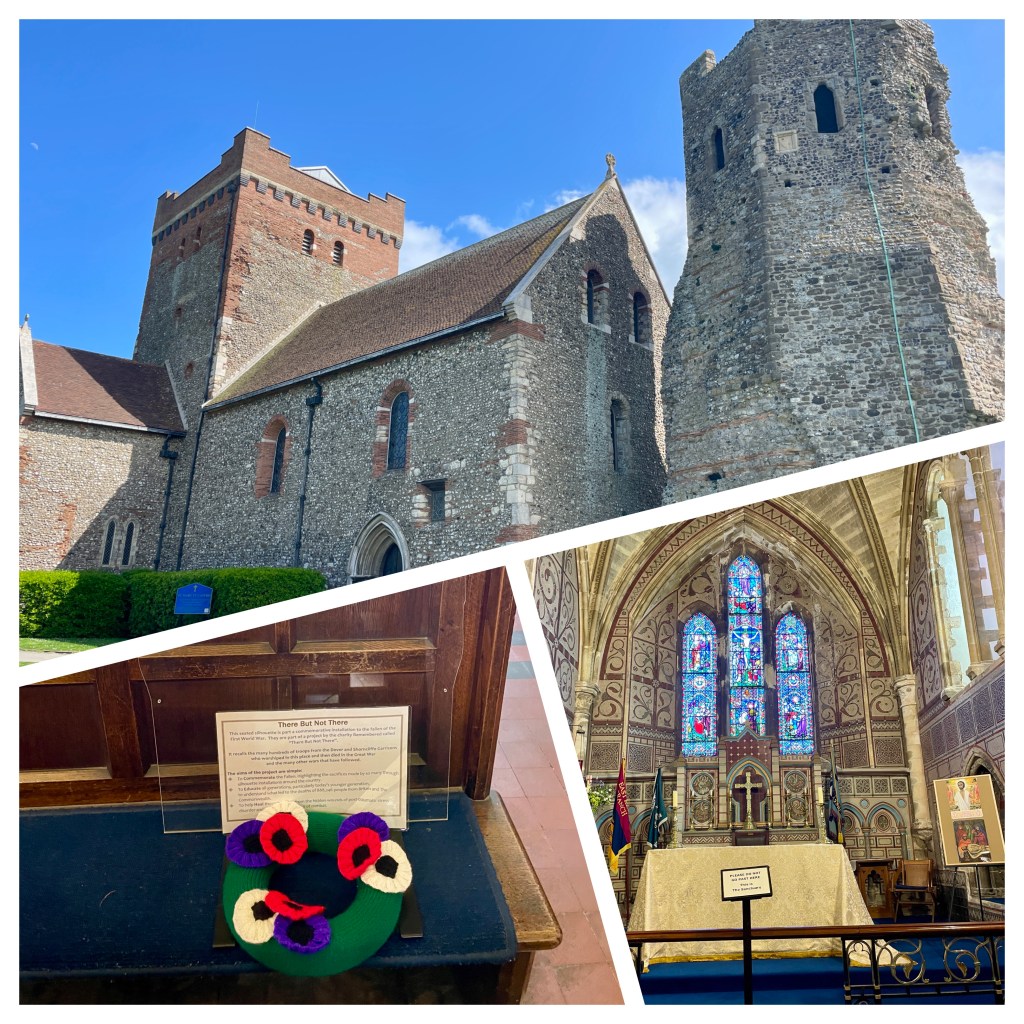
The structure to the right of the church (top) is one of 3 surviving Roman lighthouses and dates to the 2nd century CE. The bottom left photo is of a plexiglass clear chair in the church, standing for those lost in WWII. 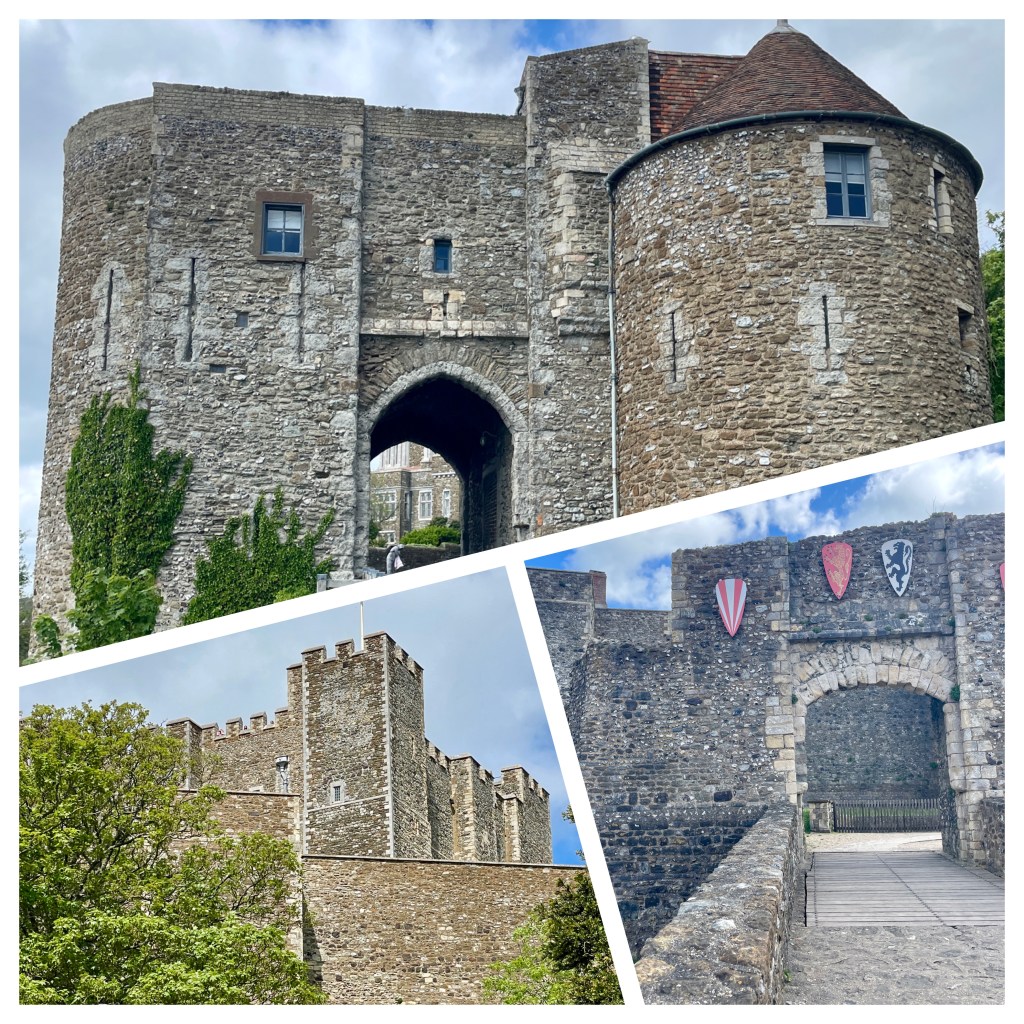
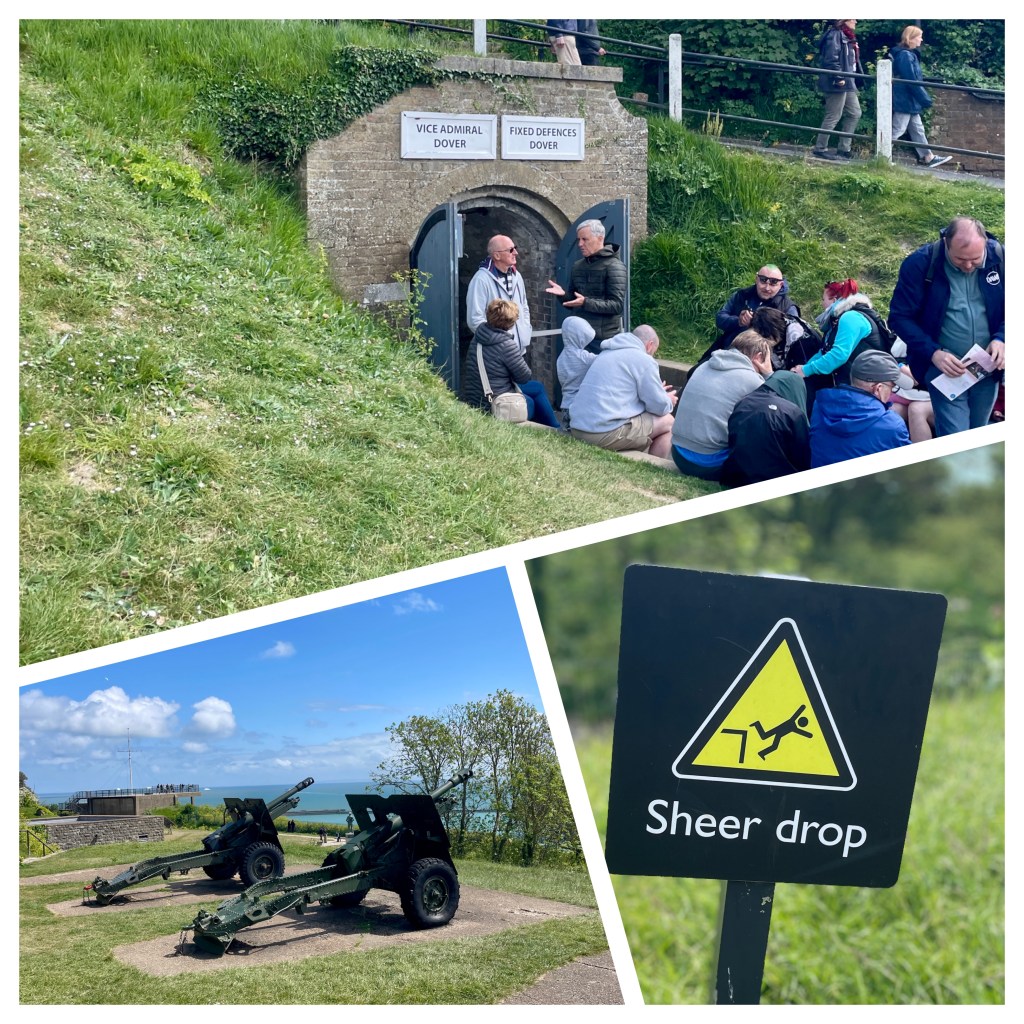
People lined up to tour the tunnels built at the end of the 1700s. Another well- illustrated sign. We left the ship at about 9:30; she returned close to 4. Bags are now being packed, to be left outside our rooms tomorrow night. It looks like we’re really finishing.
-
Honfleur, France
May 3
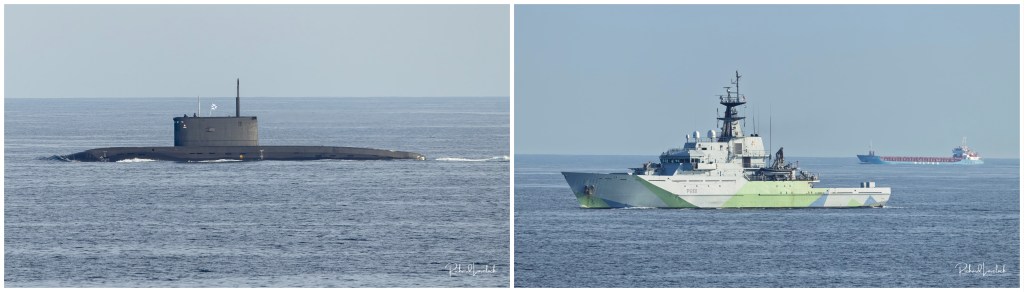
Offshore a Russian submarine, followed by a French Navy ship. 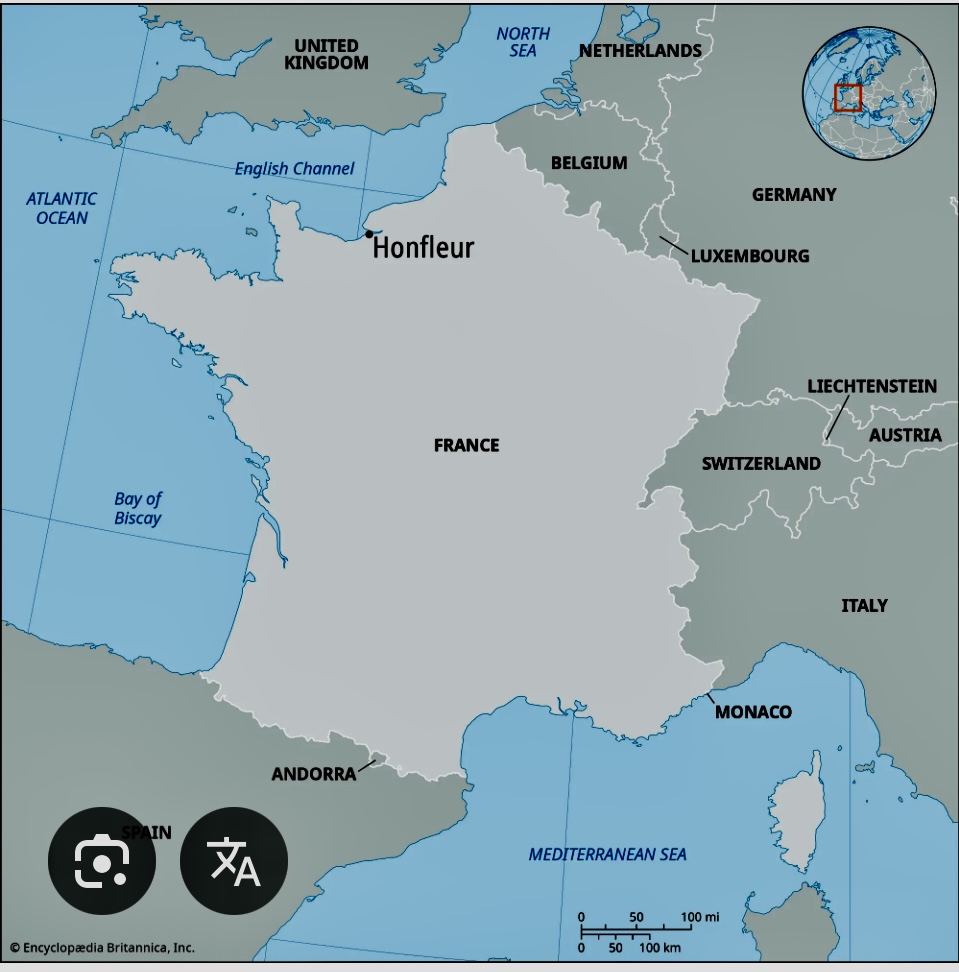
As we wind down, Honfleur looks like the perfect stop. Google says, “Ports don’t come any prettier than Honfleur on the Seine estuary.” It has a population of around 8000 people– fewer than 100 years ago. Guidebooks say that a tourist needs a half day there; usually, they say at least 2-3 days for a location. It’s about a 2 1/2 hour drive to Paris. What’s better than a small, walkable, historic town when most of your shipmates are spending the day in Paris? Cobbled streets, medieval architecture, and more.
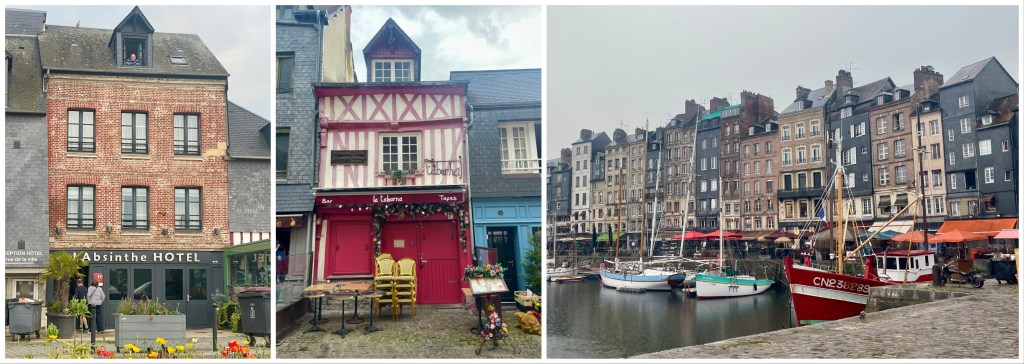
Honfleur, a small town on the Normandy coast, was established as a port in the 12th century, shipping goods to England. It was occupied and unoccupied as the French and English pursued their variety of wars. In the early 17th century, it peaked as a port for trade with Canada, the West Indies, and Africa. Slaves were an important commodity. More recently, it has become a relaxed home for artists. I think that we’ll find a relaxed, out-of-the-way cafe for lunch. I wonder if they have wine there?
What a nice little city. Old buildings, lots of little shops,and it happened to be market day, albeit a very rainy market day. All kinds of produce, clothes, etc. We had a good time walking around, eating, shopping….and, Karla got a haircut! We would come back here.
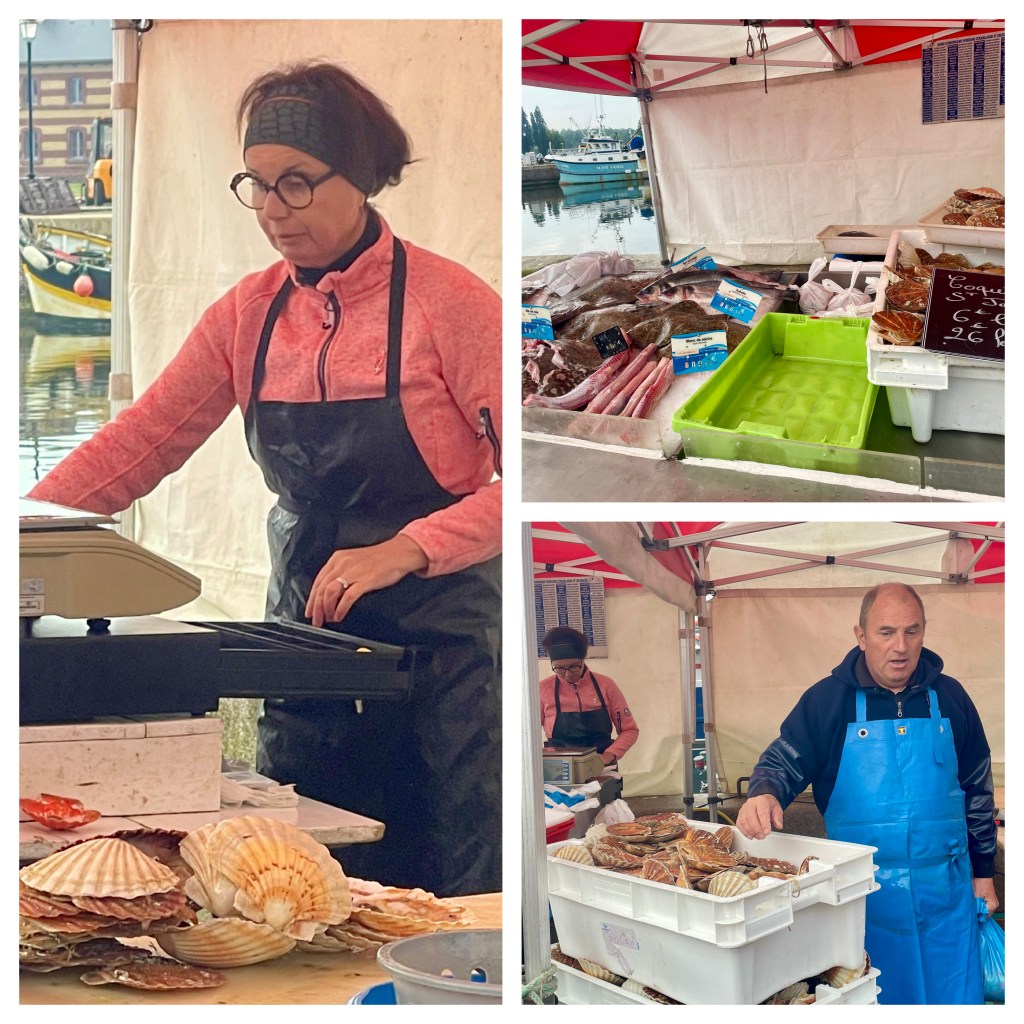
Scallops and other seafood 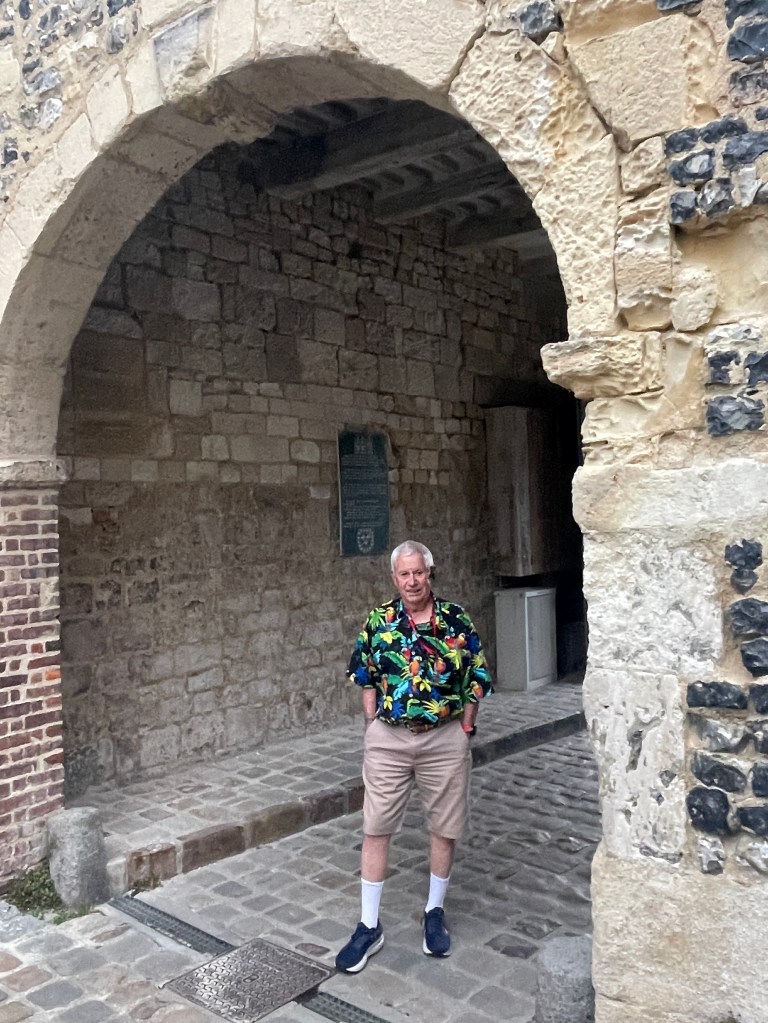
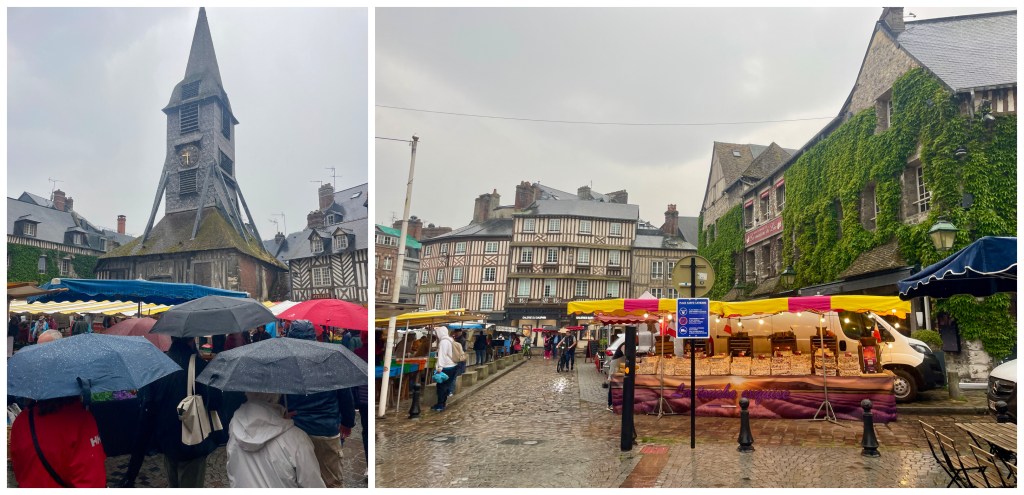
Then the rains came 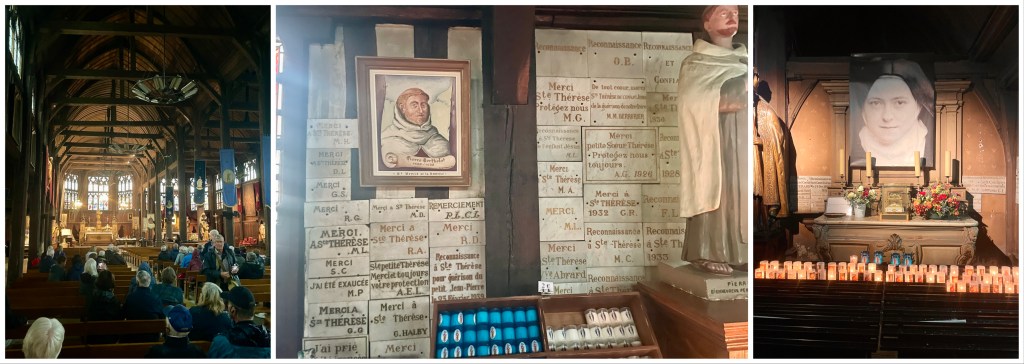
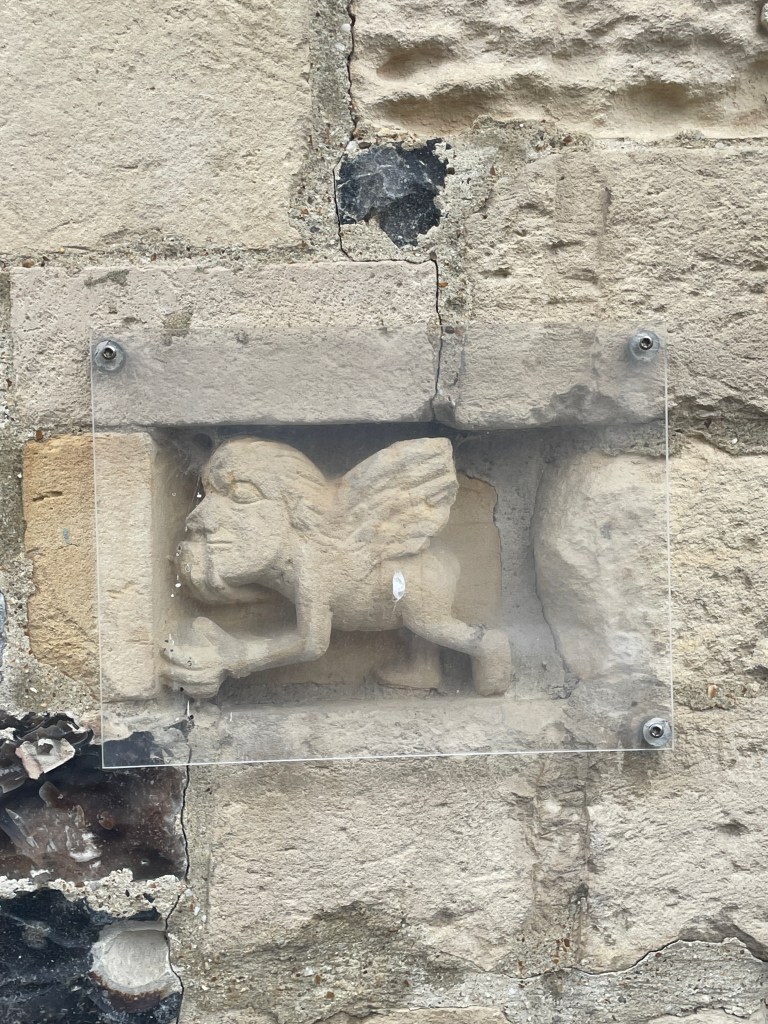
St Catherine’s Catholic Church, one of the oldest wooden churches in France, built by shipbuilders starting in the mid 1400s. 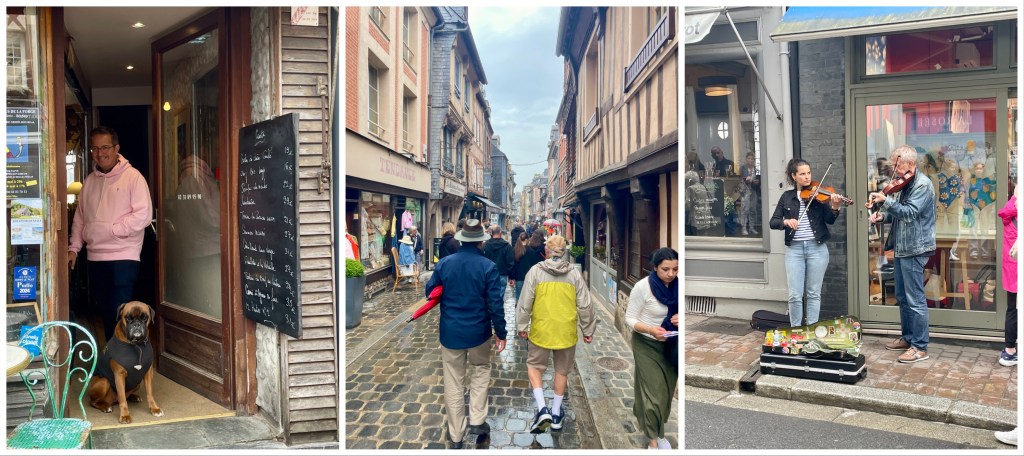
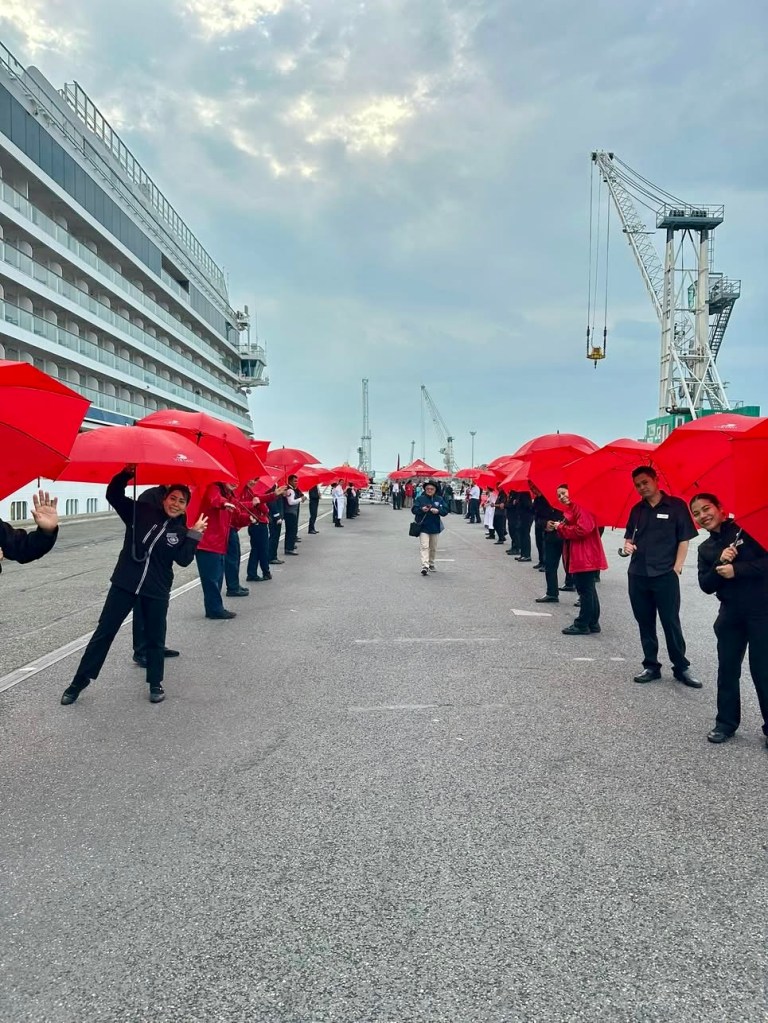
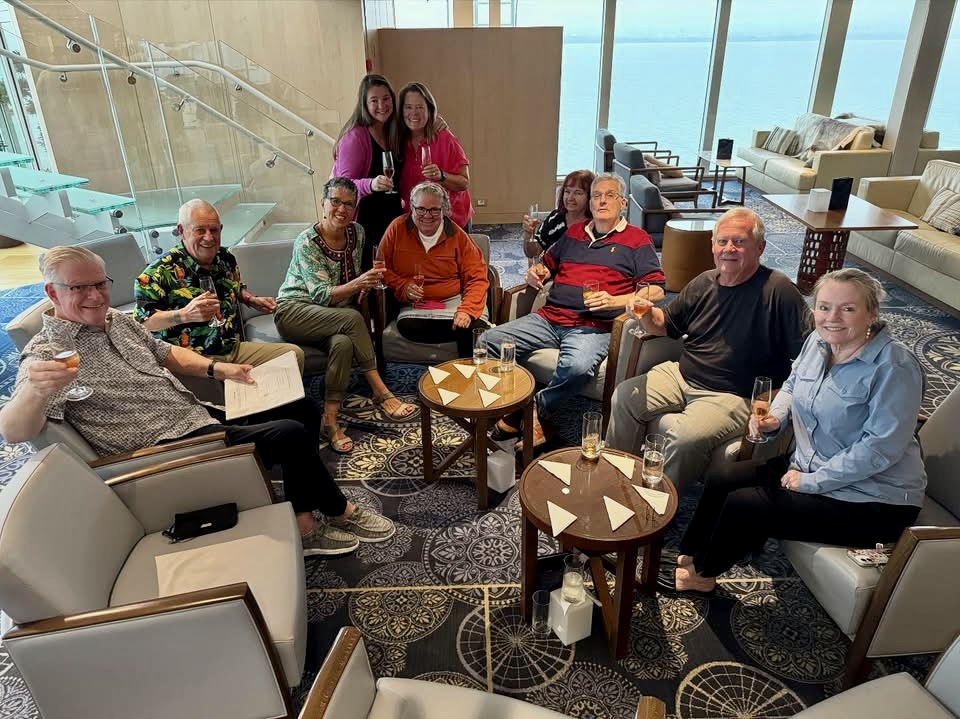
Viking crew enthusiastically greeting us back to the ship; below, our friends’ group and favorite lounge, -
Sea Days and Viking Does Brunch
May 2
Sea Days are days when Viking goes all out on food– offering a special brunch or some other celebration that involves food. The displays are incredible and the food delicious.
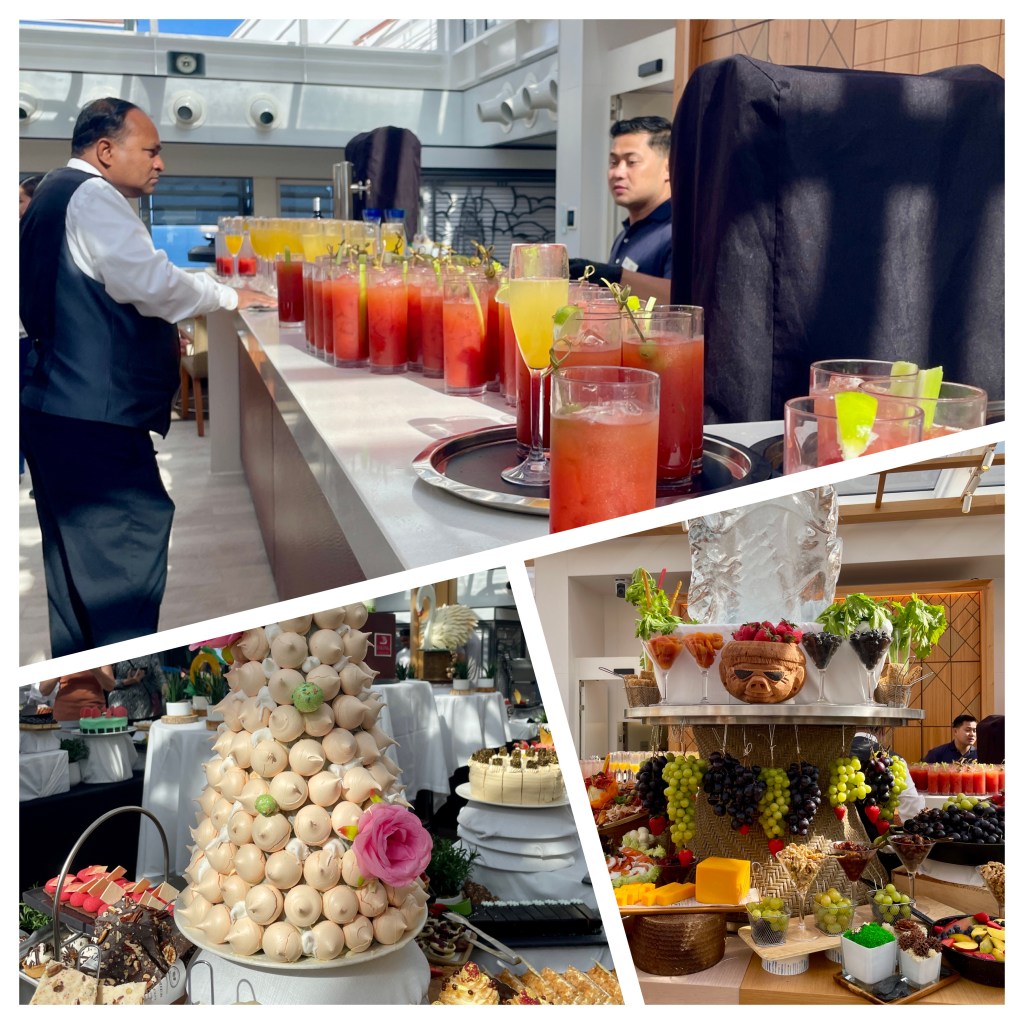
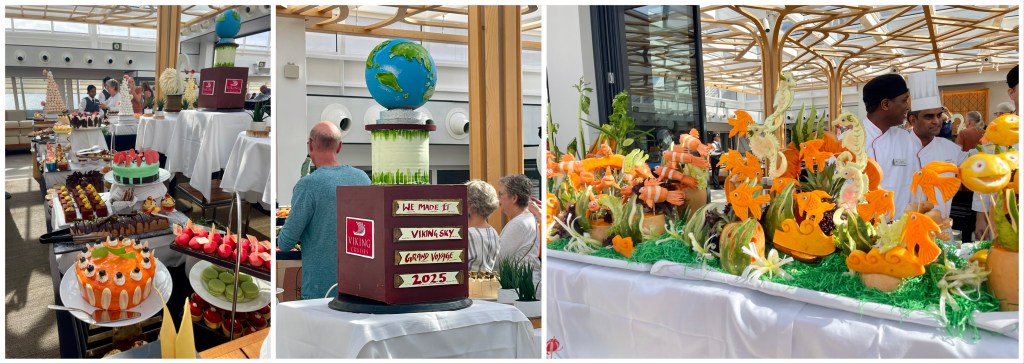
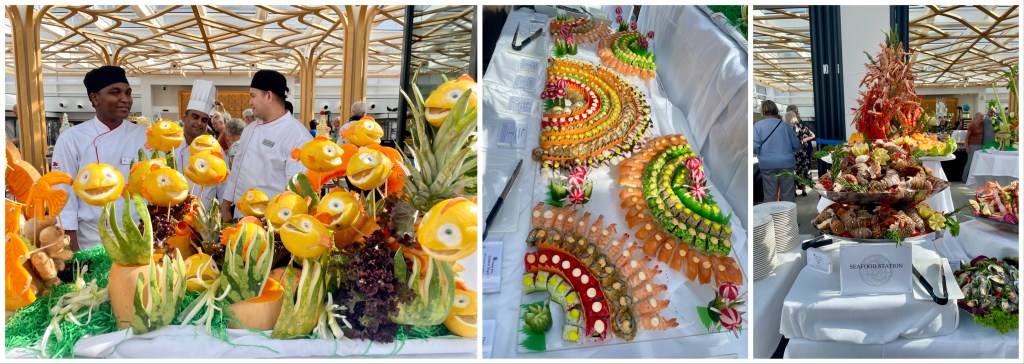
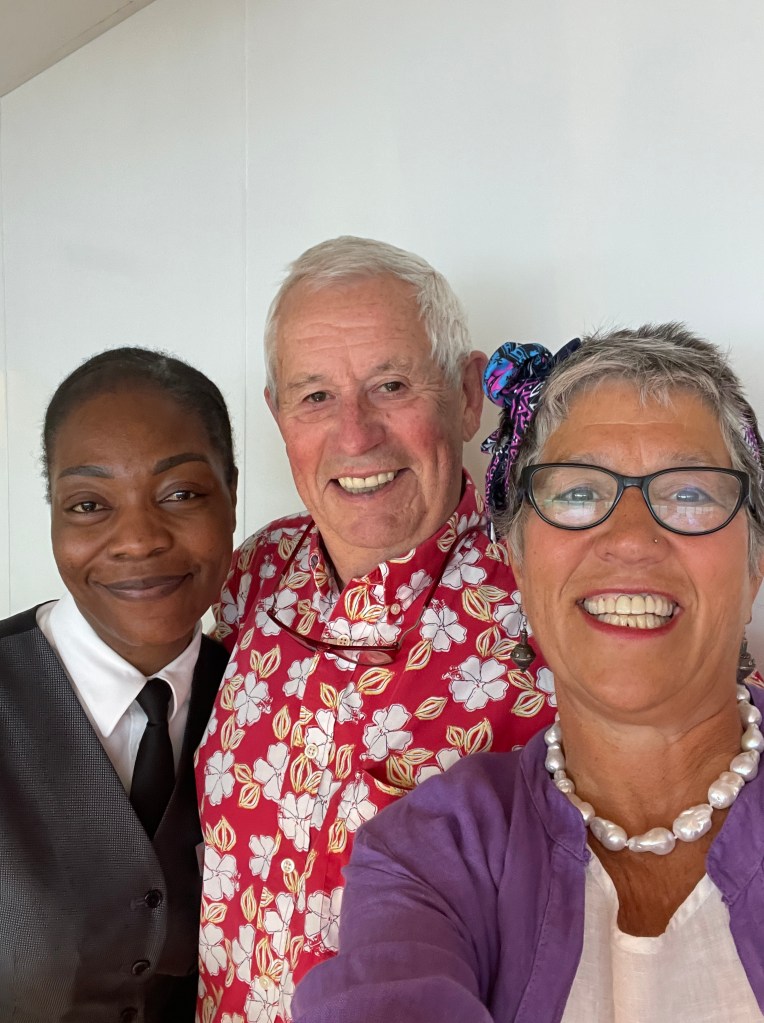
Carol, one of our favorite servers. -
A Sea Day
May 2
With an open day, it’s a nice opportunity to write my “Top 10 List” of observations from the cruise. These can be anything that has made an impression on our cruise and, probably, carryovers from previous cruises. This is our 27th ocean and river cruise; my 30th counting 3 Semesters at Sea. I won’t belabor most of them.
- The dominance of the Oceans is incredible. We have traveled six day stretches and seen nothing but water. Over 70 percent of earth’s surface is occupied by one of five oceans which contain 97 percent of the earth’s water. We forget that the earth is comprised of hills, flatlands, valleys and mountains. The oceans cover most of them. The deepest “valley” is about 7 miles deep. The average ocean depth is 2 1/2 miles. And, it’s a complex collection of currents and tides that stir up food for a complex food chain. Given all of the complex relationships, I’m glad that we didn’t follow someone’s recommendation about 50 years ago of dumping nuclear waste in the ocean where it wouldn’t be a problem.
- Thomas Friedman writes that the winners in the future will be the countries that master Globalization, Climate Change and Technology. I don’t know how to evaluate progress in technology. However, I’m concerned that we are slipping badly in Globalization with our tariff fixation and discontinuation of foreign aid. And, “climate change” has been declared a forbidden phrase in federal documents. It has been dropped from the NSA report on “National Threats.” Friedman has said that he has never been so concerned about our nation’s future. For many of the countries that we have visited, globalization is important and climate change sometimes existential.
- China is winning the “international battle” for influence. Chinese investments and aid programs were everywhere. They have invested in ports, railways, universities, highways, etc. in hundreds of areas from small islands to large countries. Their Belt and Road program has been extended for another 40 years and will position them for future trade…or conflicts. At the same time, the US has cut foreign aid and making trade more difficult.
- Africa is fun to visit, but has a challenging future. So many countries were drained of resources by European colonial powers, but the powers did not develop a social infrastructure that allows them to govern successfully. There is still lots of tribal identification and too many examples of corruption among those that get political power. While there are still lots of valuable natural resources, the benefits of their extraction are not widely shared. There are high rates of unemployment and underemployment and, seemingly, not lots of optimism for the future.
- Singapore is an incredible economic success. They have and have had a government that sets targets and successfully implements programs. Many of us raised in the US would react negatively to the level of government control, but in pure economic numbers, they’re doing great. As an experiment, it would be interesting to see an African country contract its development to Singapore.
- The Box. In 1956, a refitted oil tanker carried 58 containers from port A to port B. Now containers of 20 or 40 feet are everywhere. Larger ports have acres and acres of containers stacked and ready to move. The investment in cranes to load and unload them is incredible. And they can be moved directly to trucks and trains for final delivery. It is said that they have reduced shipping time by over 80 percent and cost by 35 percent. Now 90 percent of cargo moves on 50,000 ships. And, it is claimed that they have reduced damage and improved security. In many of our ports of call, the dominant feature we encountered were containers and their associated cranes.
- We’re #1. Lots of Americans are raised to believe that the US is the number 1 country in the world. (Interestingly, citizens of lots of countries think that their’s is the best place to live.) The United Nations and others do international rankings for a number of variables. While the calculations aren’t perfect, there’s a pattern. The US is number 1 in military spending, handgun ownership, drug use, child death by autos and firearms, and incarceration. Other rankings include:
- GDP/capita 6th Civil Rights (pre-Trump) 21st
- Income inequality 61st
- Education 13th
- Environmental quality 35th
- Global peace index 132nd
- Human Development index 20th
- Maternal mortality 46th
- Life Expectancy 42nd
- Press Freedom 42nd
- Democracy 30th
I’m sure that there could be arguments about definitions and measurements, but there’s a message here.
8. The Crew. Perhaps the high point is the crew. So many nice people who serve us well. As we get to know them, we are even more impressed. Last cruise, we asked one talented wine steward what she wanted to do later in life, she responded, ‘President of Botswana” and she was serious. The labor markets have moved many talented people to Viking as a step toward future growth. We benefit from their being here and count many as our friends.
9. A Floating Village. Being together with 950 people for 4 months is always interesting. We find lots of people we enjoy and some we avoid. Some die; some get kicked off the ship..it’s like other villages. One of our friends commented on the 80/20 rule….20 percent of the people cause 80 percent of the problems. One friend said it was tough for introverts. I happen to be traveling with an extrovert so we meet more people than most and I benefit from that.
10. After the entire experience, it is interesting to think about little things like materialism, success and happiness. I’m not sure about the right answers, but materialism doesn’t translate to success and happiness that we observe may not relate to either. If I could measure happiness, I might find the barefoot kid in Africa happier than the driven kid in Singapore. Success as an individual may not be strongly correlated with earnings or income. Our trip may not have provided “The Answer,” but travel does open your eyes and mind.
-
A Coruna, Spain
May 1
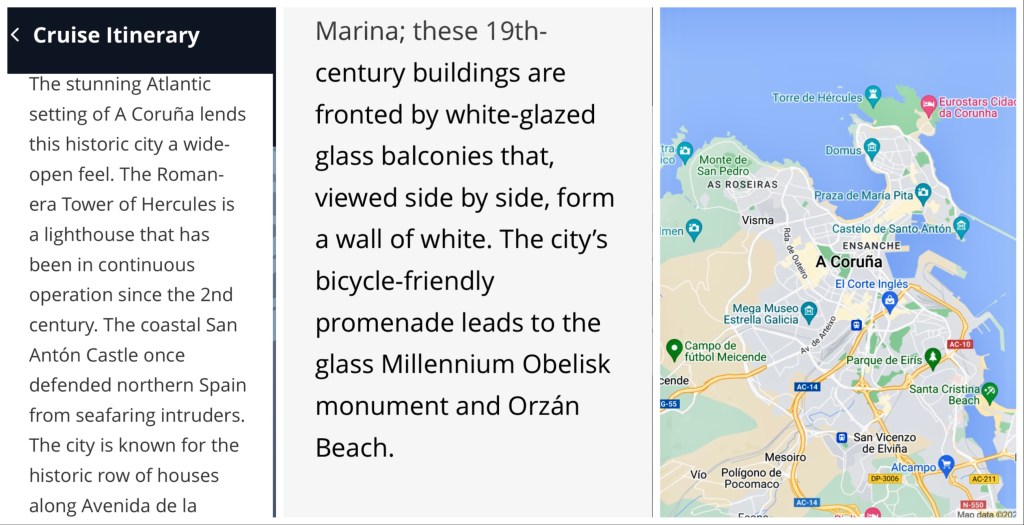
Perched in the corner of Northwest Spain, A Coruna is the second largest city in Galicia. There are 250,000 people in the city; 500,000 in the greater metropolitan area. The Romans visited in the 2nd century BCE, followed by the Vikings in the 4th century. There wasn’t much there for the Vikings, as the residents moved inland. When the Muslims came, they, too, had little interest in what is now A Coruna. In the early 13th century, a trade in salt and fish developed and textiles and spice were added in the Middle Ages. Today’s economy benefits greatly from both fresh and processed fish. The financial sector is strong and tourism is a huge contributor. Tourists not only visit A Coruna, but use the city as an access point for Santiago de Compostela. The locals are proud that the textile brand Zara is based here. I wasn’t expecting much. When we lived in Spain, it wasn’t on our screen.
Our city excursion wasn’t until two hours after our arrival, so we decided to wander around the Old Town, which was near the port. It was May 1, which happened to be a Labor Day so our expectations were low. The Old Town was really attractive, with lots of old buildings, narrow streets, several nice squares and old churches. Our excursion exposed us to more of the Old Town as well as lots of oceanside development and monuments. The weather was nice and it was really attractive. We got out 6-7 miles on a beachside promenade and Karla dismounted in order to walk back. I explained to people around me that it was for disciplinary reasons.
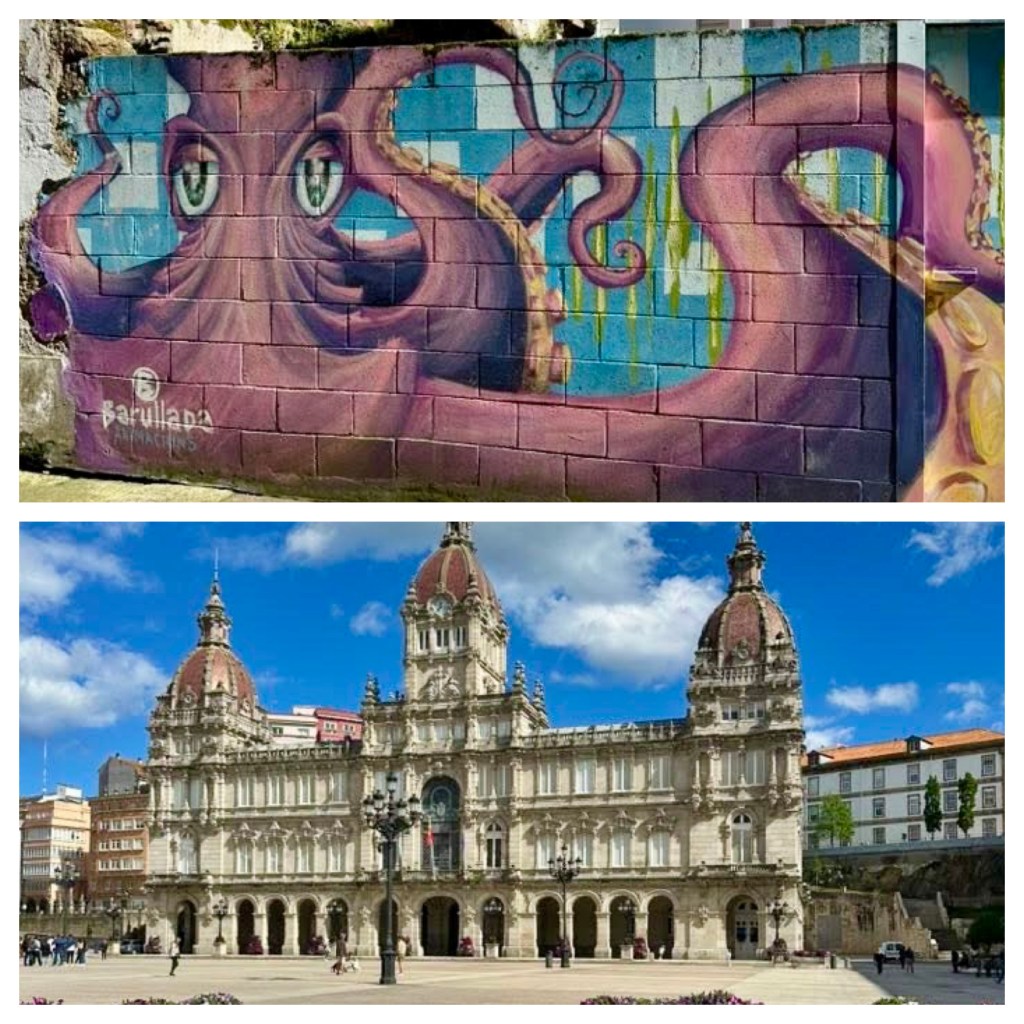
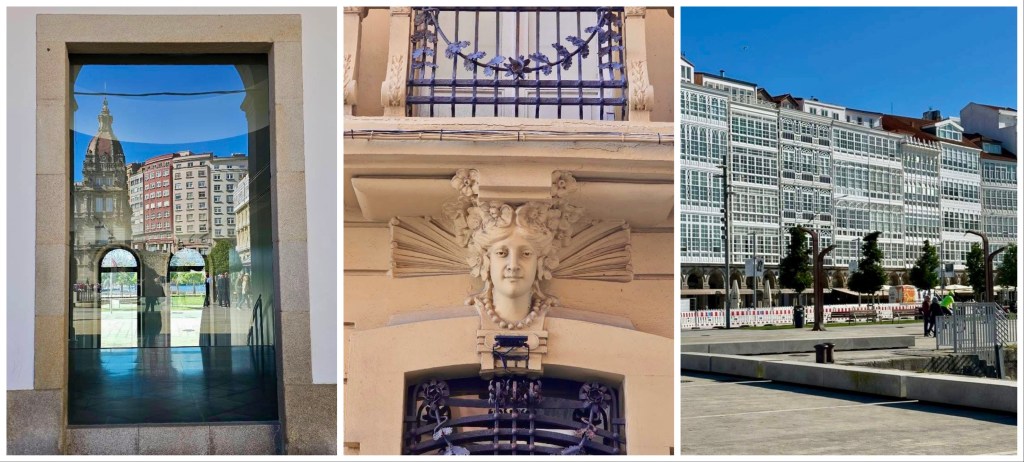

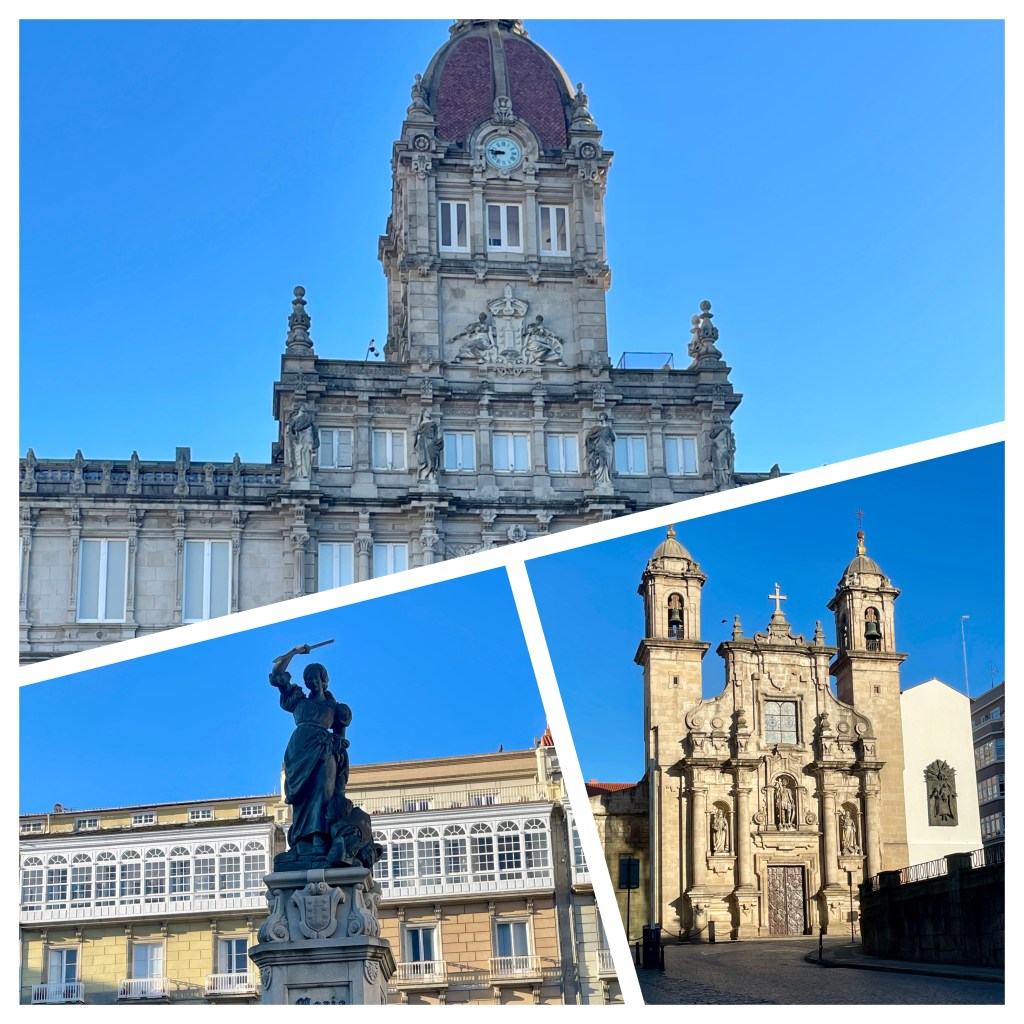
Central square city hall; statue of Maria Pita who defended the town against the invading English in the late 1500s. 
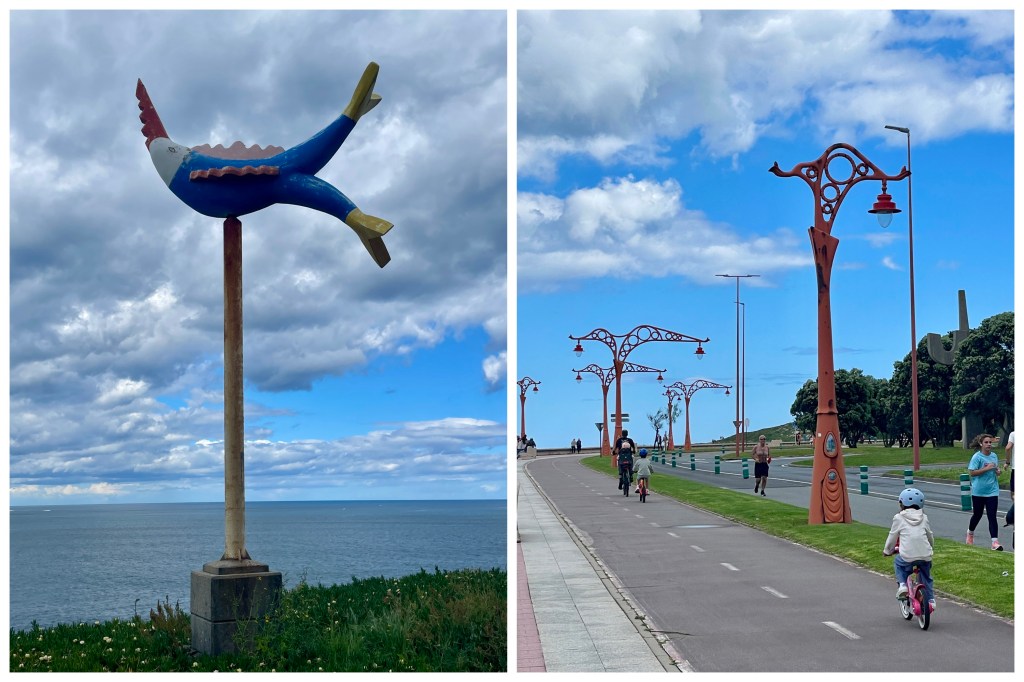
Art along the seaside promenade 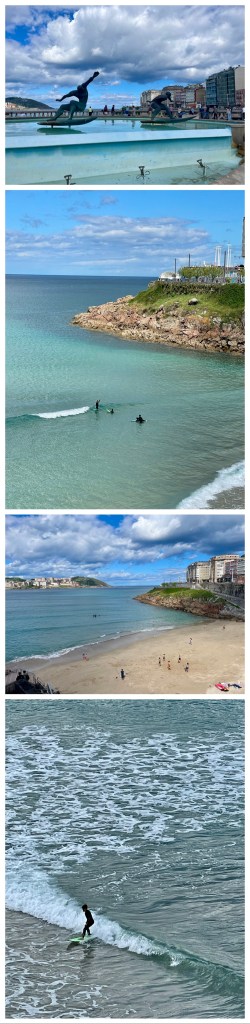
Surfing statue and surfers. 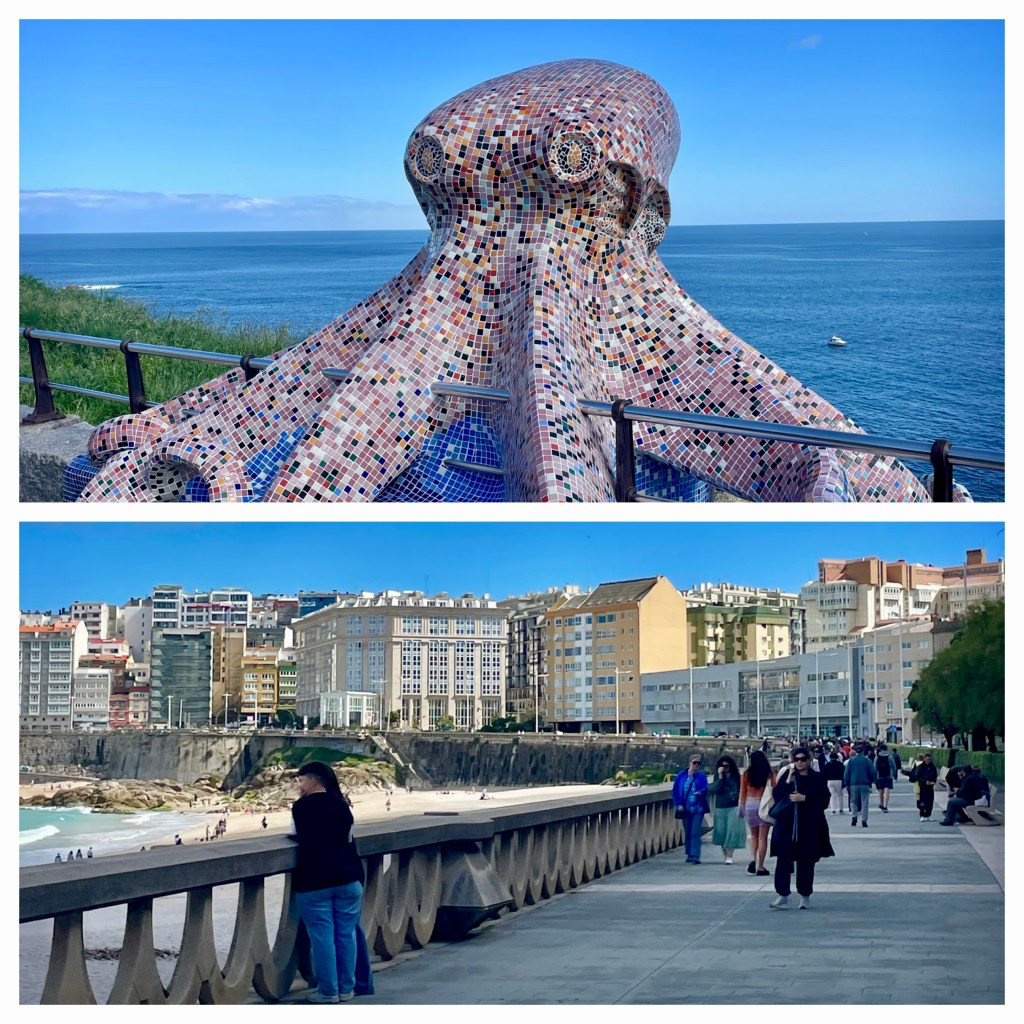
Mosaic octopus. A Coruna is known for octopus specialties. 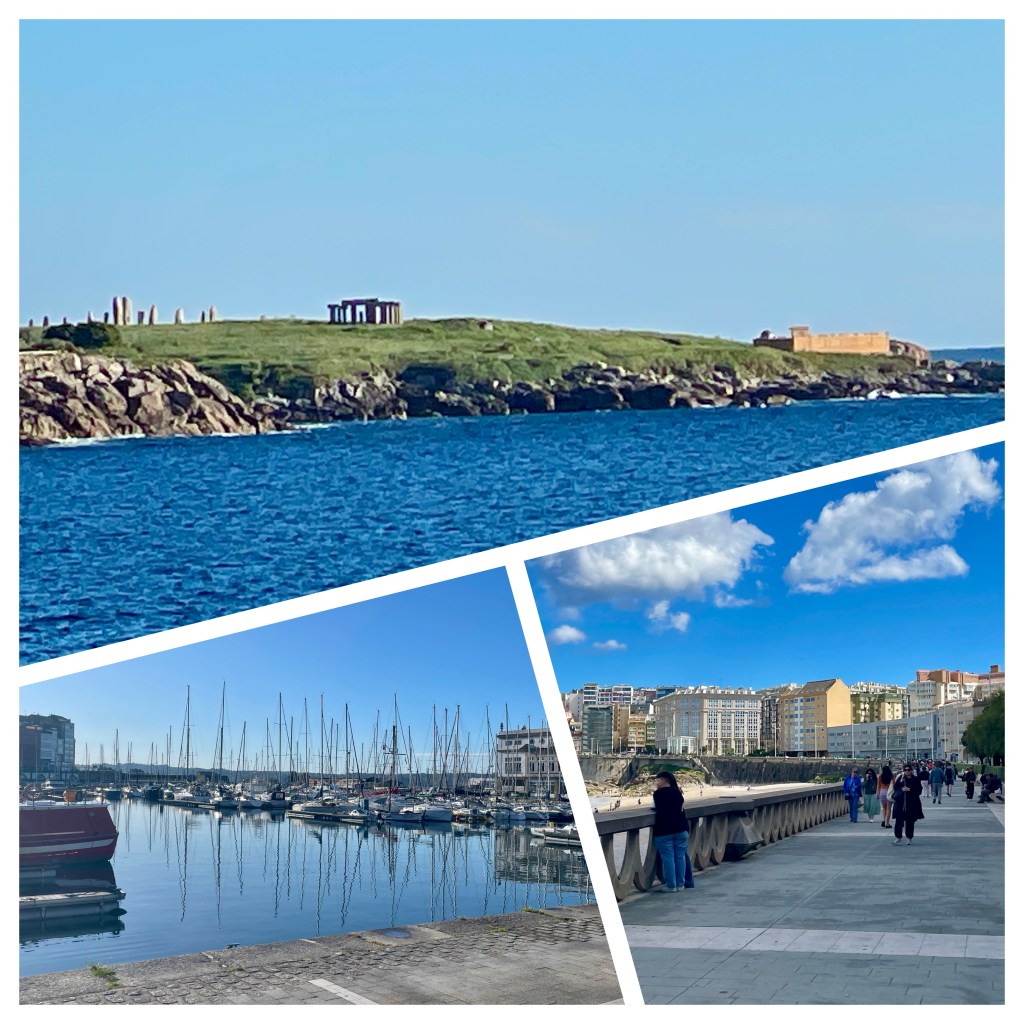
Above left an art installation honoring victims of Franco’s regime. 
1st century Roman lighthouse, still used; story is that Hercules built the lighthouse. 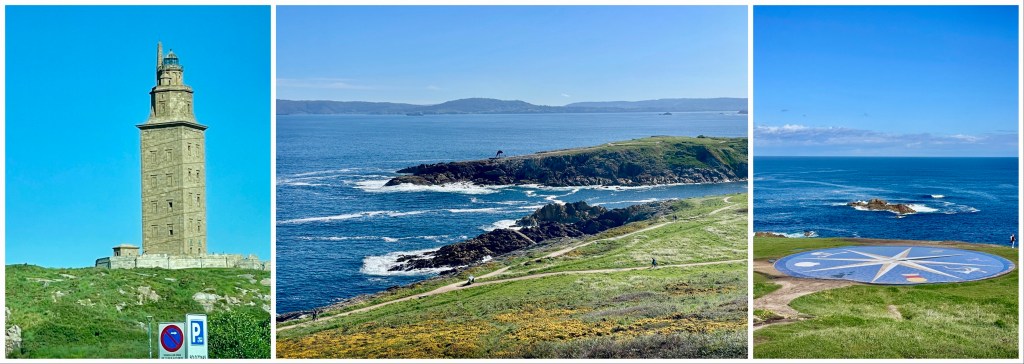
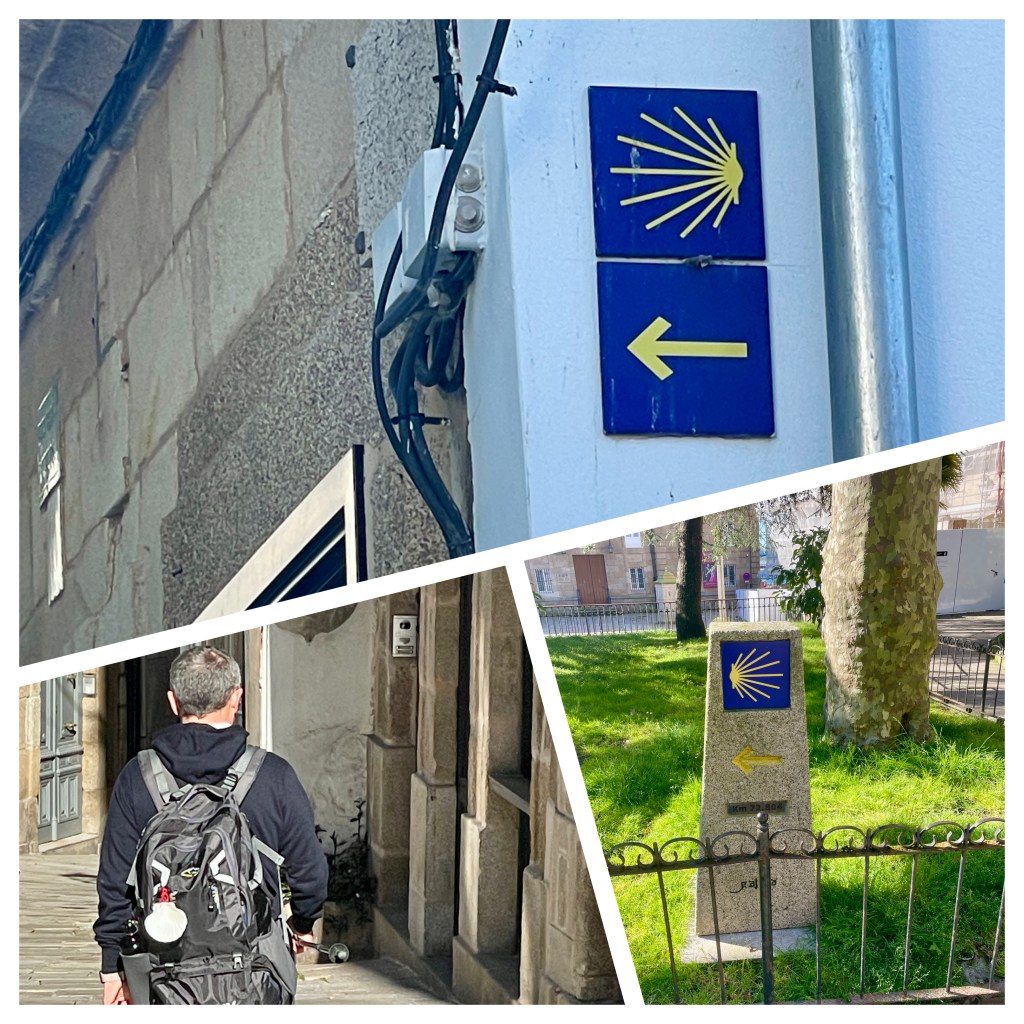
Camino milepost and signage. Upon Karla’s return, we decided to visit a small cafe/tavern off the beaten track. We chose one and ordered the local beer and wine to go with our octopus and squid…as well as a local cheese. They were all good. If we were to do another world cruise…which we don’t plan to do…we would do lots more small cafe eating. Our tendency to eat on the ship (where everything is paid for), has kept us from sampling local food and culture.
A Coruna surprised us. It’s definitely a place we would come back to. Karla speaks of doing the Portuguese Camino route, which would end very near here. I could see waiting for her here and getting more modest exercise…and not having to deal with all those pilgrims.
-
Vigo, Galicia, Spain
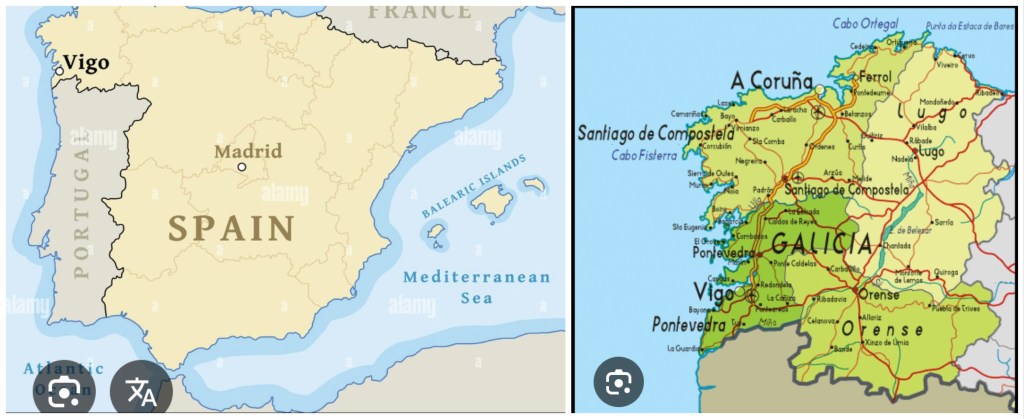
Vigo on country and regional (Galicia) map. 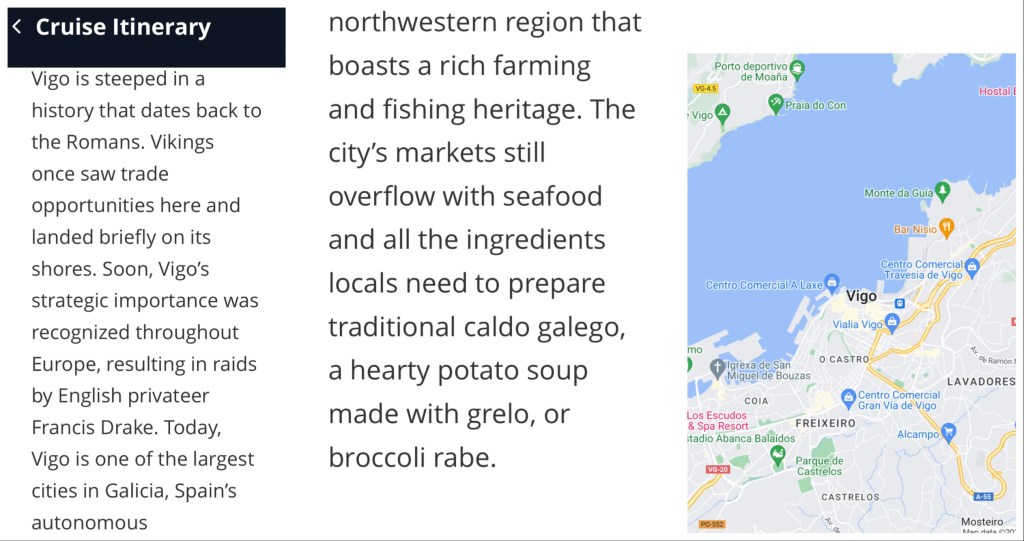
April 30
When foreigners think of Spain, they generally think of Madrid, Barcelona, Valencia, or Seville. However, if discussing Galicia, in western Spain, Vigo makes the list. With 300,000 inhabitants…550,000 in the urban area…it is the most populous city in Galicia. It has a prime location on the coast, but given it’s historically small population, it didn’t receive much attention from foreign raiders. The Vikings raided Vigo several times, as did Sir Francis Drake. In 1702, as the Spanish were at war with Scotland, the British occupied the city for a while. And, in 1808, The French annexed Spain, Galicia included. But, it was the first city freed with Napoleon’s demise.
In 1947, Vigo became a Free Trade Zone and the economy picked up. Today, Vigo is home to some of the world’s largest fishing and shipbuilding companies. It is one of the main fishing ports in the world and exports lots of processed and canned fish. Other principal exports include cars, granite, wood and processed food.
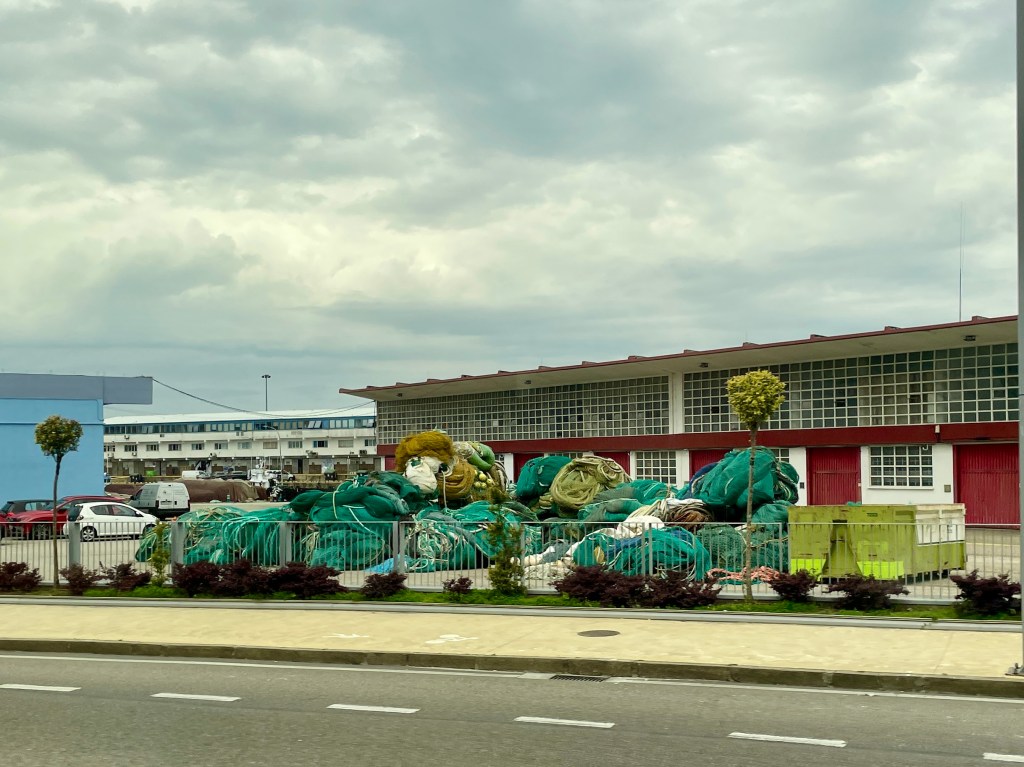
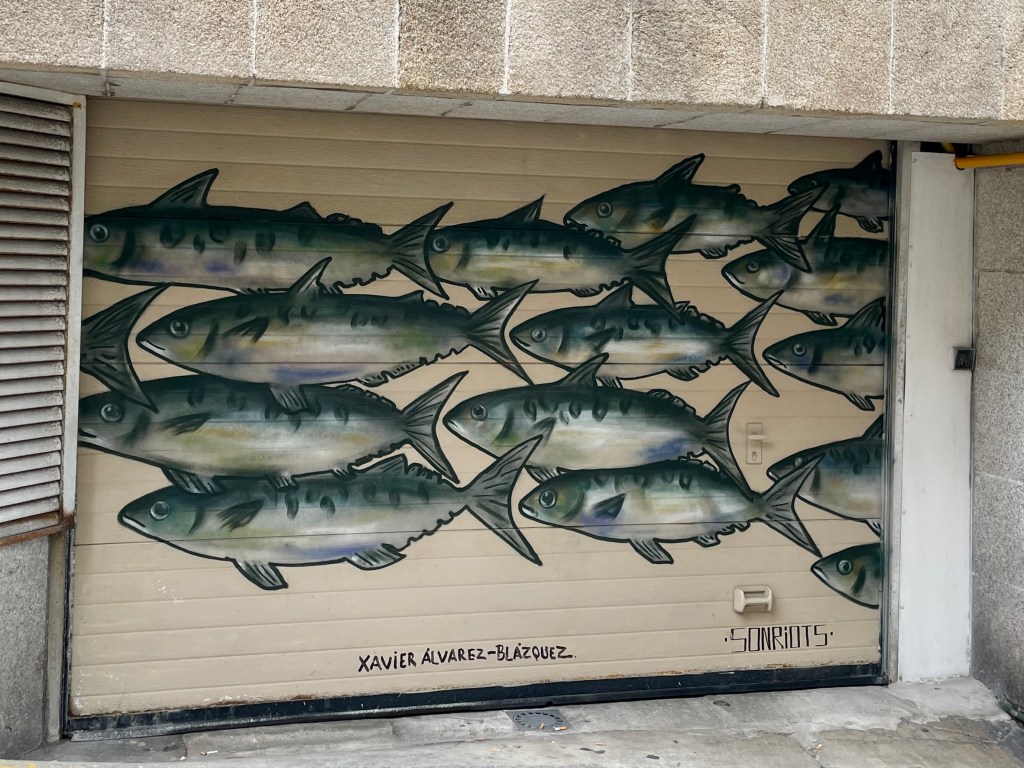
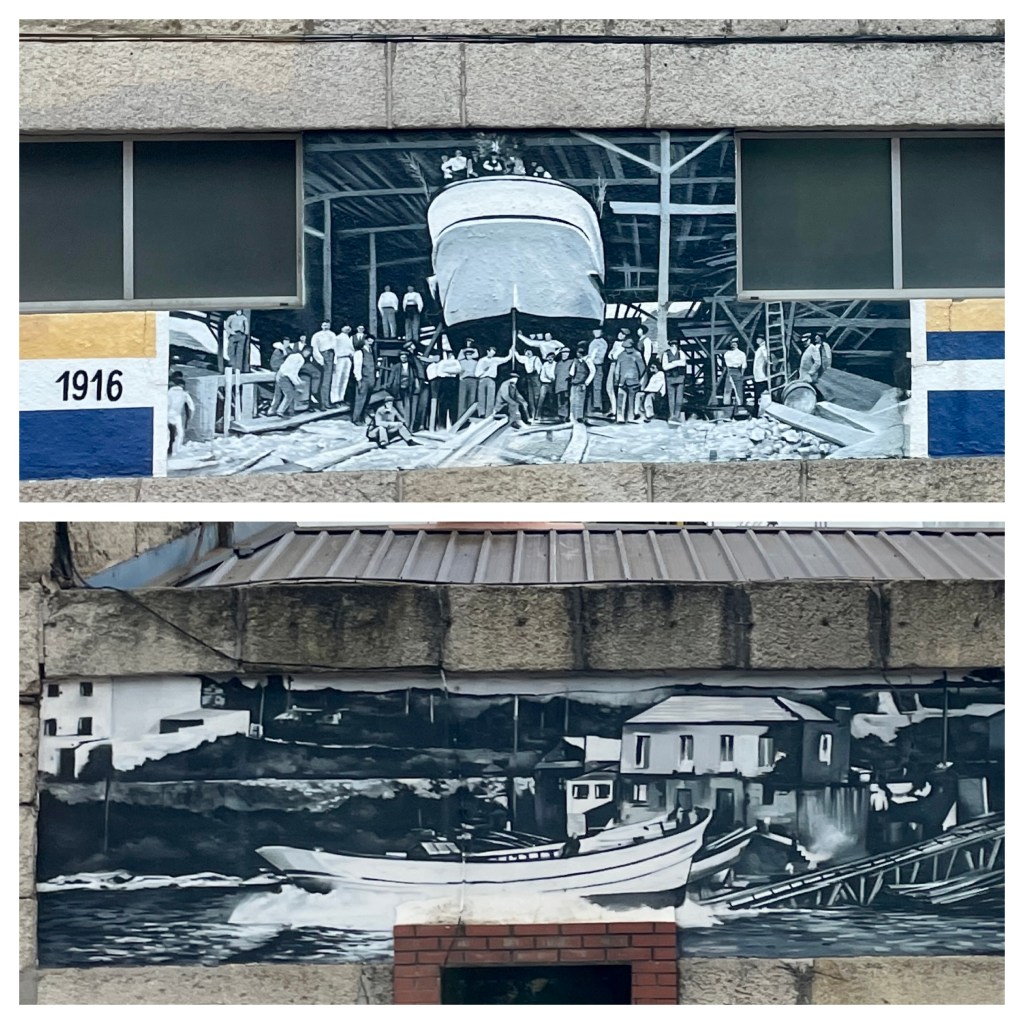
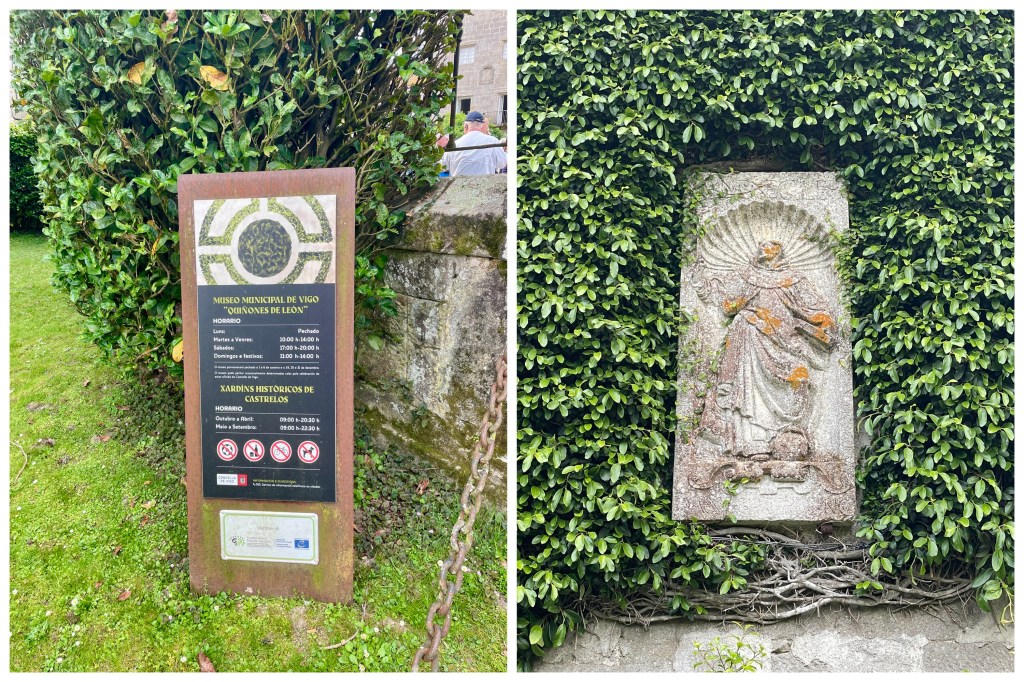
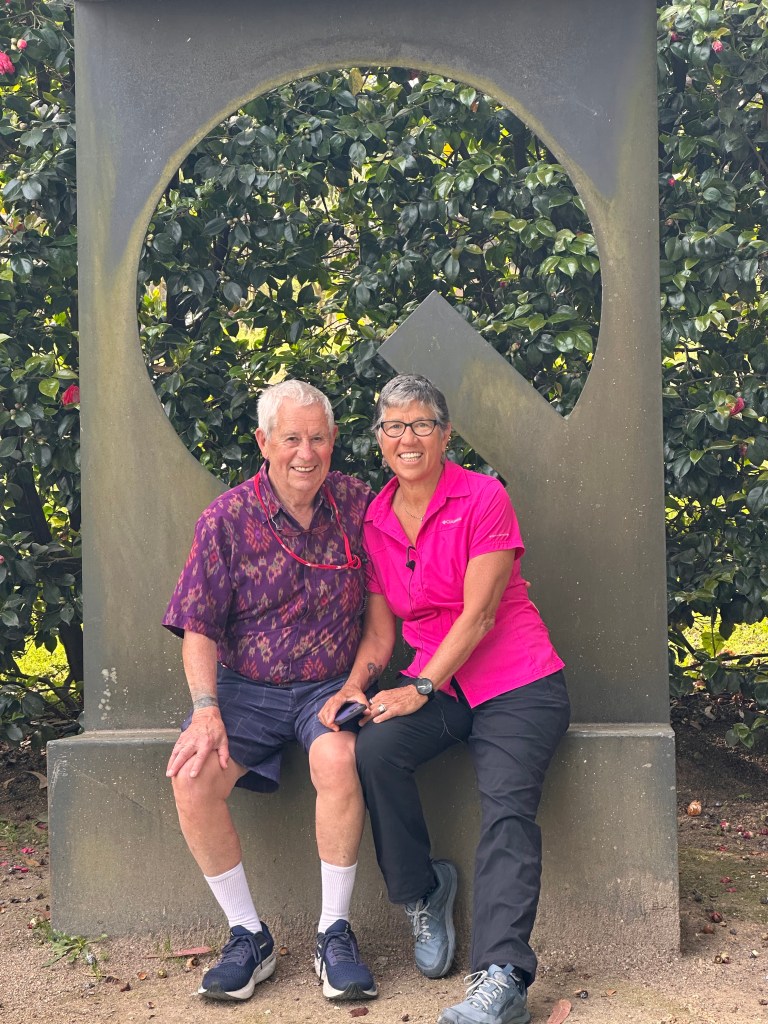
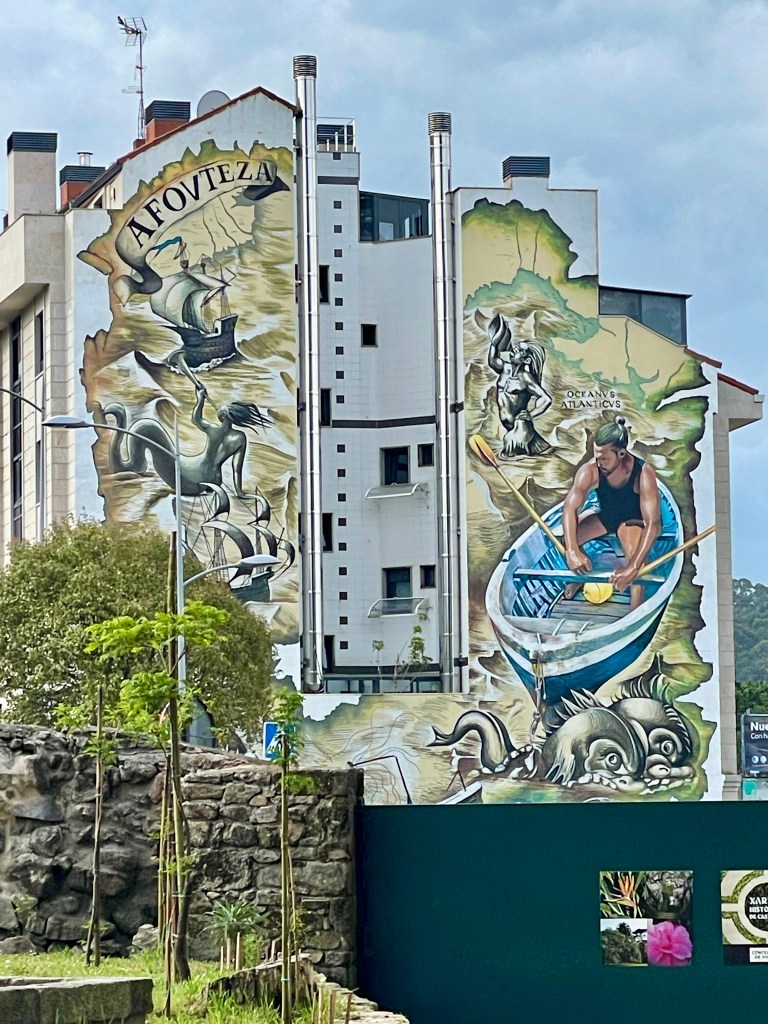
Designs on the walls outside the major ship builders: Freire, Cardama, Armon, and Nodosa I’ve said before that a good guide can make an excursion successful. However, there are limits. Our 2 1/2 hour bus trip took us to 2 forts/castles…neither of which we could enter. It also took us by a coastal area with rocks and sand; we,ve seen some of that before on a 4 month ocean cruise. It did allow us 45 minutes in a botanical garden which was impressive.
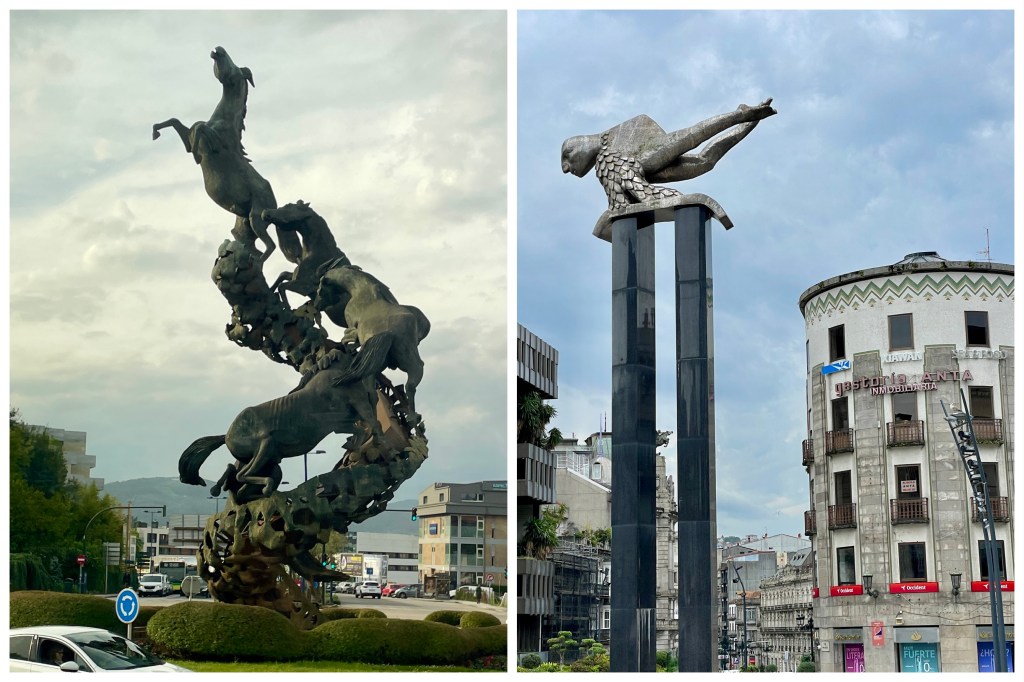
Left statue celebrates curros (rapa de bestos), a regional festival in which wild horses are corralled and their manes and tails are cut. Merman statue on right. 
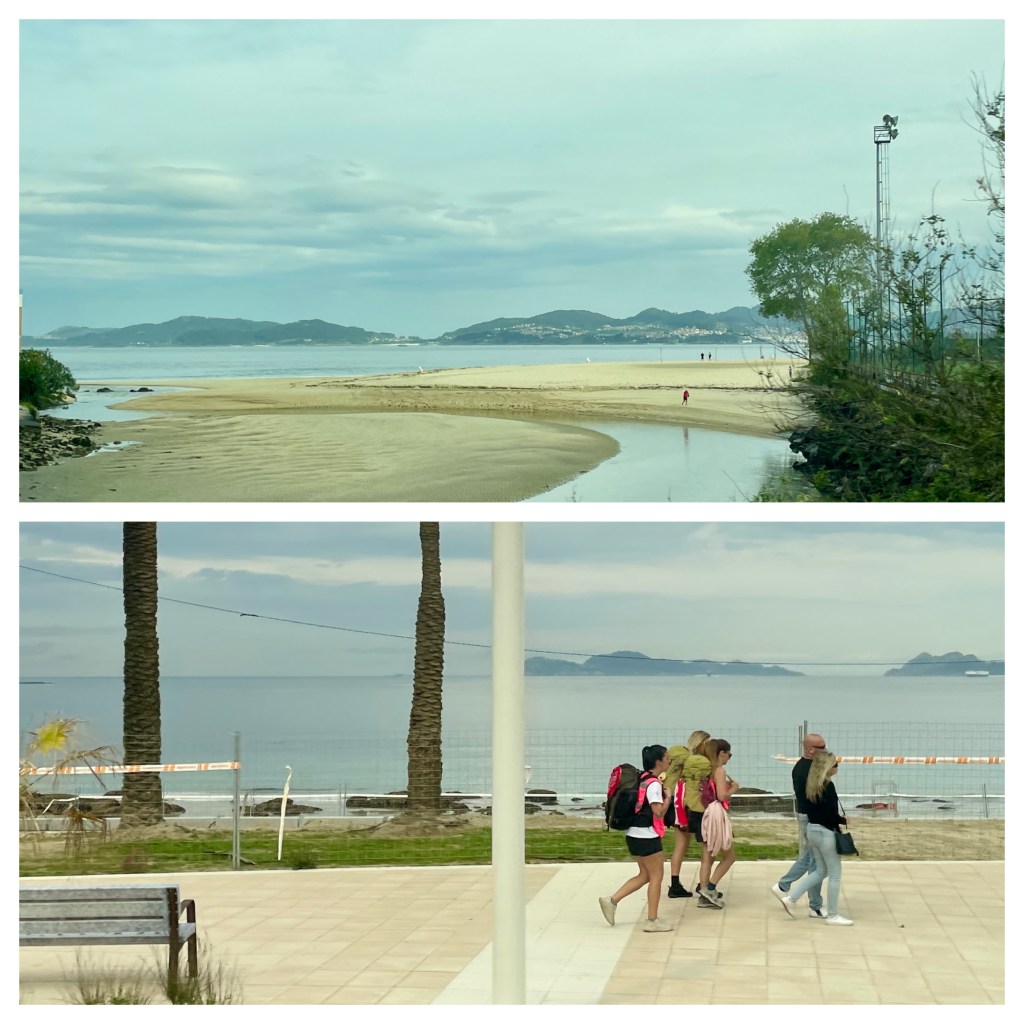
Playa Samil and Camino pilgrims on their way to Santiago. 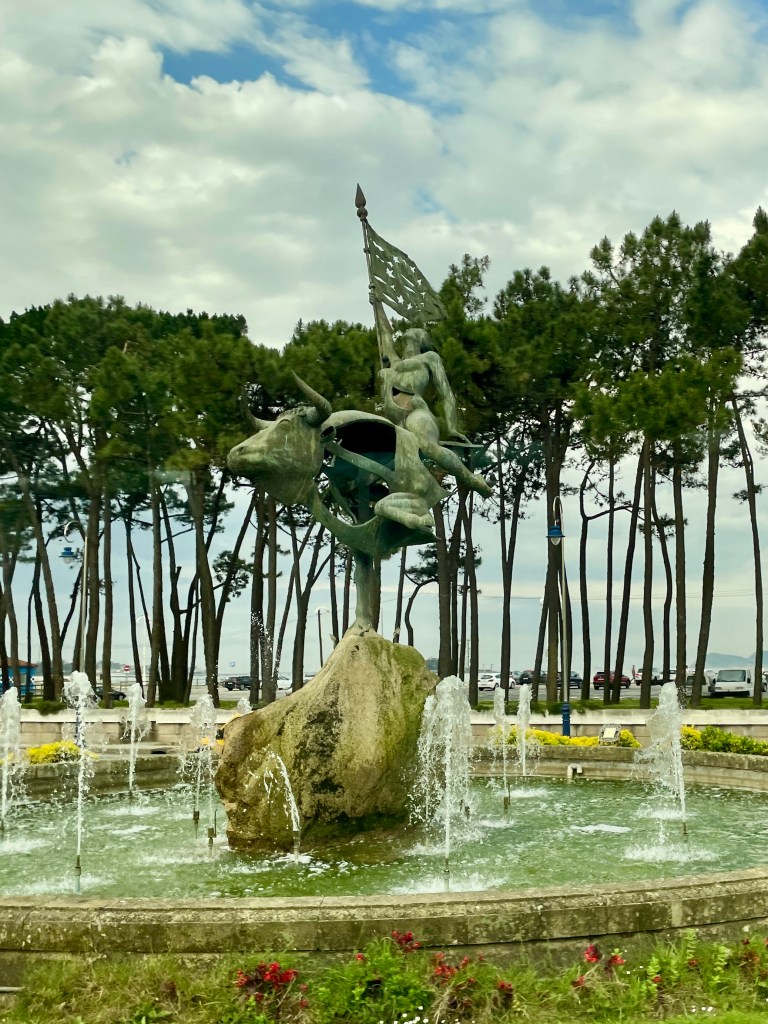
Zeus kidnapping Europa. I was ready to list Vigo on the low side of ports visited until Karla and I took a walk in search of the old city at the end of our excursion. We found a great old town with winding streets, plazas and lots of shops. We stopped at a restaurant that was a bit out-of-the-way. We wanted to try the local wines and seafood. Our mussels were good and squid great…as were the wines. We tried the regional whites: Godello, Albarino, and Treixadura, which we liked in that order. We sat at an outside table and were offered to move inside when the clouds darkened. The heavy rain storm didn’t bother us because we’re northwesterners. (The restaurant owner tried to give us an umbrella, but we persuaded him that we weren’t sissies.)
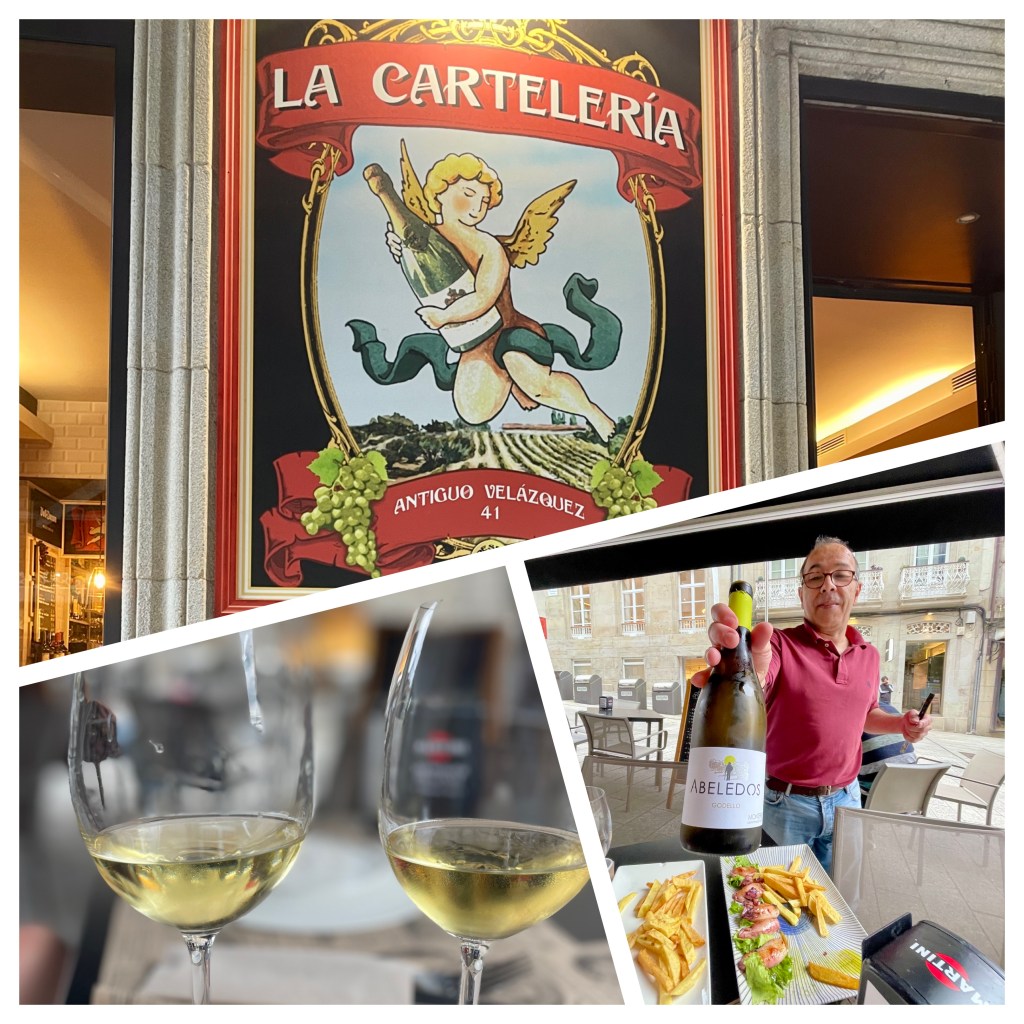
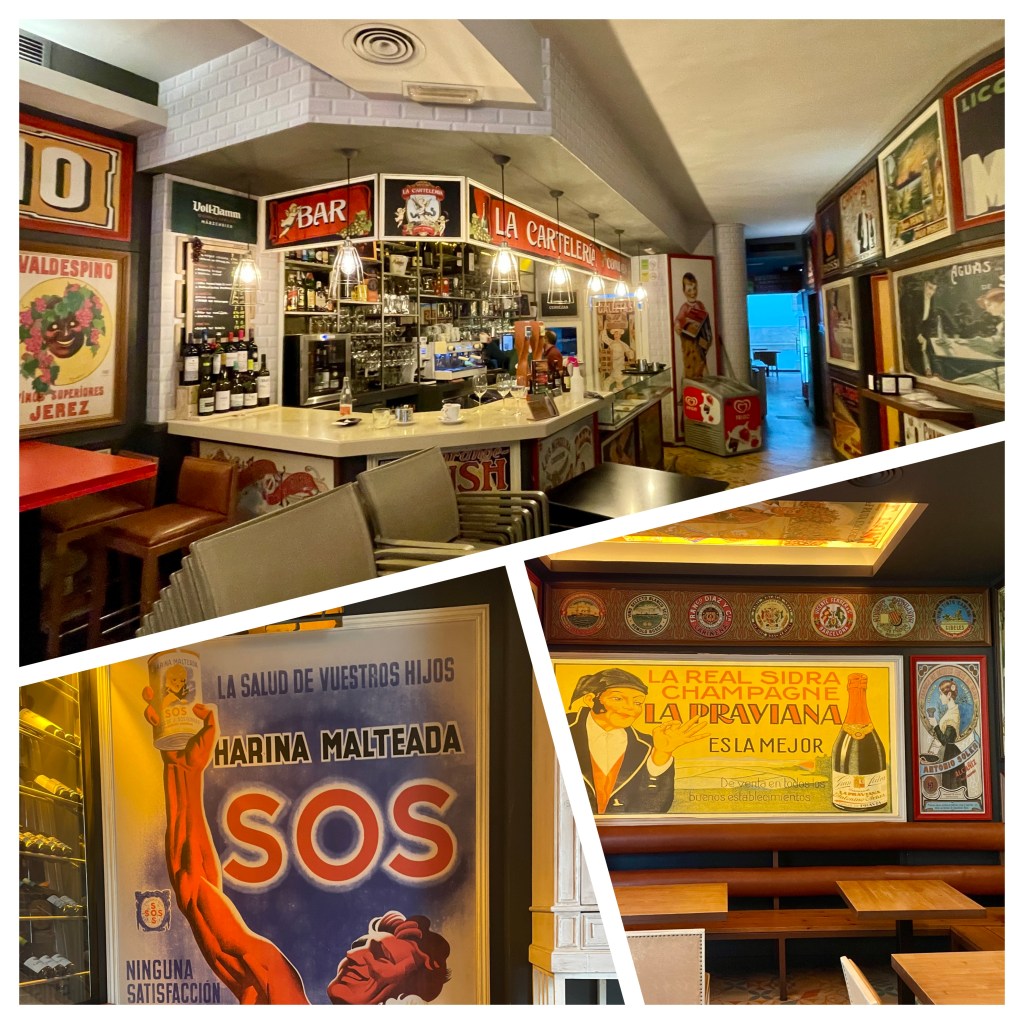
The inside of our lunch restaurant with lots of old advertising posters. Our walk and the food/drink experience moved Vigo up our desirability ranking. Karla is talking about hiking the Portuguese stretch of the Camino. Santiago de Compostela, the terminal point for the Camino is less than a two hour drive from Vigo. A start in Oporto and a finish at Santiago would make an interesting coastal walk.
On an unrelated note, one of our favorite waiters, Tinashe, told us that he was leaving the next day and disclosed that he and a wine stewardess who we like are getting married in the relatively near future, upon return to Zimbabwe. We gave them a monetary wedding present. Karla saw Karen this afternoon and she said that we could watch the July ceremony on zoom. In the discussion, Karen commented that Tinashe will need to provide a negotiated number of cows…the price being negotiated and determined by a number of factors relating to Karen’s family efforts to raise a marriageable daughter. It gets complicated, but some of the cows need to be female if Karen wants to have kids. Tinashe can pay the dowry in cows or cash but at least one cow (a bull) has to be included in the deal. Karen mentioned the price of a cow is about $200-250. The successful negotiation and payment of the dowry concludes the tribal wedding and Karen mentioned they will also have a “White wedding,” where vows and rings are exchanged. This is a complicated world.
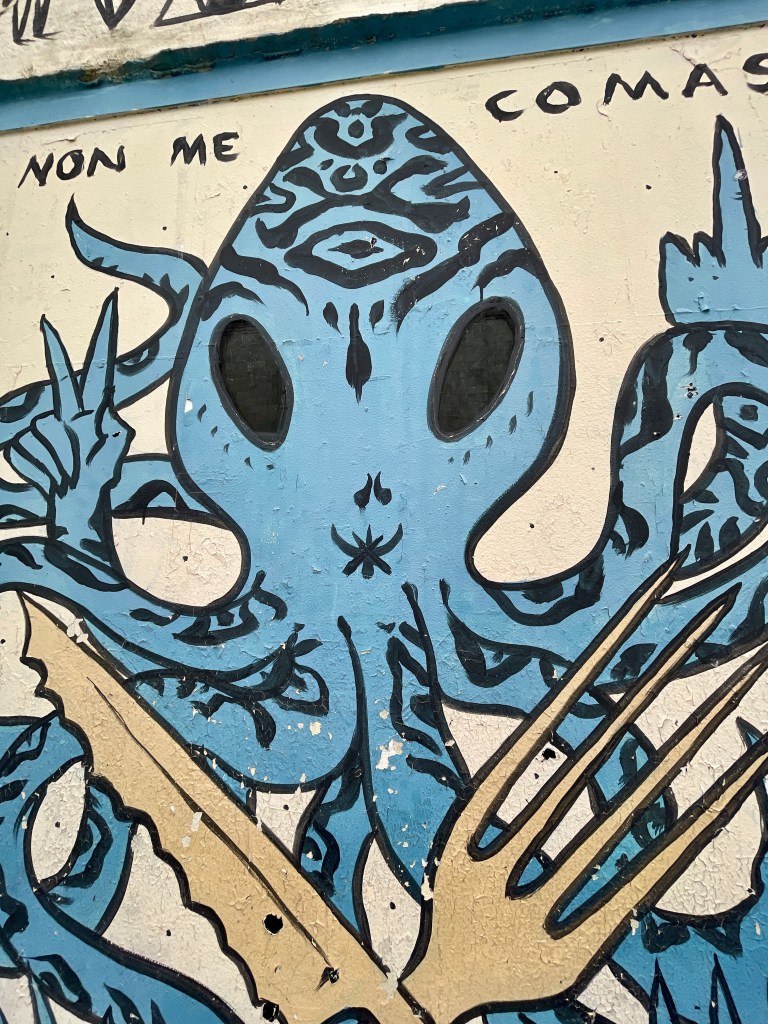
Wall art: don’t eat me. 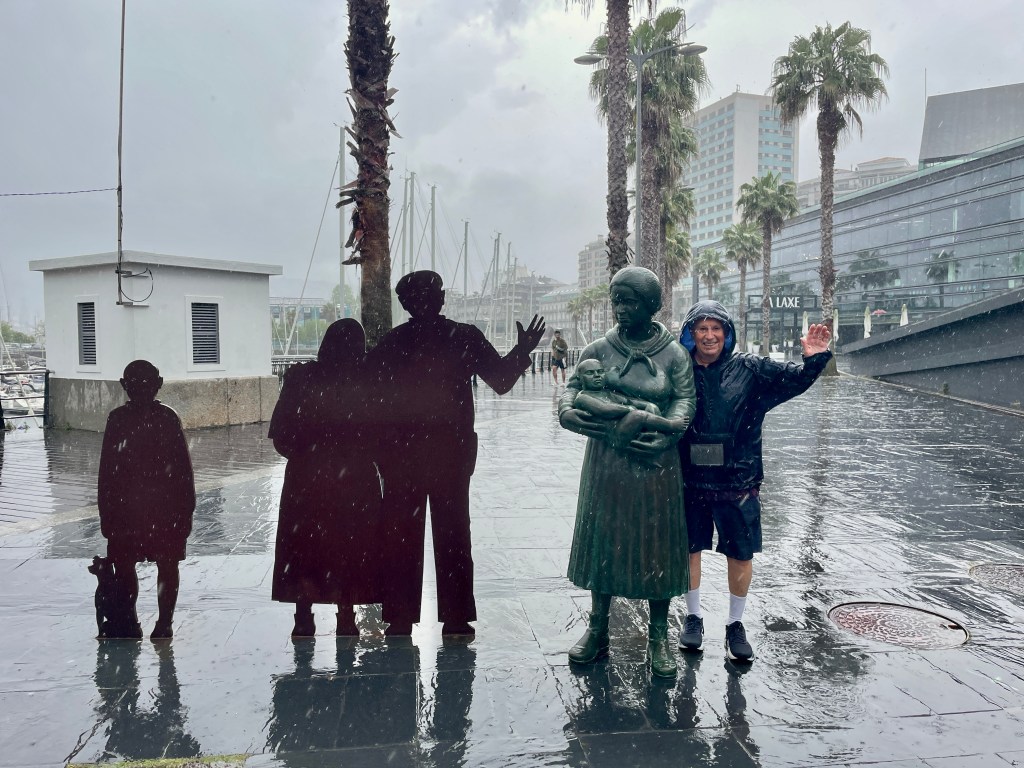
Drenched. Port statue commemorating emigrants who left Vigo for the Americas. -
Oporto, Portugal
April 29
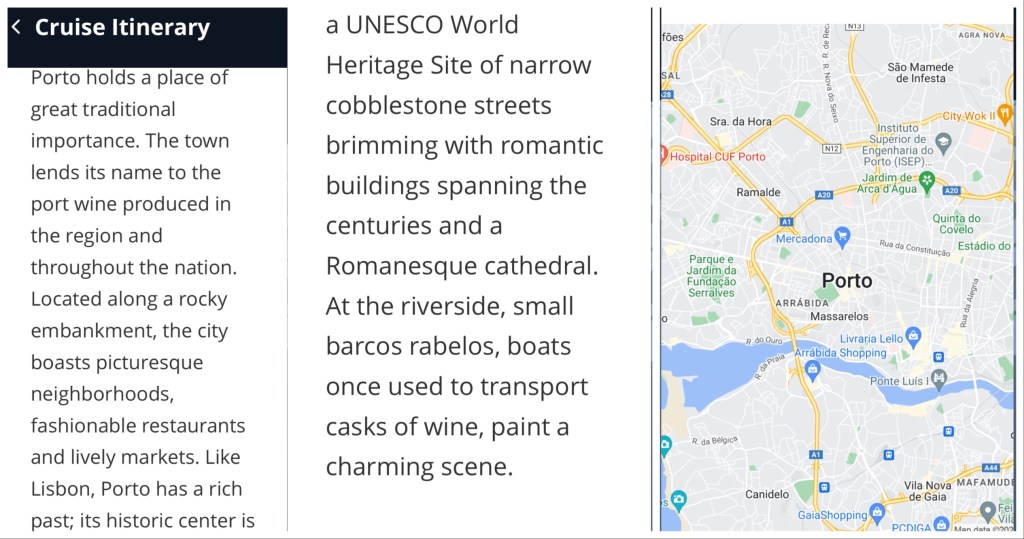
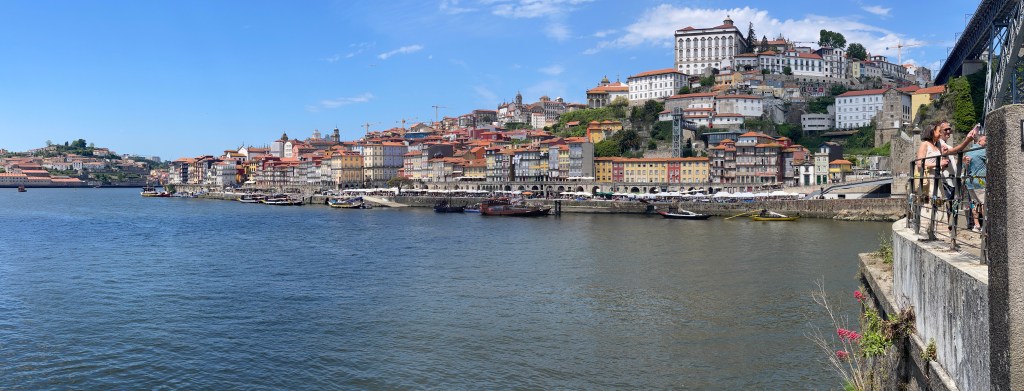
Having skipped Portimao, it appears that we’ll have more time in Oporto. That’s good because we like it there. We’ve had 2-3 previous visits and enjoyed a Viking river trip on the Douro River. Someone else apparently discovered it before us. It was declared a UNESCO World Heritage site in 1996 and in the past 10 years has been chosen Best European Destination, City of the Year, and Leading Seaside Metropolitan Destination. The city has about 250,000 people, but the urban area has close to 1.5 million people. Interestingly, a number of older houses are at risk of collapsing and about 100,000 citizens have moved to the suburbs since 1980. There has been some history of collapses; in 1806, thousands of citizens fled a French invasion and 4000 died when the bridge collapsed under the weight.
Oporto has been a key port since Roman times. In the 14th and 15th centuries it was a center for shipbuilding and Portuguese exploration. In the 18th century, the English established a trading post and developed a specialty of port wines. In fact they established a foothold with port wine cellars; hence the number of port wines with English names. It is now an industrial center, and exports dry fruit, nuts, olive oil, and, of course, port wine. Tourism is a major source of revenue.
We opted to go on a Port tasting excursion which Karla arranged in the afternoon. Our early arrival allowed us to wander around the small city– Leixoes– near the port in the morning. Karla thought that she had been there before. She said, “I think there’s a thrift store on the right on the next street.” There was a thrift store on the right…adding to her credibility. We both got about 10,000 steps before the real day started…actually, she stayed in the town longer and added to her count.
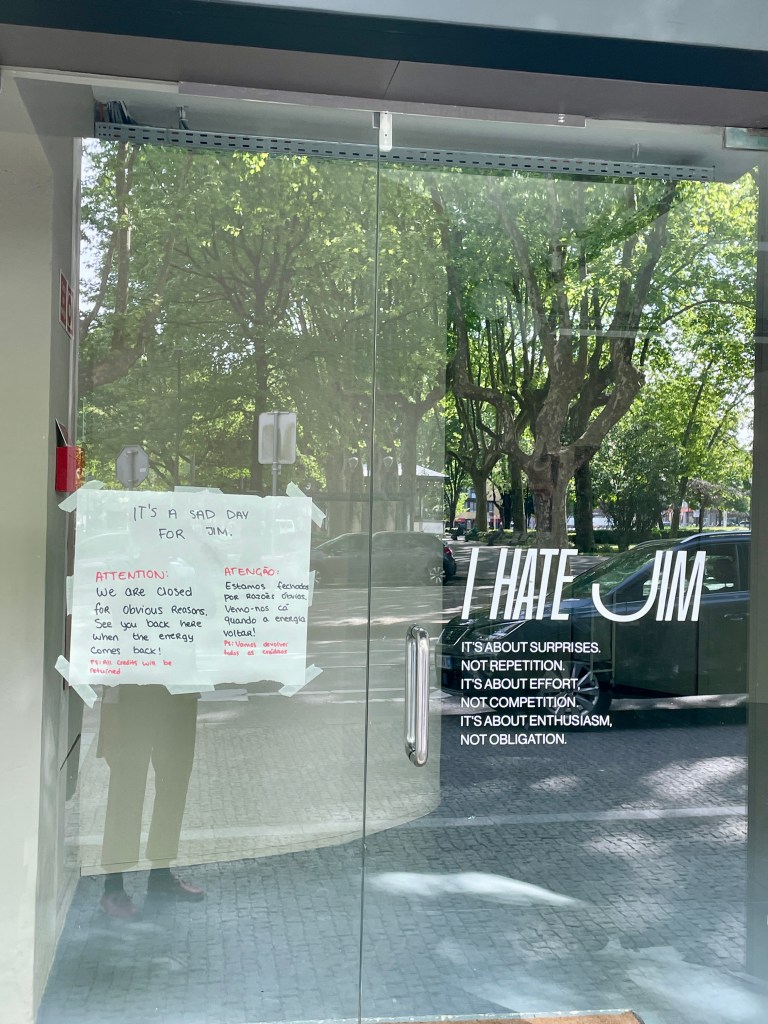
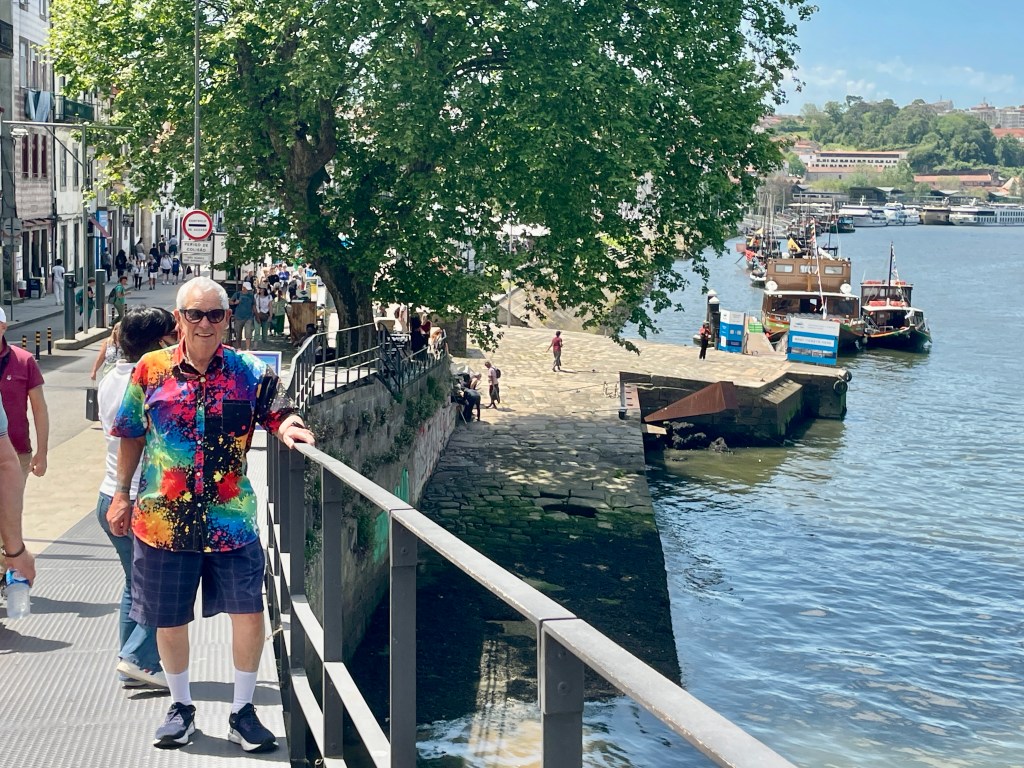
We arrived the day after a nationwide power outage that affected both Portugal and Spain. This was posted at a local gym, cleverly called “I hate Jim.” A ship shuttle bus took us to a drop off point in Oporto around 11. We stopped at a small, “hidden” restaurant for a salted cod (baccalau) lunch, which was very good. Then a mile walk took us through winding streets and then the active riverfront area. It’s loaded with colorful shops, street stalls, street performers and restaurants. We crossed a bridge to find more of the same before arriving at our tour starting spot an hour early. That gave me a chance to get a nap on an unoccupied spot on a lawn. As I woke up, I was not bothered by overflying birds and dogs walking by, even though the grass had various shades of discoloration.
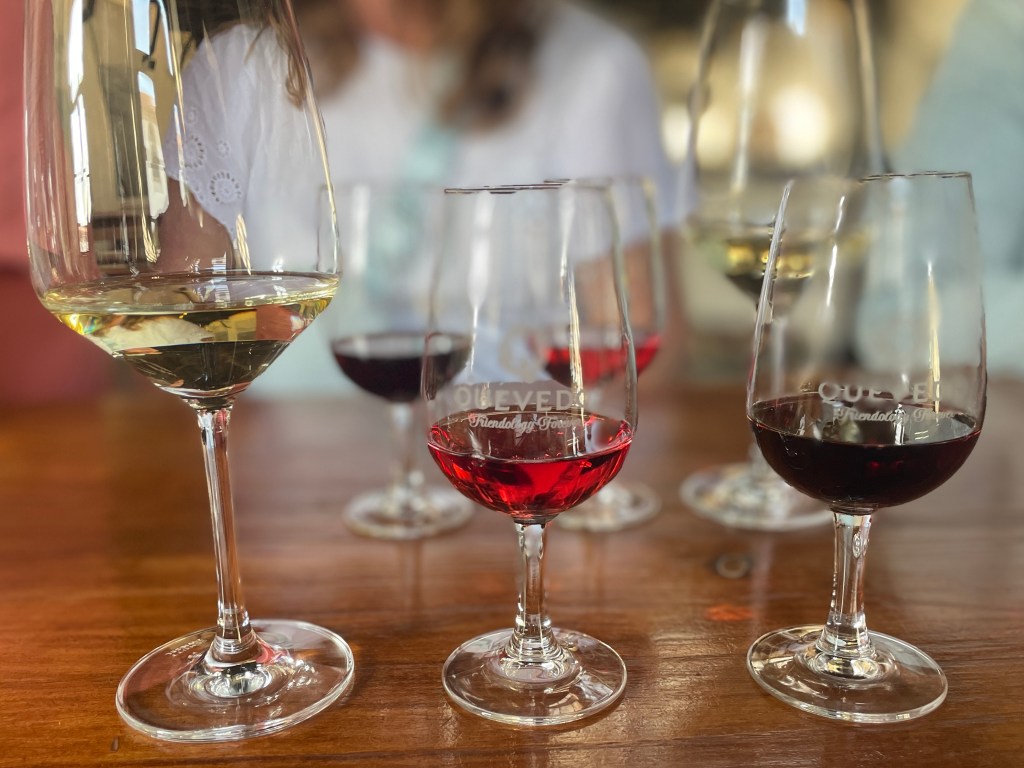
Our tour leader guided us to 3 port cellars which allowed us a total of 10 tastings. The wine was decent…including some “regular wines.” It’s hard to make an indecent port. The last port cellar was the most interesting. They are trying to find new markets with products like port ice cream and rose port which can be used for Port fizzes….appealing to the younger set. A good day…..lots of walking, nice port, and a charming city. Everyone should visit Oporto.
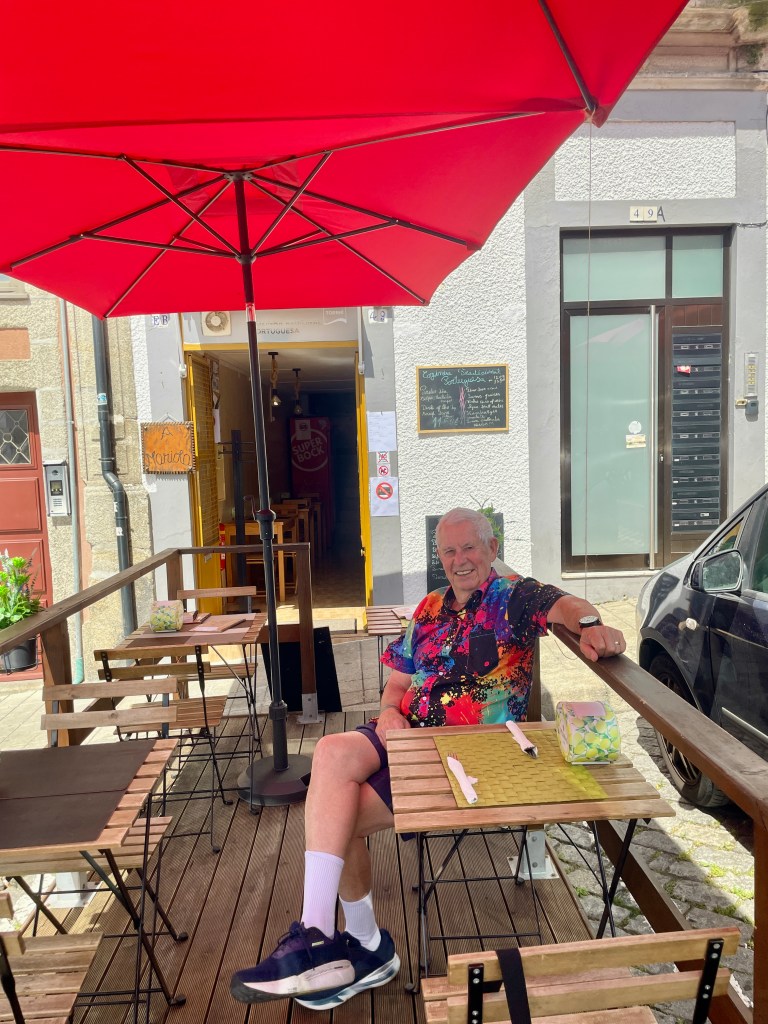
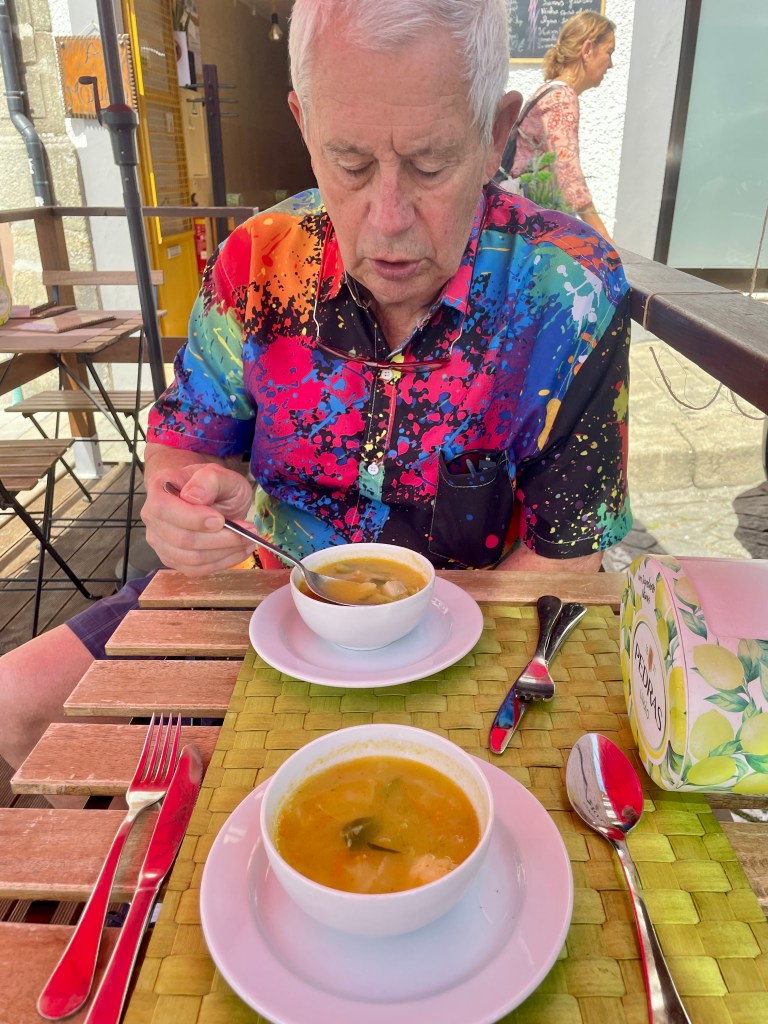
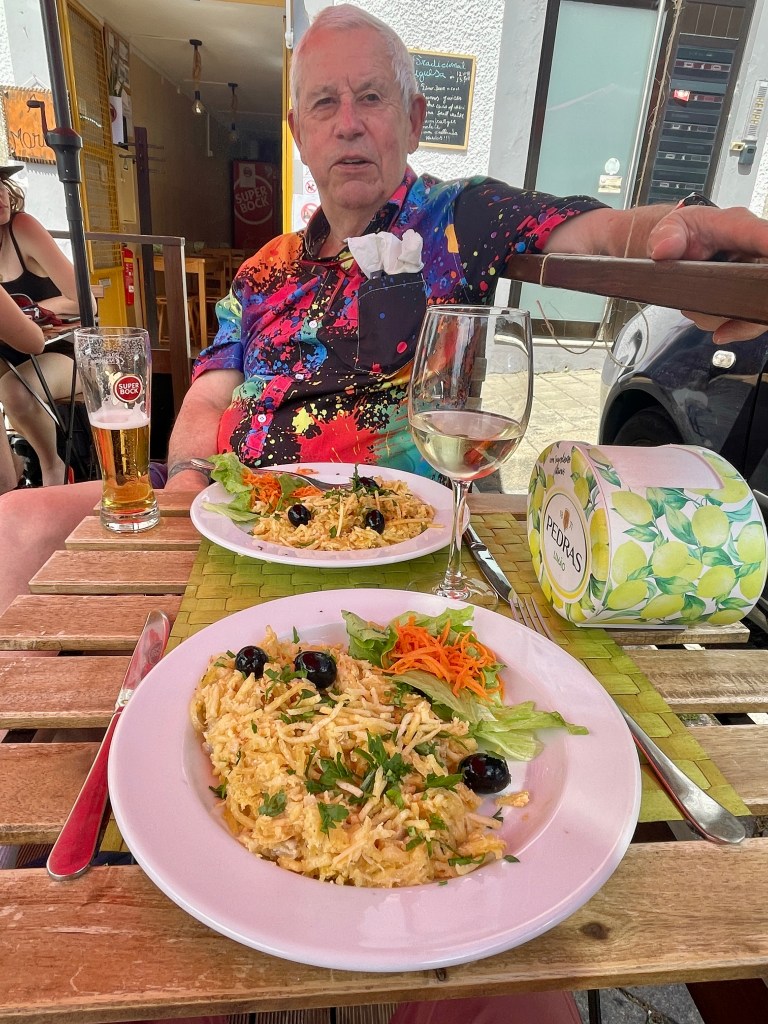
Porto restaurant; menu del dia was bacalao with potatoes and onions, vegetable soup, and wine or beer. Karla enjoyed the vinho verde. 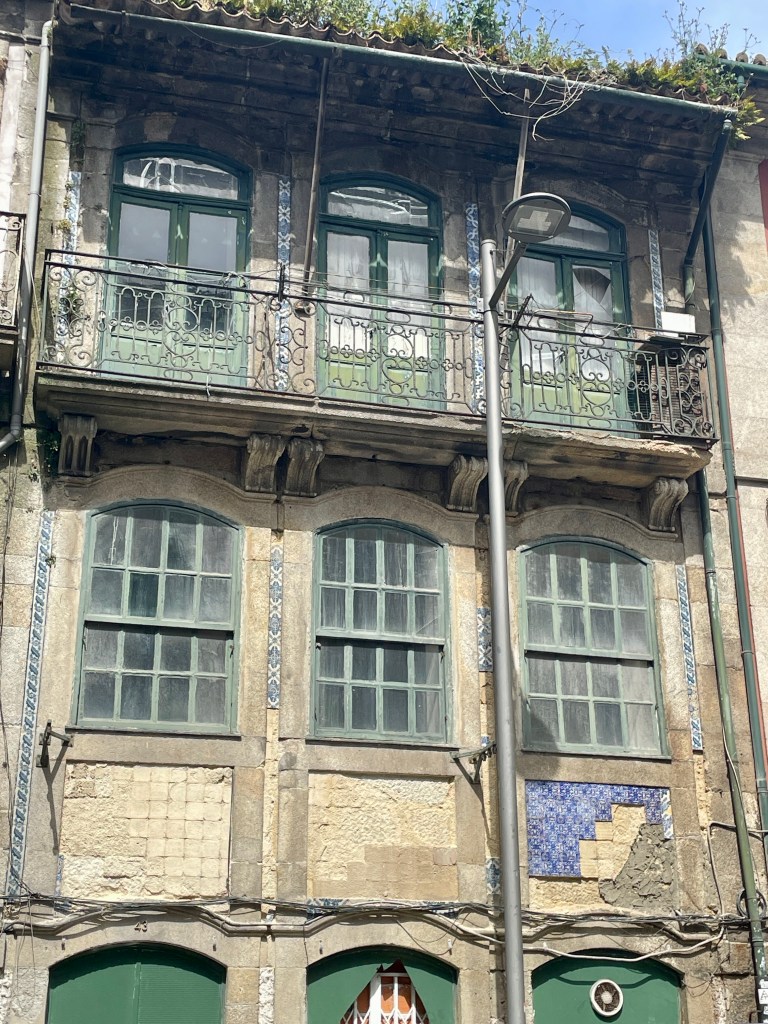
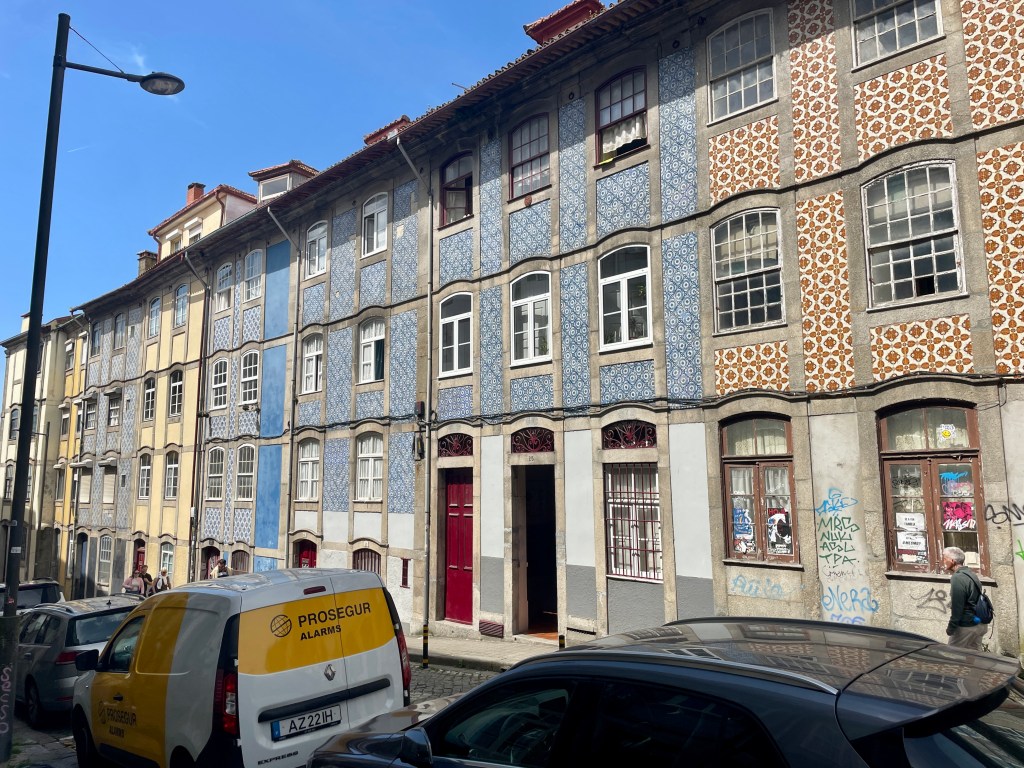
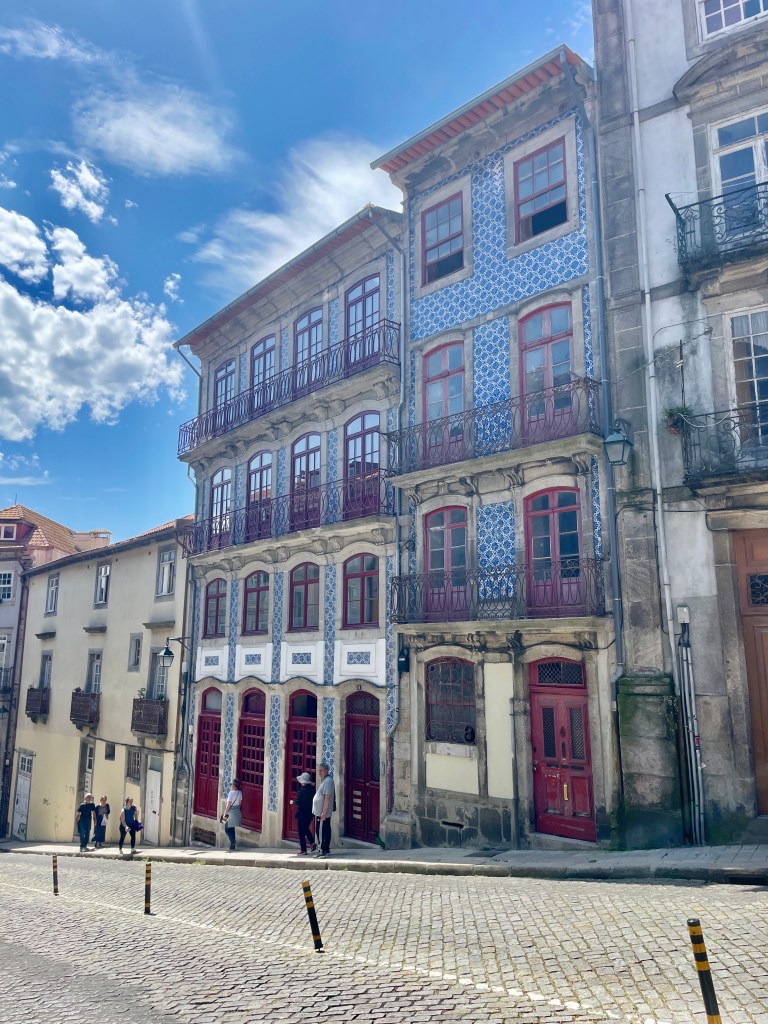
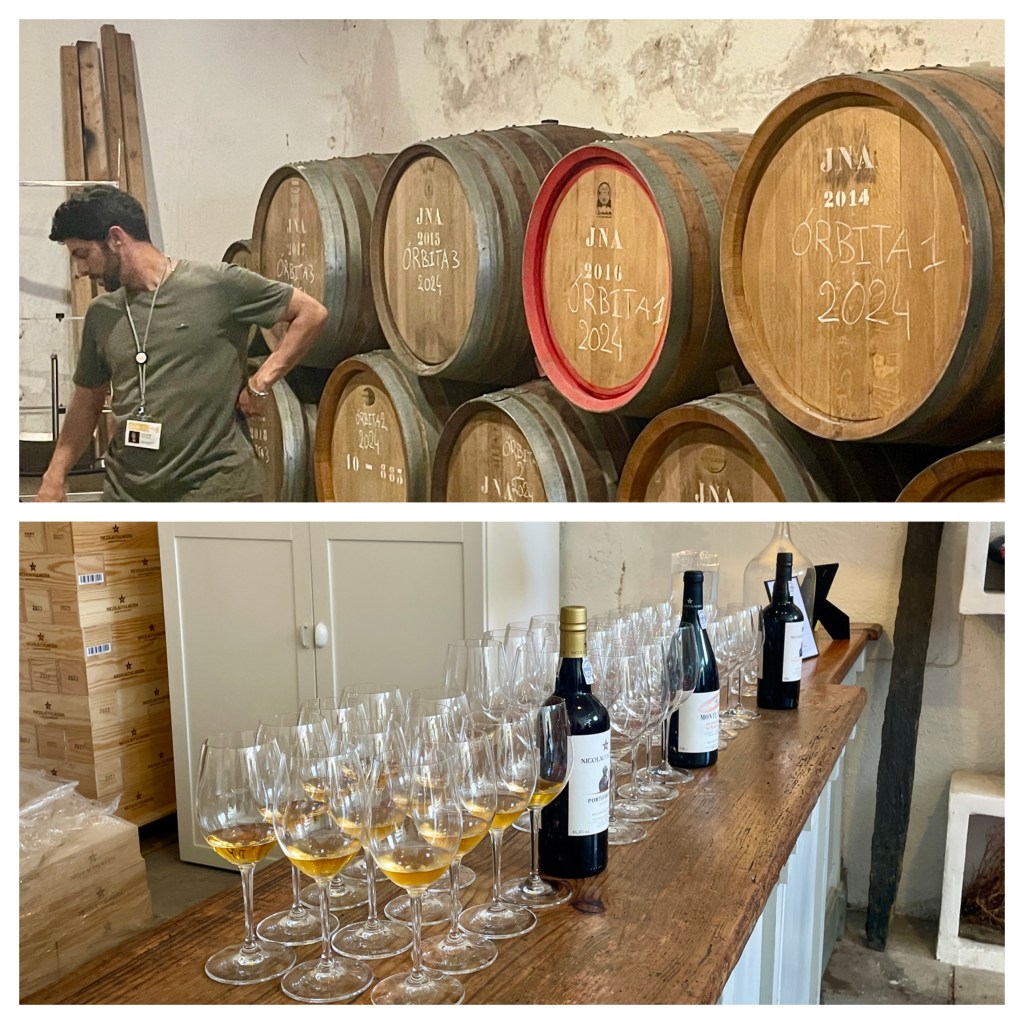
Nicolau de Almeida, Quinta Do Monte Xisto, was our first port cellar visit. Second and third: Vasques de Carvalho and Quevedo. 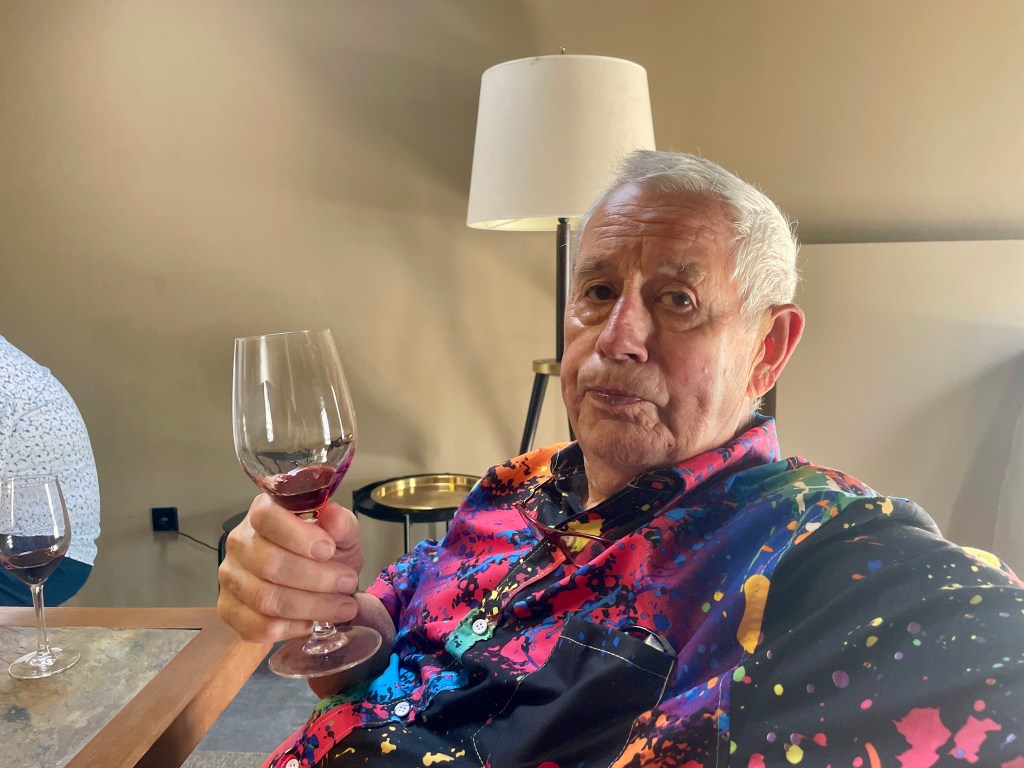
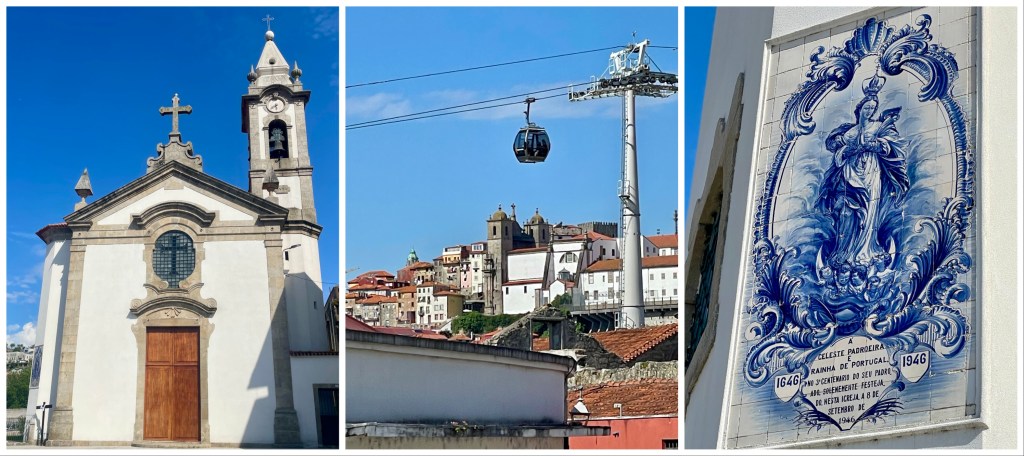
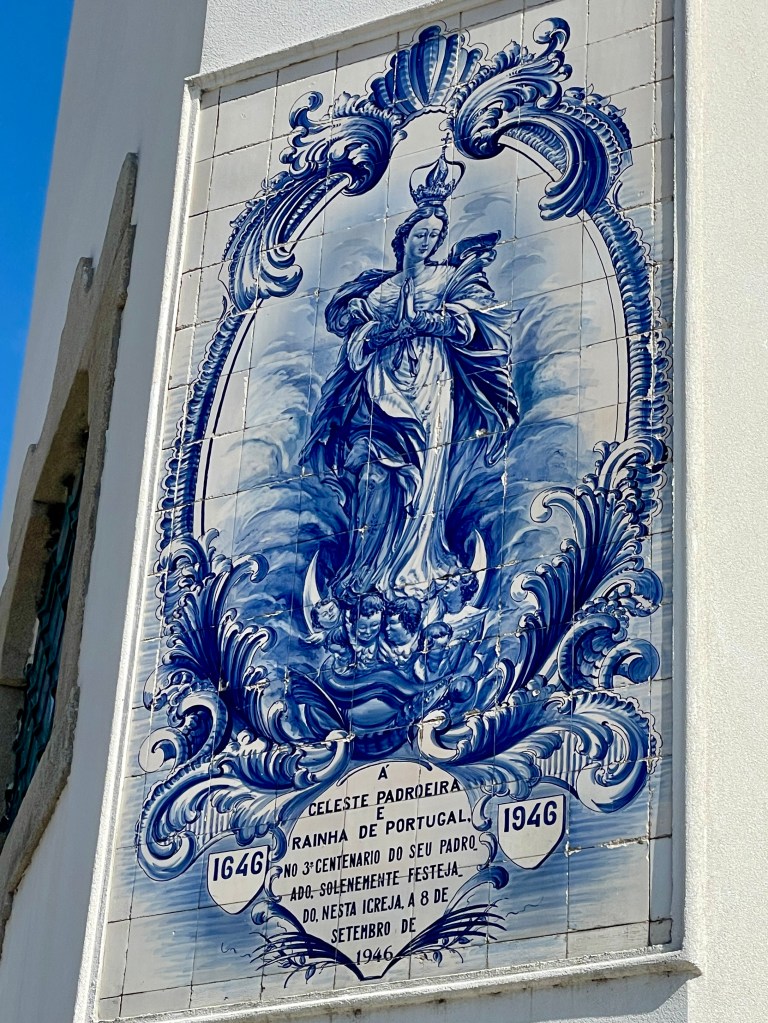
On the Gaia side of the Duoro, across the river from Porto. 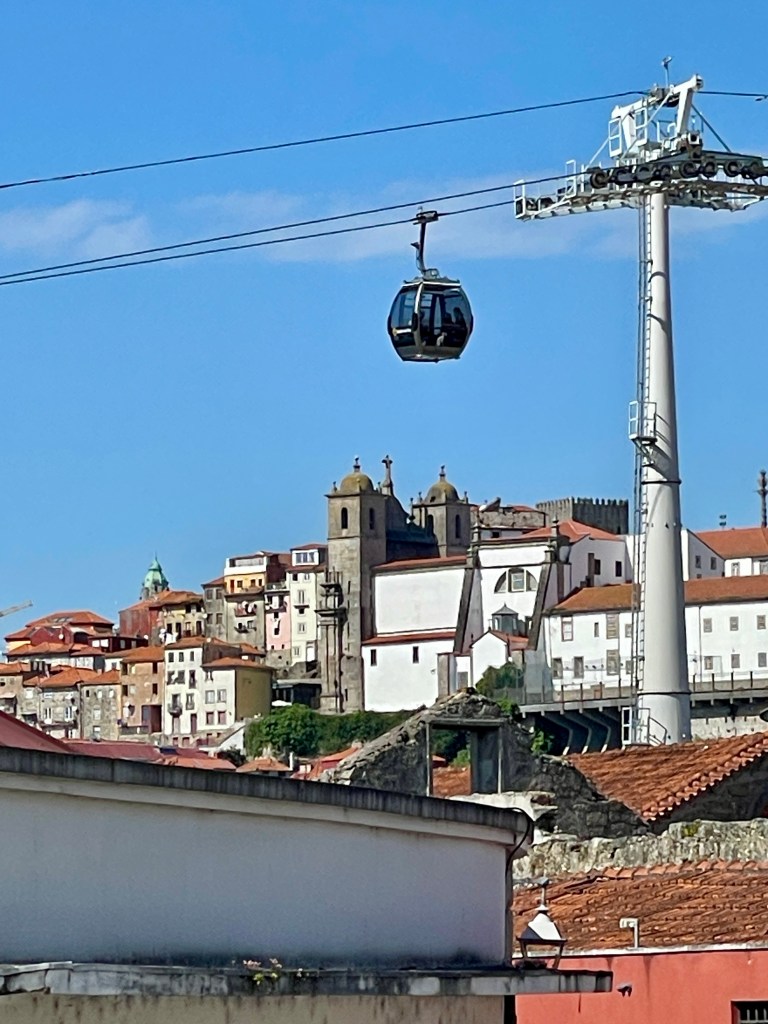
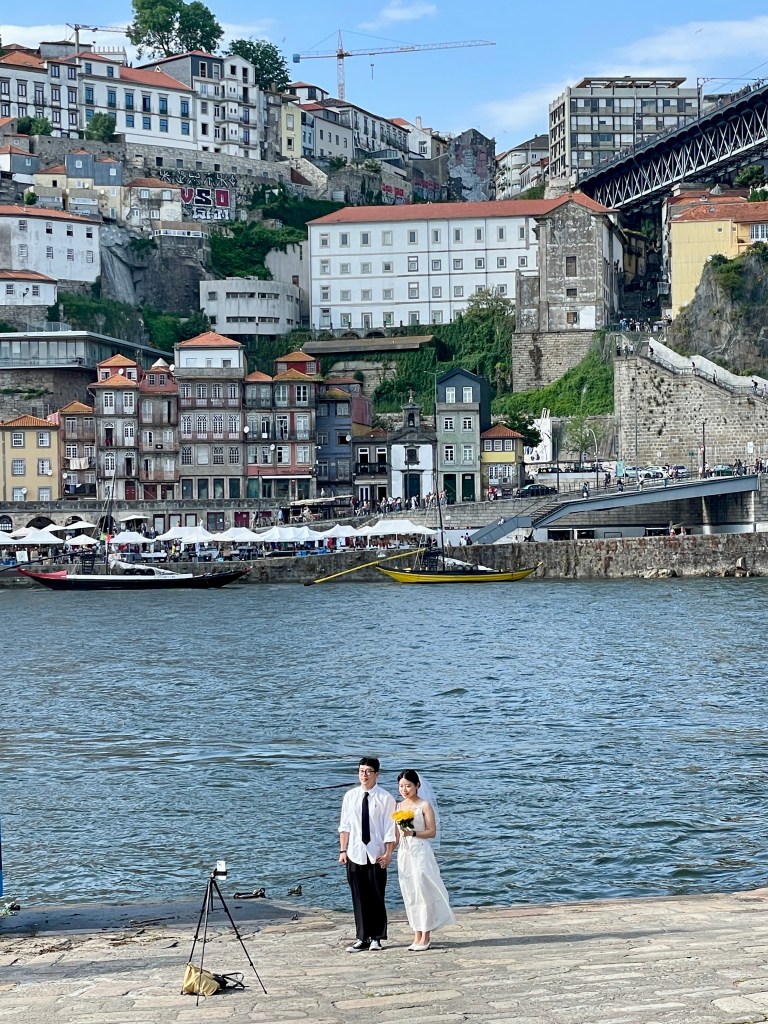
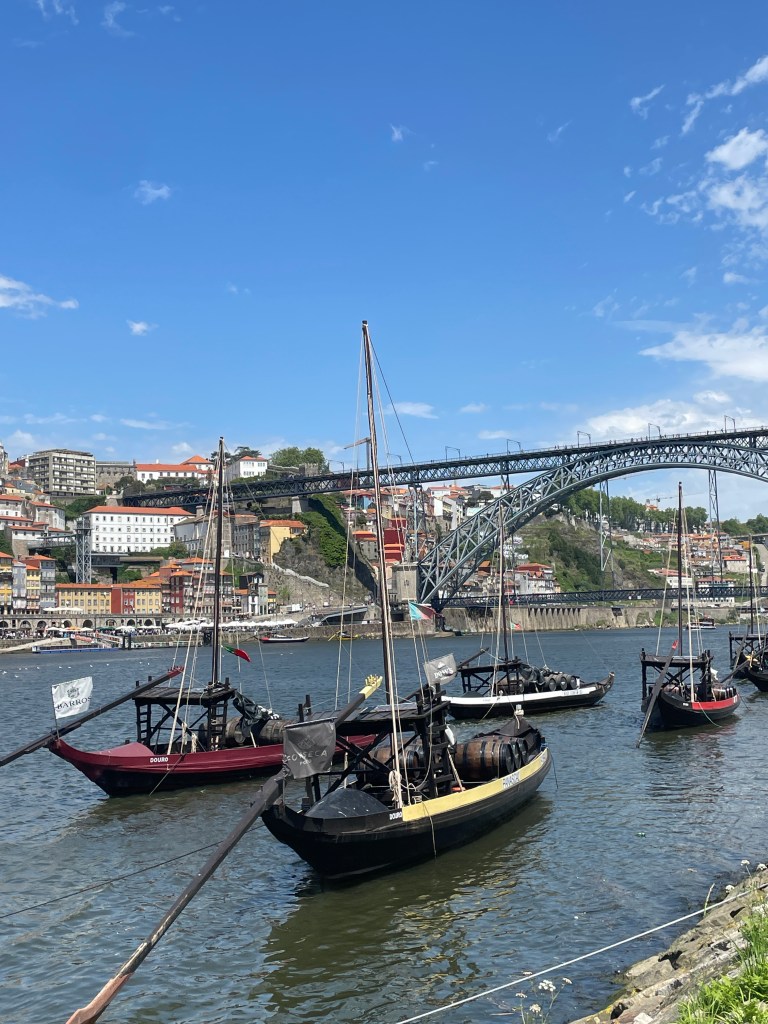
These boats used to be used to transport the port barrels. Eiffel built bridge in the background. 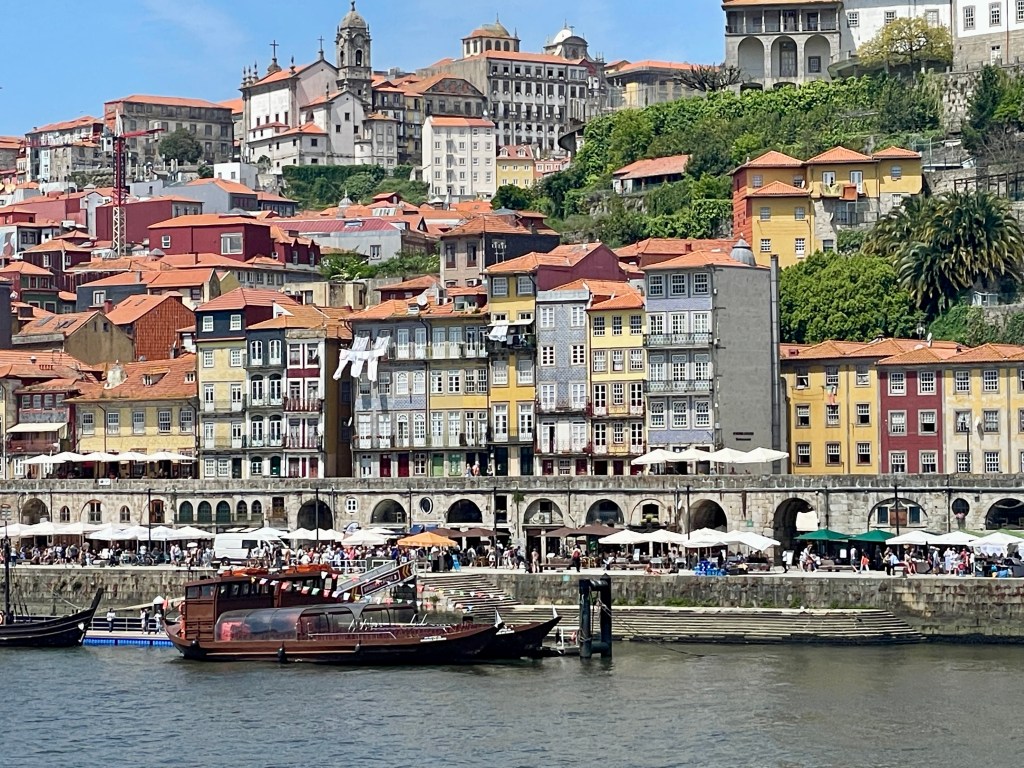
-
Portimao, Algarve, Portugal
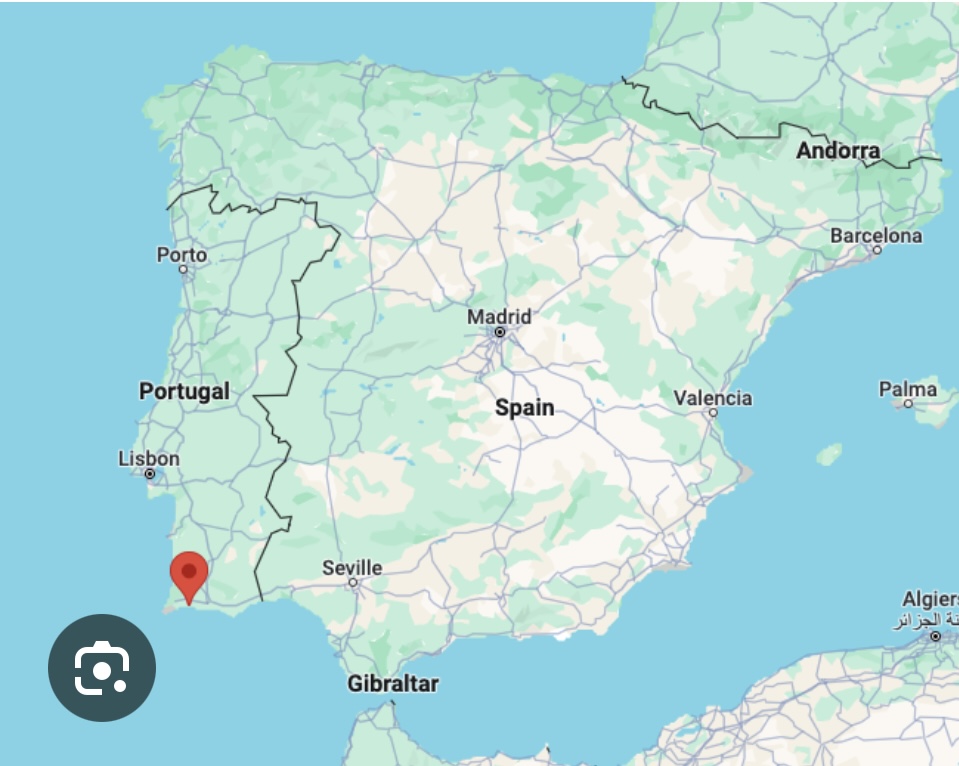
April 28
Portimao is a tourist town on the Algarve region of Portugal with a population of 60-65,000. It followed the “usual” path to development, having been populated by the Carthaginians, Visigoths, and then Moors. Portugal conquered the area in 1249, but it was considered unsafe for settlement because of the pirates that frequented the area. By the 1600’s, an export trade developed and the region moved figs, olives, wine and fish to other areas. An earthquake in 1755 slowed the export business. In the 19th century, fishing led an economic comeback, but that was dampened by a recession.
Today, Portimao specializes in homes and chalets for tourists. There are 4-5 million visitors per year, mostly from the UK, Ireland and Portugal. Just about all of the advertised “things to do” are water sports or wine tours. They seem to have found their niche.
This morning, when we got up, I checked the wind speed….about 20mph. I said to Karla that there could be a problem anchoring and riding the tender into port. The captain, perhaps having overheard me, announced that we would be skipping Portimao…the wind speeds are projected to pick up. At these speeds, the tender moves up and down…perhaps 3 feet. We have no trouble timing our steps, but lots of passengers do. It’s scary watching someone with a cane or walker negotiate the step. I’m sure that Viking worries about injuries…and liability. Of all ports, this seems like a good one to skip. The captain is seeing if we can dock at Porto earlier.
With extra time, I checked in on Truth Social.
“FAKE NEWS! They aren’t covering it, but you are witnessing the MOST SUCCESSFUL first hundred days in our nation’s history. Tariffs have all of the other countries focused on ME. I’ve been cutting some GREAT deals. China is dying to talk to me. You know what else is working….TRUMP meme coins and 2028 hats. Talking about money, I have a plan to charge kids $1/egg for next year’s’ White House Easter egg roll. Let them get some skin in the game. The left wing woke media is claiming that I’m not getting all my campaign promises done. You know what…they don’t know when I’m sarcastic or joking. They should pay attention to what I mean, not what I say. Sleepy Joe Biden left me with a disaster. AG Bondi should find a way to put him in jail along with several disloyal judges. Did you see ME at the pope’s funeral mass? The turnout was nowhere near my inaugural crowds…but neither was the turnout at the sermon on the mount.”
-
Cadiz
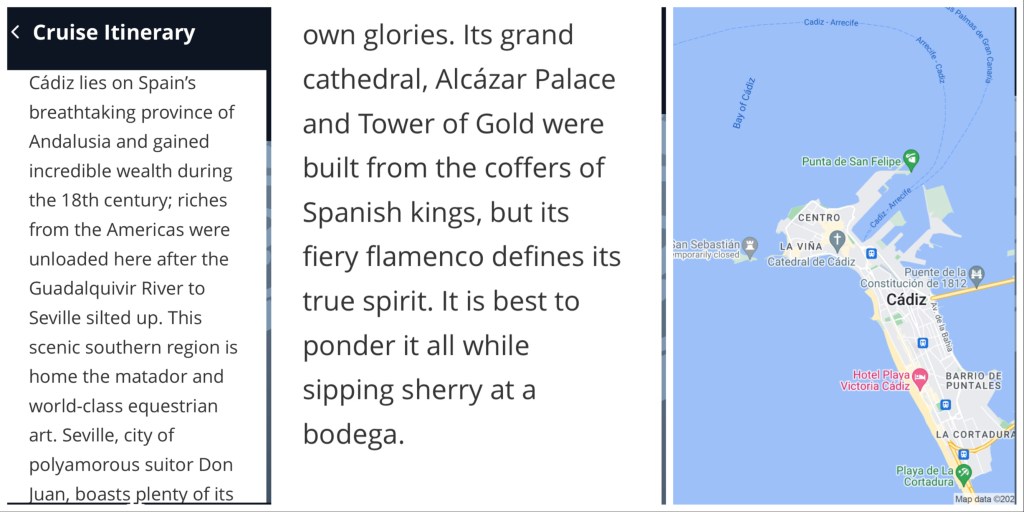
April 27
In 2005, when we lived in Spain, we traveled to Cadiz, Jerez and a “white city.” I recall 2 highlights. First, the kids played at a large square with an historic cathedral while we ordered “famous” fish and chips at a restaurant. We were expecting a couple pieces of fish and french fries. We received 30-40 fish…all fried. The small ones… sardines, I think…were fried whole. The larger ones were cleaned and then fried with bones in. We finished them, but it was tough.
The second memory is 2005–Karla’s half marathon in close-by Jerez. We arrived at the registration desk in the midst of a number of Spanish runners smoking. I think that’s important for their performance. Karla encountered a young Kenyan who was somewhat confused about how to sign up; he spoke no Spanish. As she was helping him sign in, she asked, “Are you going to win?” He replied very seriously, “I think so.” He did…and won the 500 Euro prize. The kids and I watched him finish on a track in a large stadium. Upon completing 3/4 lap, clearly in first place and with hands raised in a victory salute, the race officials signaled that he needed to run one more lap. He did so and won again, easily. Our favorite runner entered the stadium a bit later. She always tries to pass at least 3 “competitors” on the final lap. She did so, although looking less fresh then her Kenyan counterpart. She seemed a bit more disappointed with the “do another lap signal,” but managed to do it. She won no money. I would think that the Kenyan might have sought her out with a tip for registration help, but it didn’t happen.
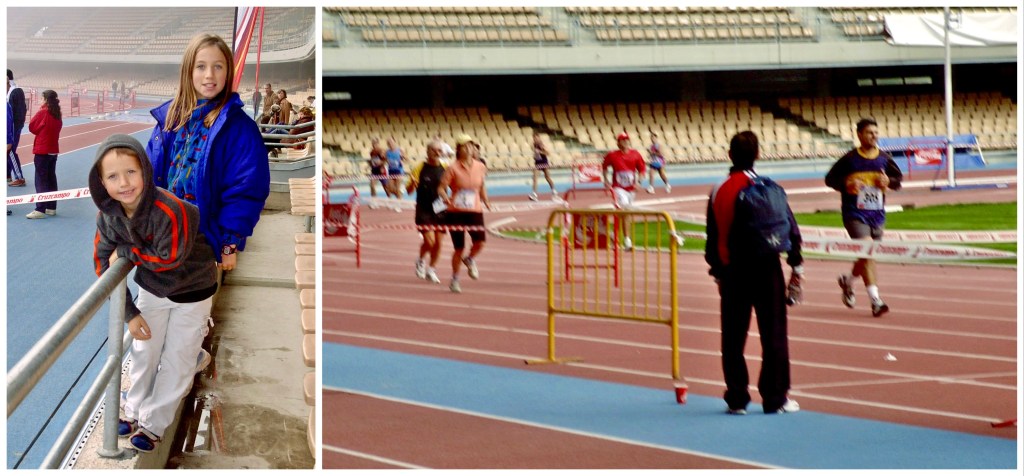
Kids waiting at the finish; Karla is in the apricot color shirt with cap. Cadiz is a well-located city on a peninsula in the Atlantic. Today, it is the capital of the province of Cadiz in the Autonomous Community of Andalusia. There are about 120,000 residents although the population is on the decline. There is no room to expand and the relatively high unemployment results in younger people leaving for better opportunities. Its location has led to a long history as a trading port. Following the earliest settlers in 1100 BCE, Cadiz has been occupied by predictable powers…Phoenicians, Carthaginians, Romans, Visigoths, and then the Moors from 711 to 1262. As the “Voyages of Discovery” began, it played a key role as a supply and trading port. In fact, Columbus began his 2nd and 4th voyages from Cadiz. Later, it became home for the “Spanish treasure fleet” and a target for Barbary pirates as well as Sir Francis Drake. Drake occupied the port for 3 days, captured 6 ships and destroyed 31 others. When the locals wouldn’t pay a demanded ransom, he had the city burned. There are still lots of old buildings, many of which have been cleaned or restored.
Our day started with the “Viking Marathon” …which is a bit misleading for a 5K walk and run. The walk was at 7am; the run at 8:15. I got up at 5am and walked more than 5K by myself so that I could avoid the crowd. Karla walked with me a while and then decided to join the crowd. She placed 2nd behind a well-conditioned friend. Last cruise, she was the winner, but seems to be aging. Still, by the end of the day, she’ll have 30,000 steps; that’s very good for a woman of her age. Our Cadiz walking tour and other ambling should get me to 20,000.
The walking tour was a pleasant 3 hours over territory we had seen previously. Still, it was enjoyable…narrow streets, lots of cathedrals, plazas, and cafes. It is Sunday so many shops were closed. There was still plenty of foot traffic and there was “crowd energy.” It was a pleasant way to spend a 75* Sunday. This is a place we could come back to.
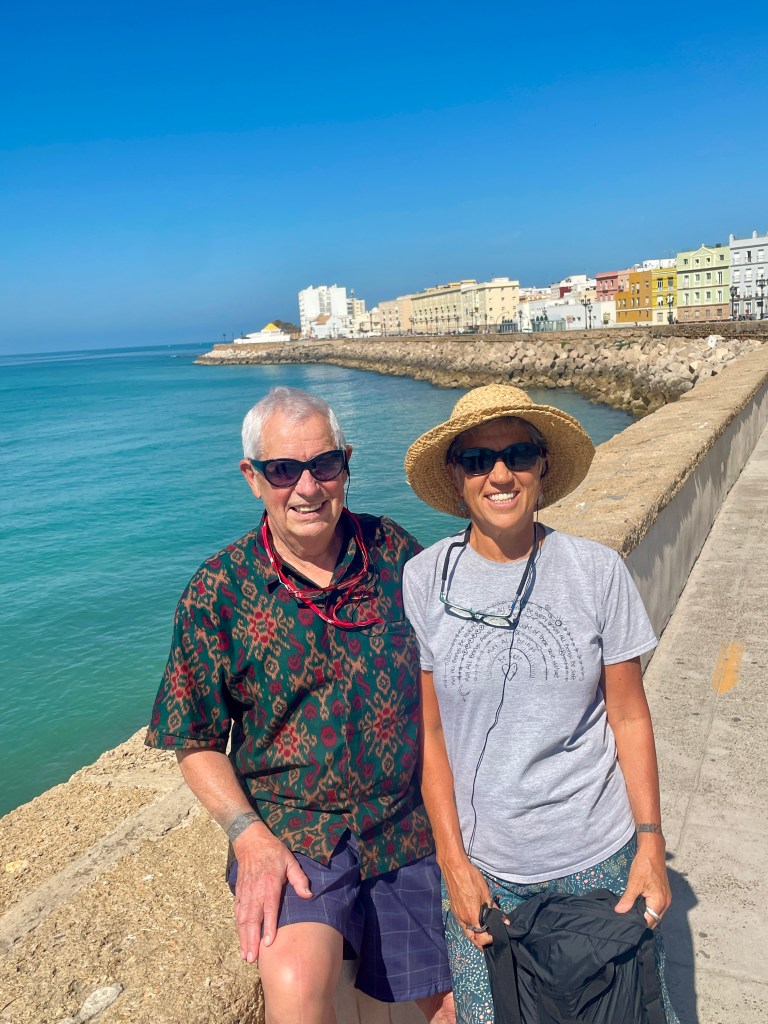
Cadiz’s seawall walkway (malecon) was a model for Havana. In previous visits we have walked its length. 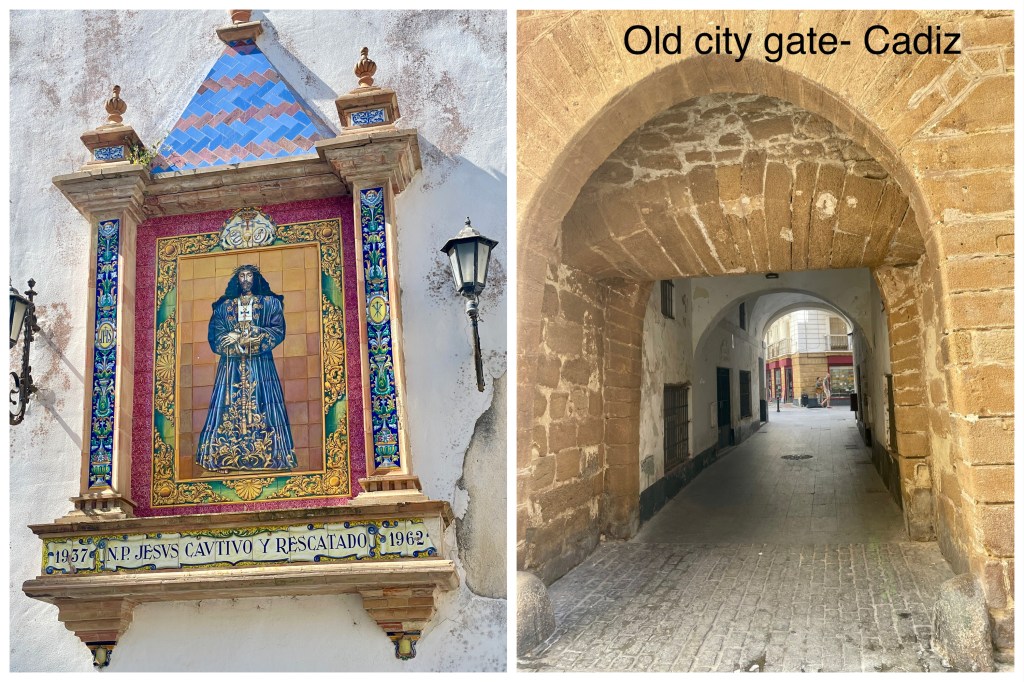
Black Jesus outside a church and one of the old city gates. 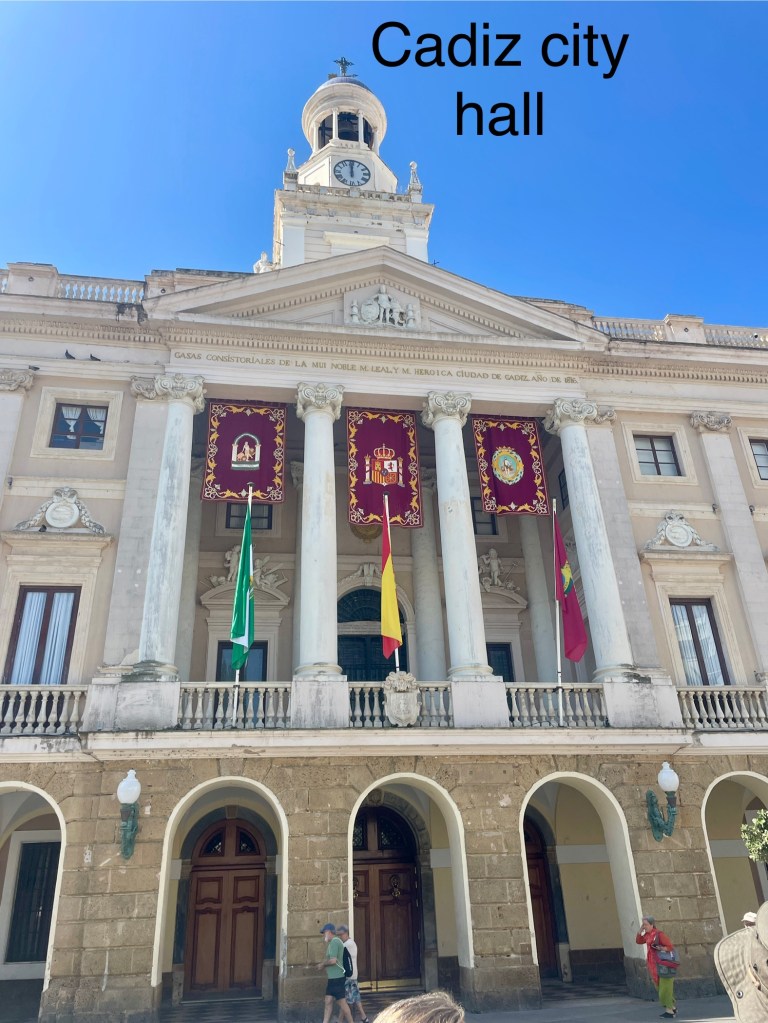
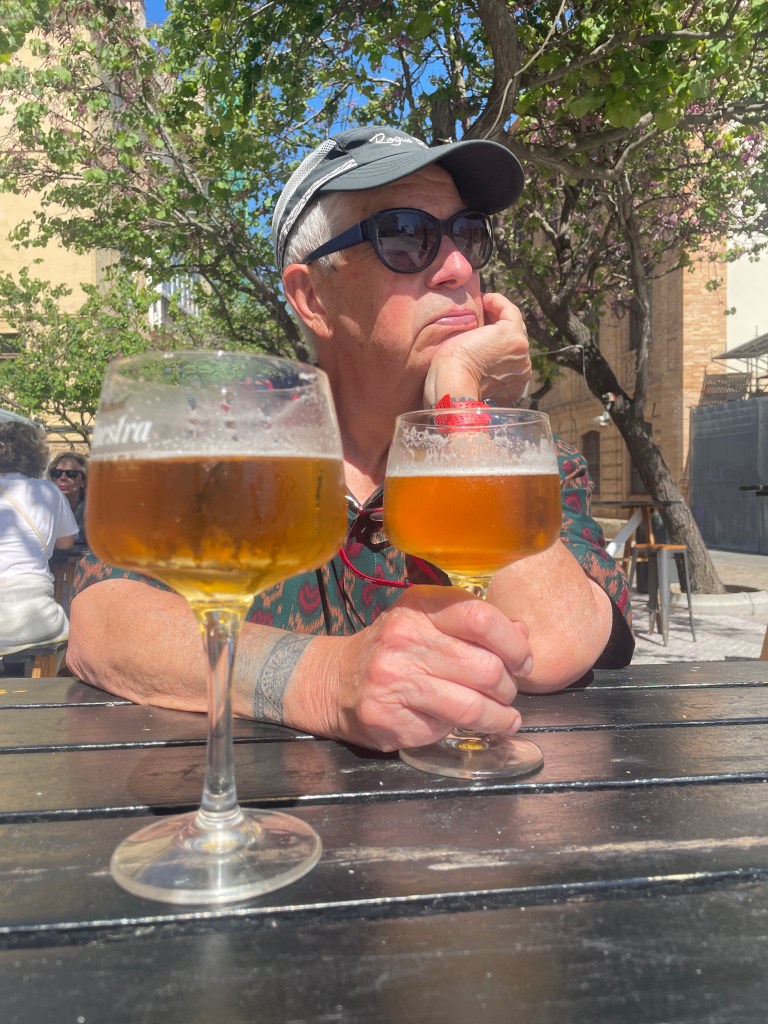
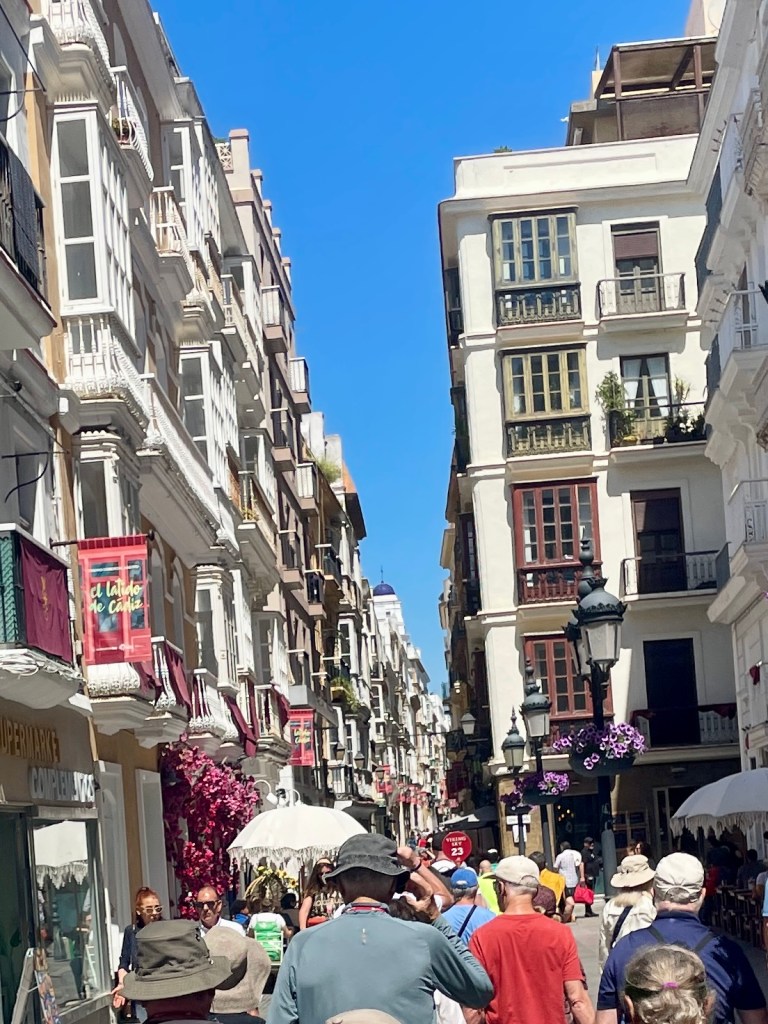
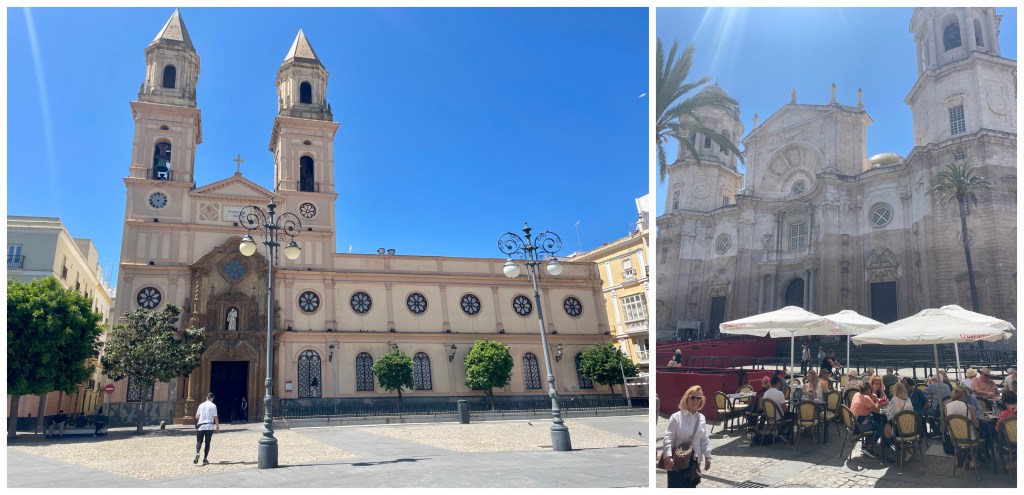
Left: plaza de San Antonio; right: cathedral and the square where we first had fish and chips many years ago and the kids ran around. 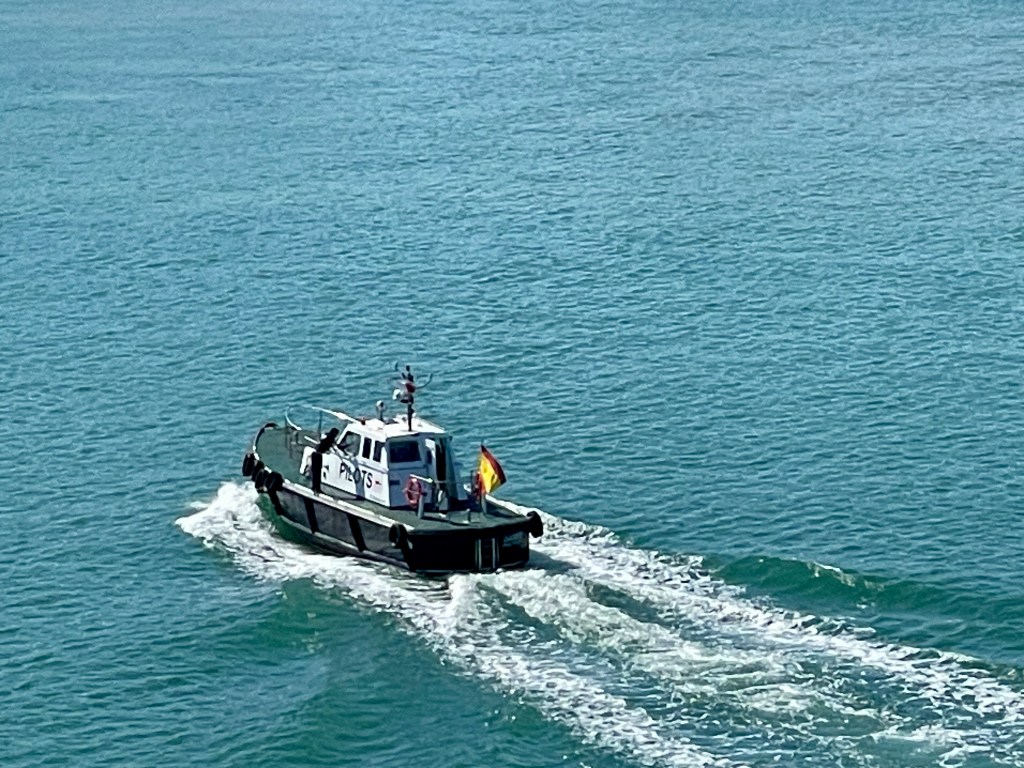
Pilot boat helping us out
-
Subscribe
Subscribed
Already have a WordPress.com account? Log in now.
 Millers World Cruise 2025