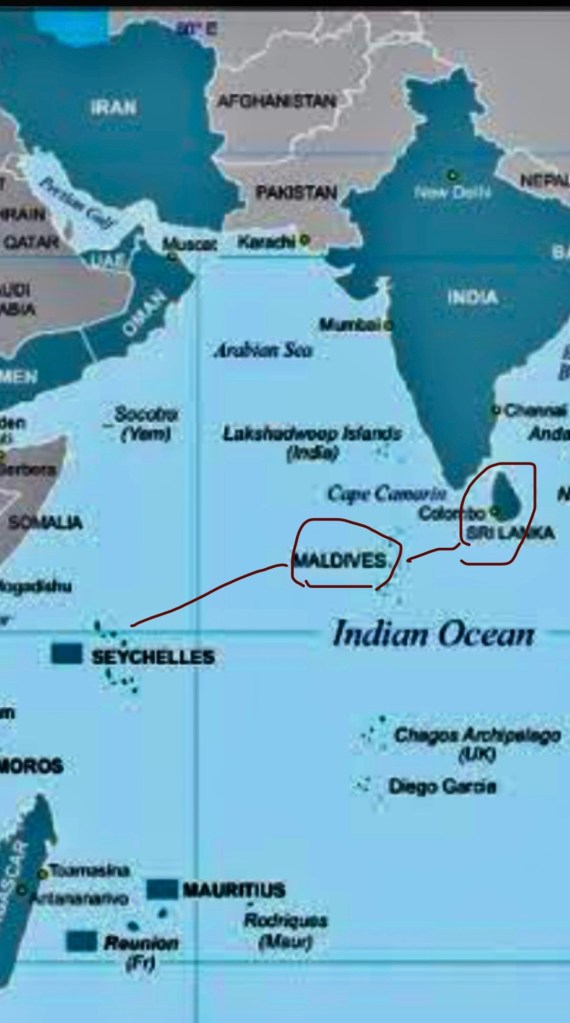
March 15
As we sail from the Maldives to the Seychelles, we are encountering the “flattest” water we have experienced. It has appeared to be a quiet lake for two days. The only disturbance was the bump when we crossed the equator.
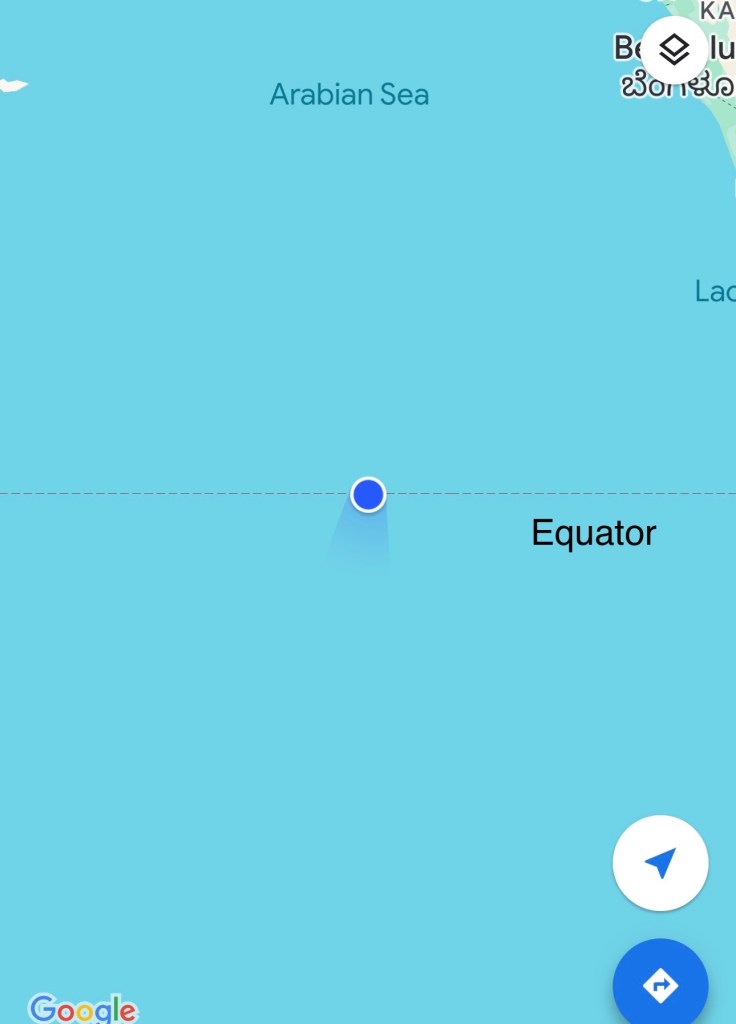
Evidently, we are free of the gyres and currents in this area. That’s good for flatness, but bad for fish viewing. They prefer more turbulent waters as they circulate more food. It’s great to have such clear views, but it would be better if there were something to see.
Actually, we have seen lots of flying fish and a few dolphins. And, a few birds. Fortunately, we now have a wildlife specialist (Richard Lovelock) on board and he can explain what we can’t see. He’s very knowledgeable and entertaining and will be with us through London. He both gives lectures and holds 8am viewing sessions to prepare us for what’s coming.
Lots of Lovelock learnings:
-Flying fish can be 2 inches to 2 feet long. Ours are about 4 inches at this stage. They can glide as fast as 37 mph, usually to escape predators. Our ship and its vibrations appear to them as a giant predator so they take to the air. Mother Nature takes over and alerts birds to their presence. Lovelock says that birds can smell their presence (fish oil) as far as 20 miles. Not through yet, MN alerted a falcon to one of Lovelock’s ships where it stayed for 3 days….eating the birds that were trying to eat the flying fish.
-Speaking of birds, they can fly while sleeping. Some of them have been found on ship….perhaps after flying into windows. Their feet are made for swimming, not walking. They appear to be injured or drunk. Lovelock gets calls for the rescue. He carefully picks them up and flings them overboard. That used to be bad news for pirates, but is good news for the birds as they fly away.
-There are 90 species of whales, dolphins and porpoises. We are expected to see some as we near Africa. Evidently, they were 95% hunted out at one time, but are now coming back. There are some interesting whale facts:
-Blue whales used to number about 350,000. After dwindling to about 5000, there are now 25,000. They can grow to be 100 feet long. They move to cooler waters to feed…as much as 16 tons per day or 30 million calories of mostly krill. The Moms, after fueling up, swim to warmer waters to give birth. The little rascals are born weighing about 2.7 tons. They then drink about 100 gallons of milk per day. The mom doesn’t eat for about 6 months. She uses her stored food for milk production.
-Whales in Alaskan waters are attracted by salmon. For some reason 98 percent of their salmon are Chinook.
-Pilot whales travel in large pods which are led by a female. They actually go through menopause and then focus their energies on leadership. The other pilot whales follow her lead., even when she beaches herself. We don’t know why she does that. The followers, when returned to the water, will go right back to the beach if the leader is there.
-When we visited the Faroe Islands something like 15 years ago, the bay had a red hue. Then we saw motor boats hauling 2-3 whales by cable to a central spot. As it happens, every year or two, a lucky islander finds a pod of a couple hundred and herds them to the bay. Their throats are cut by chainsaw and then they are moved to the holding area and numbered. Jackson and I visited the spot and saw 224, all numbered. The “lucky islander” gets first choice and then they are distributed to the islanders, old folks homes, schools, etc. Faroe Islanders have the highest protein consumption in the world. I should add that as Jackson and I were observing we came across a baby whale in a big tub. Whale veal?
Lovelock, our naturalist, commented to Karla that the Faroe Islands are now among the richer countries and do not need to kill so many pilot whales and dolphins.
Incidentally, we are now sailing in an ocean of 15,000 feet depth. We could be moving over a Mt Hood equivalent and not see it. An Everest equivalent would be an island with a mountain of over 10,000 feet.

 Millers World Cruise 2025
Leave a comment